
Author: Nora Čulić Matošić.
This March, during four days, the Old Power Station in Ljubljana was a place of international meeting between three academies with dance programmes: Magyar Táncművészeti Egyetem from Budapest, Akademia Sztuk Teatralnych from Krakow and the Academy of Dramatic Art of the University of Zagreb. The event, that was hosted by Slovenian non-governmental organisation Bunker, was called Beyond School whose name, besides being complementary with its ‘mother’ project ‘Beyond Front@: Bridging Periphery”, signifies the importance of stepping out of academies’ doors and showcasing work outside the educational context and abroad too. The art of dance has the advantage of translating its non-verbal expression beyond language and text. Therefore, it is a great medium for international and cultural exchange of impressions and aesthetic articulations. On the final day of the event, all three academies presented their annual productions which were all different in the sense of genres in which they were performed. I was honestly excited to see what the students prepared since I had no idea what to expect and could tell they were all eager to perform their pieces from the short time I spent in their company. Also, they showed genuine interest in each other’s skills and background which differs between academies and individual dancers.
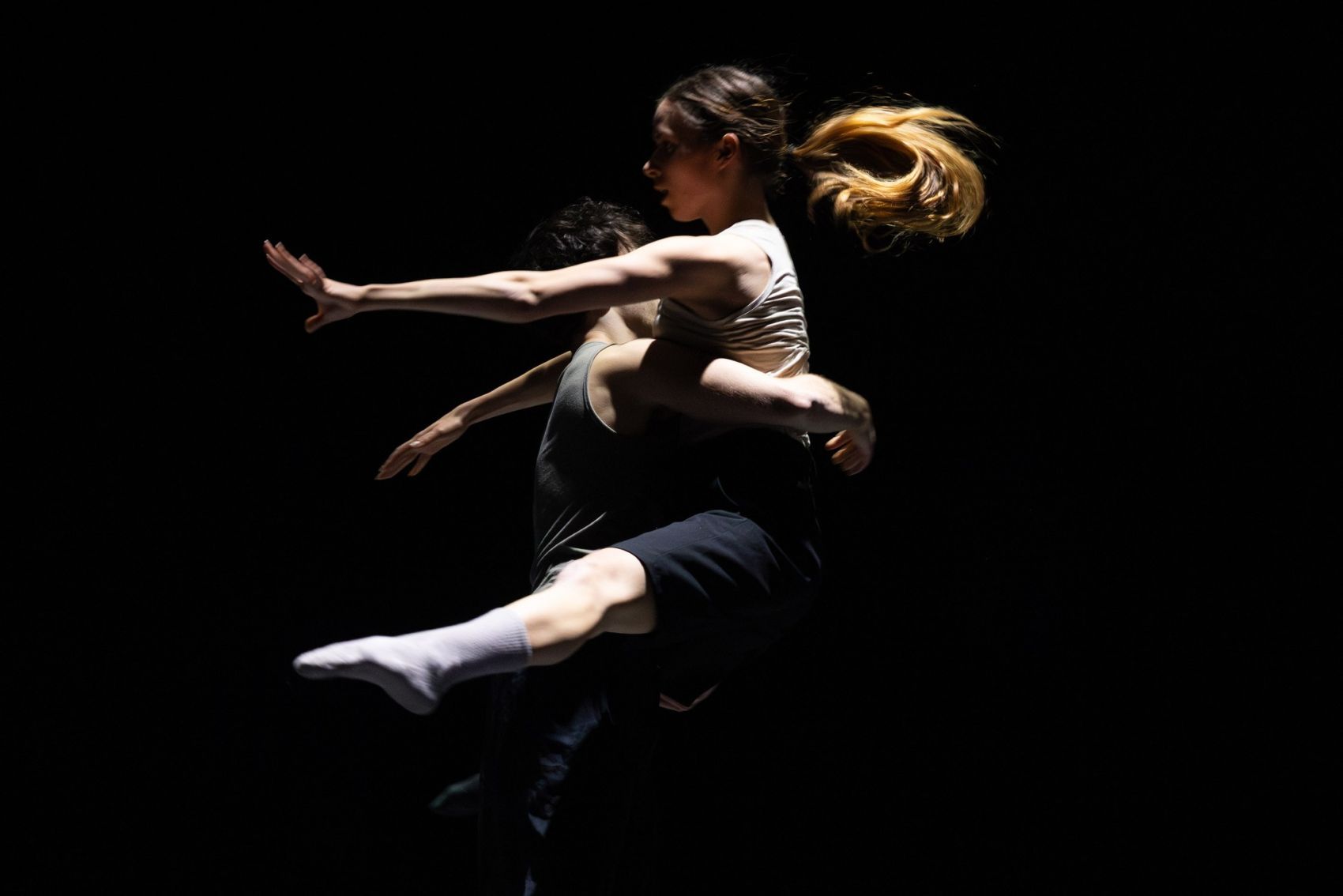 What if… by Hungarian Dance University– Ljubljana, Slovenia – 19 March 2025. Photo by Nada Žgank
The first up were the Magyar Táncművészeti Egyetem, with the choreography titled What If… which was, out of all three, the most genre diverse performance. It featured five dancers: Panna Pozsony, Viktor Kéri, Eszter Anita Kis, Janka Kőműves and Bianka Varga, who were mentored by Gabriella Kézér and Virág Sóthy. The choreography consists of solos, duets and other numerical combinations of the ensemble members. The performance could be classified as a fusion of genres, with elements from different styles such as modern ballet and modern dance, hip-hop and contact improvisation. This style diversity is followed by the music background which is similarly heterogeneous. The piece acts as a showcase of each of the dancer’s ability which is further enhanced by the lighting design that mostly consists of putting spotlights to the centre of the stage. Their counterweighting manoeuvres are quite skilful and impressive, the collective energy is high and present as the dancers pay attention to one another.
When all of them perform on stage, their movement is, at the same time, unified but unique. The rhythm and tempo exchange is also smooth, the dynamics of the choreography or be it the alternation between faster and slower parts is well thought through. Towards the end of the piece, the choreography shifts to minimalistic movement in silence where the only noise is their breathing. What if… shows, as described by the authors, the diversity of human relationships and dynamics between them which is predominantly seen from the diverse movement and genres that can be recognised, especially by including the ‘commercial’ styles. This is not to say that commercial is bad or non-artistic – in fact, the choreography gives space to dancers to present their own style and abilities that can be furthered explored in their future.
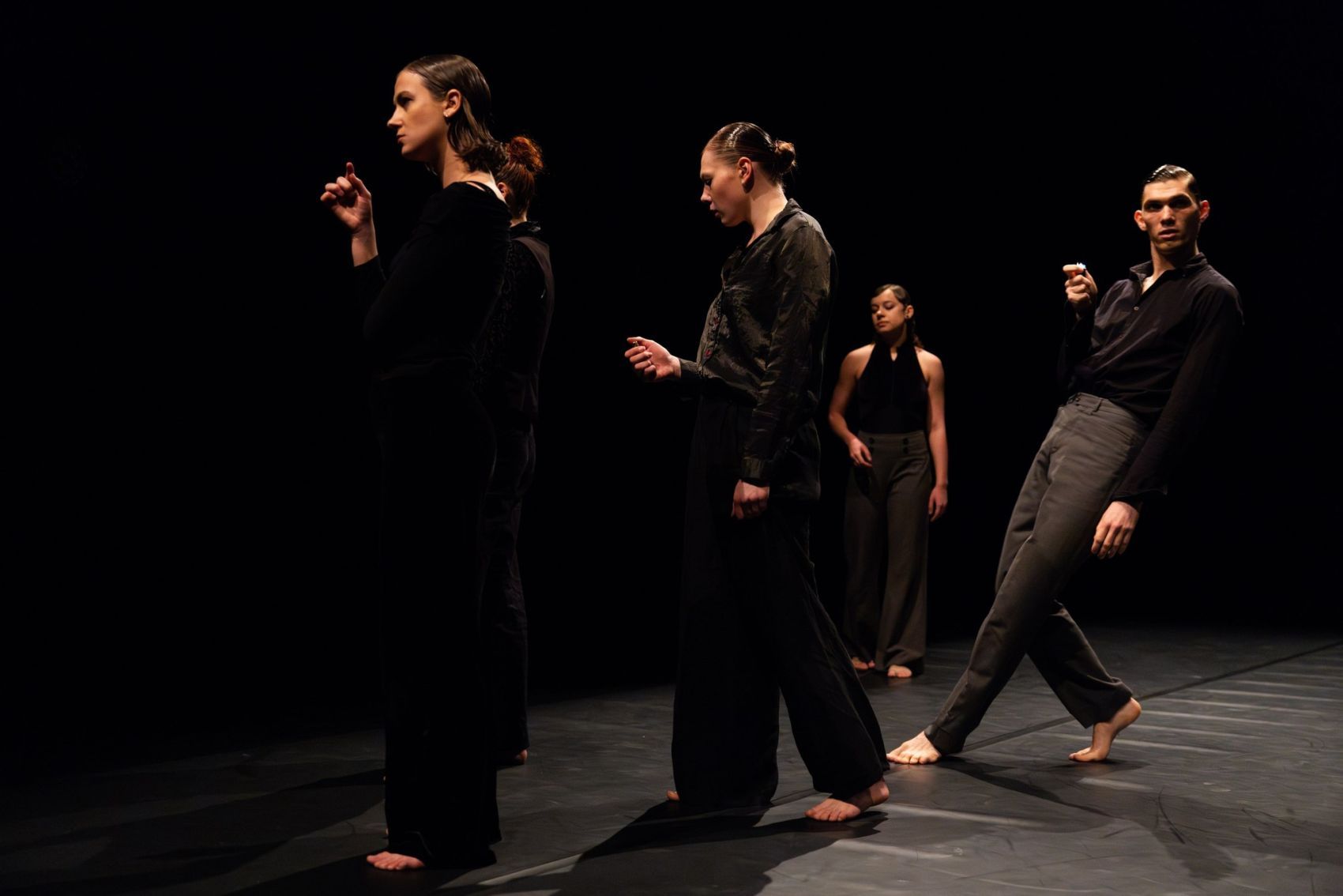 Smoke (chor. Eryk Makohon) – Ljubljana, Slovenia – 19 March 2025. Photo by Nada Žgank
After the Hungarians, the Polish Akademia Sztuk Teatralnych followed with the piece titled Smoke, a final project for the subject Contemporary Dance Techniques held in the third year at the Faculty of Dance Theatre in Bytom, a course taught by Eryk Makohon. In the description it is stated that the goal of the performance was ‘to combine movement techniques with issues related to stage presence’. The dancers start with sitting in the front row of the auditorium with their back facing the audience, all dressed in black or grey smart business outfits with their hair slicked back from their face. One by one, they stand at the proscenium and try to light their cigarettes. But the moment of lighting doesn’t come. They are unnerving the audience by playing with our anticipations and assumptions we have constructed from the striking visual first impression. In this first part, the movement is minimal and, even though all dancers are standing together in a line, they seem alone on the stage, as if there’s no one around them. Still, not a single cigarette is lit, when suddenly tango music (or rather its contemporary take) starts to play and the noir vibe intensifies.
The counterbalance exchanges are quick and dramatic – one second a dancer is lifted very high and then suddenly disappears back in the group. Their group formations from which the dancers execute these counterbalances are impressive too because the manoeuvres come unexpectedly. There is tension between the dancers and within their bodies which is seen from their clean and sharp movements, like in traditional tango. From the three performances, the AST piece stood out to me with its noir atmosphere and vibe, I felt like I was transported into a silent film. The music changes again, this time to techno and the dancers follow up with moving to the beat, head banging and letting loose the entire body, giving in to the trance of the beat. The choreography comes to an end with a last music change to a French chanson and the movement slows down, becoming more unified… The cigarettes are finally lit and dancers are smoking in precise unity. Finally, the smoke is shot through the fog machine at the bottom of the auditorium and the dancers slowly disappear in the misty darkness.
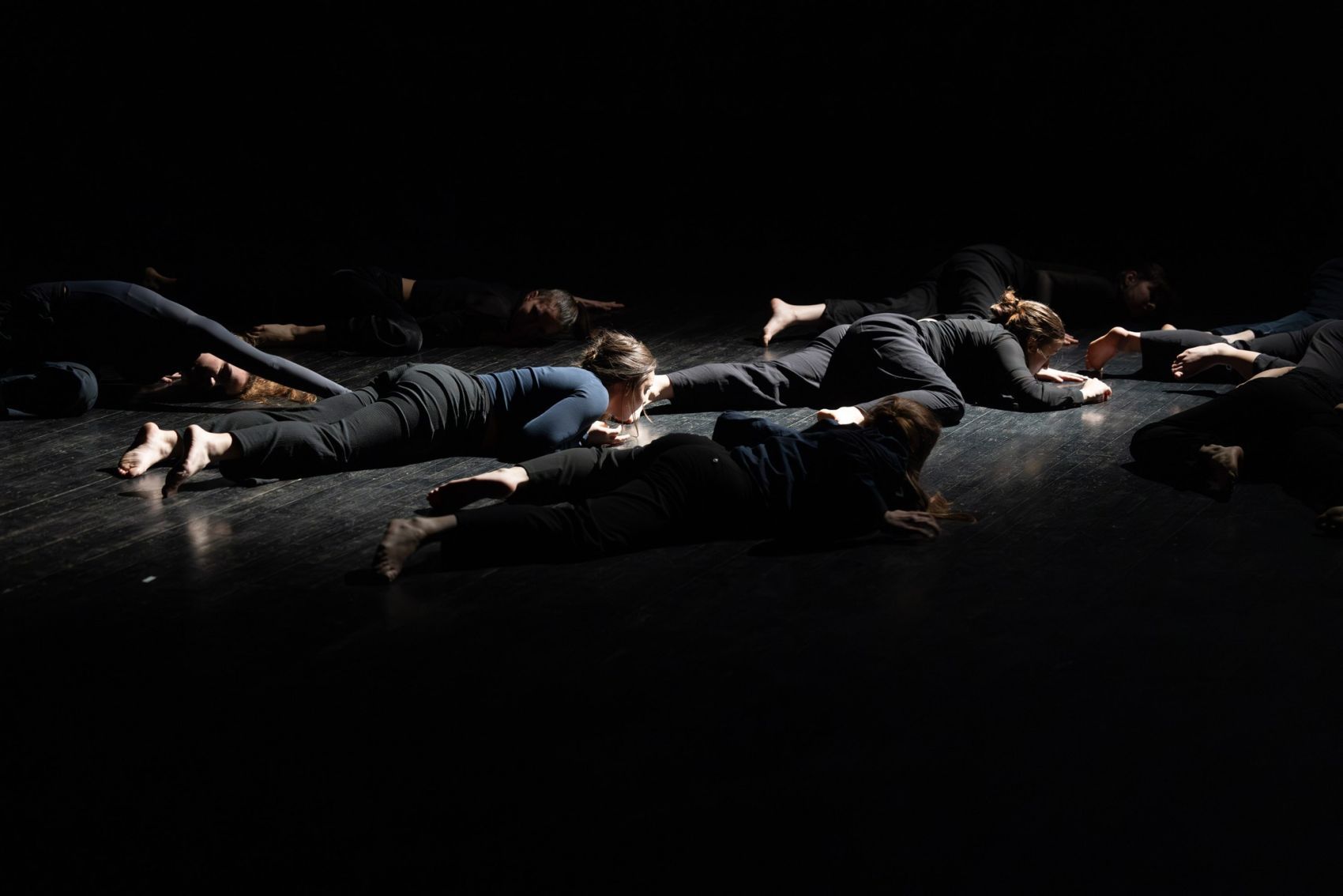 Close (chor. Charlie Brittain) – Ljubljana, Slovenia – 19 March 2025. Photo by Nada Žgank
Lastly, the Croatian students from Academy of Dramatic Arts (ADU) Zagreb, department of Contemporary Dance performed their piece titled Close which was actually an exam for the course Performance Workshop I. It was choreographed by Charlie Brittain in collaboration with the dancers: Nina Baburić, Tara Breški, Iman Kapetanović, Mark Marić, Jana Malčić, Noa Pavlinović, Larisa Radanec, Iva Stanisavljević and Klara Zrilić. From what I gathered, unlike other students that are finishing their undergraduate programmes, the Croatian group are all freshmen students. This was quite impressive as ADU performance stood out from the others with the maturity of the piece. If Polish AST brought noir to stage, the ADU choreography reminded me of slow cinema – every choreography sequence looks like a film scene where the audience has the time to take in as much details as possible. The slow rhythm allows the audience to dip into the contemplative atmosphere that the choreography carries. There is a persistent sound behind the music we can hear, the meditative sound of rain which maintains the same rhythm, persisting as a background white noise. The lighting is at times dramatic and sharp, it falls vertically at the right angle on the dancers, evoking the chiaroscuro effect. Because of it, the dancers are in the semi-darkness most of the time and they look more like their own shadows.
Similar to Hungarian piece, dancing sequences change from solos to duets and other formations but with a notable difference: the rest of the ensemble lingers on the stage and dances in the background. This way, every dancer is a part of the collective body that moves around the stage in different formations. The staging is a bit different from other pieces too – the linoleum ballet floor and backdrop curtains are removed so the initial stage space is rougher, deeper and wider. The ensemble uses the now bare stage to its almost full capacity: one of the dancers does a solo up against the back wall that is far from the audience. The distance they create makes it seem like the dancers are in another time and space that differs to the time of the audience, as they are dancing inside a vacuum with their gaze turned inside. This impression is emphasised with the before-mentioned semi-darkness through which the dancers collectively move and change formation. Because of its slow rhythm and greater distance from the auditorium, the spectator has multiple points of focus and can give attention to multiple dancers at once.
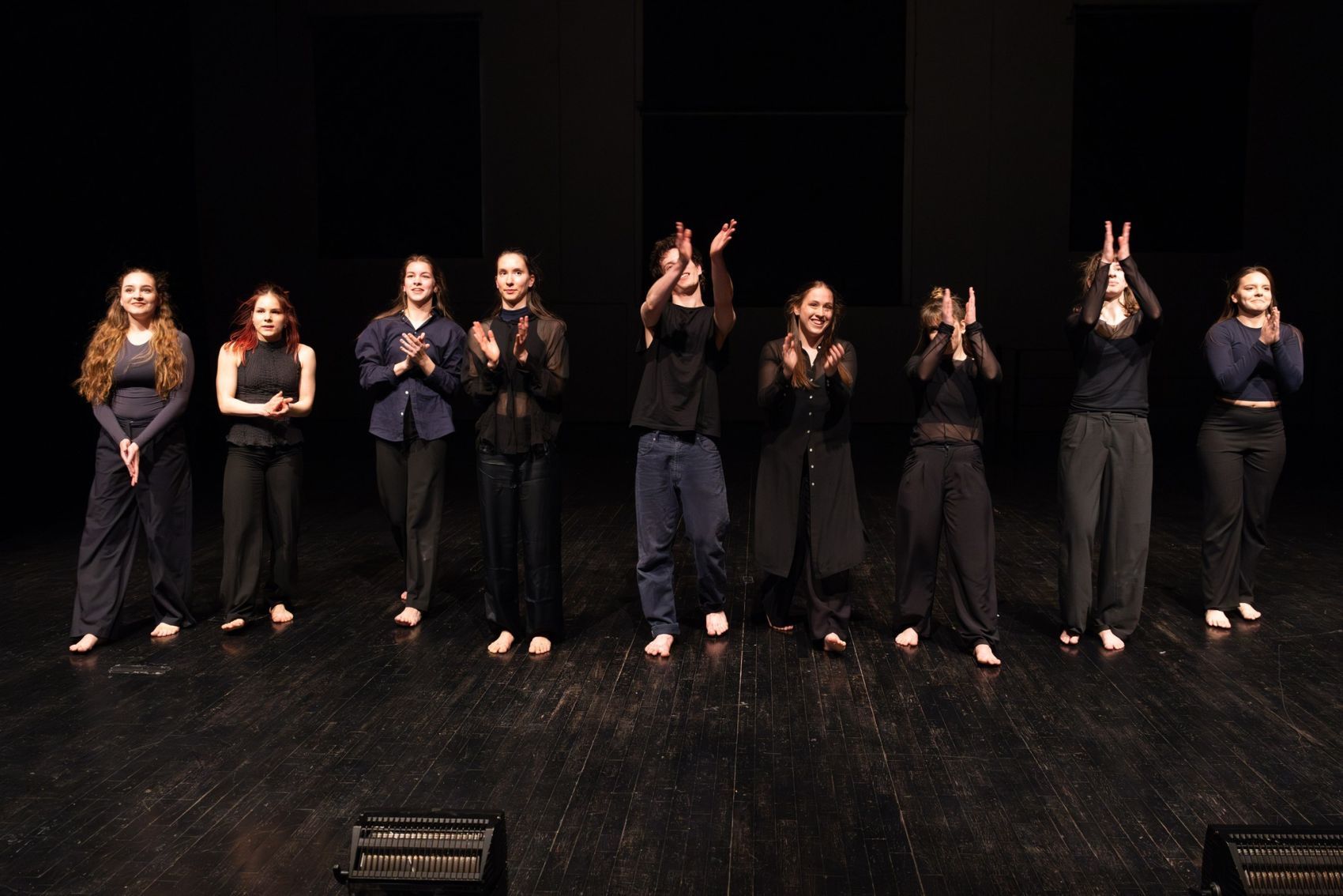 Close (chor. Charlie Brittain) – Ljubljana, Slovenia – 19 March 2025. Photo by Nada Žgank
To rather abruptly end this long report, I believe that the importance of these international meetings isn’t necessary to showcase the best of our best, but to make sincere connections with colleagues and peers from the same or similar branches of endeavour. As mentioned in the introduction, dance is a great medium that can easily bring international artists together who can, with their diverse knowledge and education, combine and create new creative movement styles. This exchange of experience and knowledge is where I see the greatest potential in artist’s personal and professional growth. Likewise, it can be very fruitful for possible future collaborations, both between dance academies and individual dancers. Hopefully, a further project along those lines might follow, so I’m looking forward to the future works from institutions and dancers.
This text was written by Nora Čulić Matošić within the framework of the Beyond Front@: Bridging Periphery project.

