
Author: Jaka Bombač.
Jaka Bombač visited the 24th Drugajanje Festival and writes about the performance Nowhere Like Here by Francesco Scavetta, presented on 11th November 2025.
In this short report from the Drugajanje festival, I will share my thoughts on the performance Nowhere like here, choreographed by Francesco Scavetta, after which I also moderated a public discussion in the Old Power Station. I also aim to further develop my thoughts on the topic of decentralization, which I opened up in my report from the HERE festival in Vitlycke. Finally, I want to speak about the epistemic meaning of public discussions after performances, which are oftentimes put aside as something »extra« and merely accidental to the performance itself.
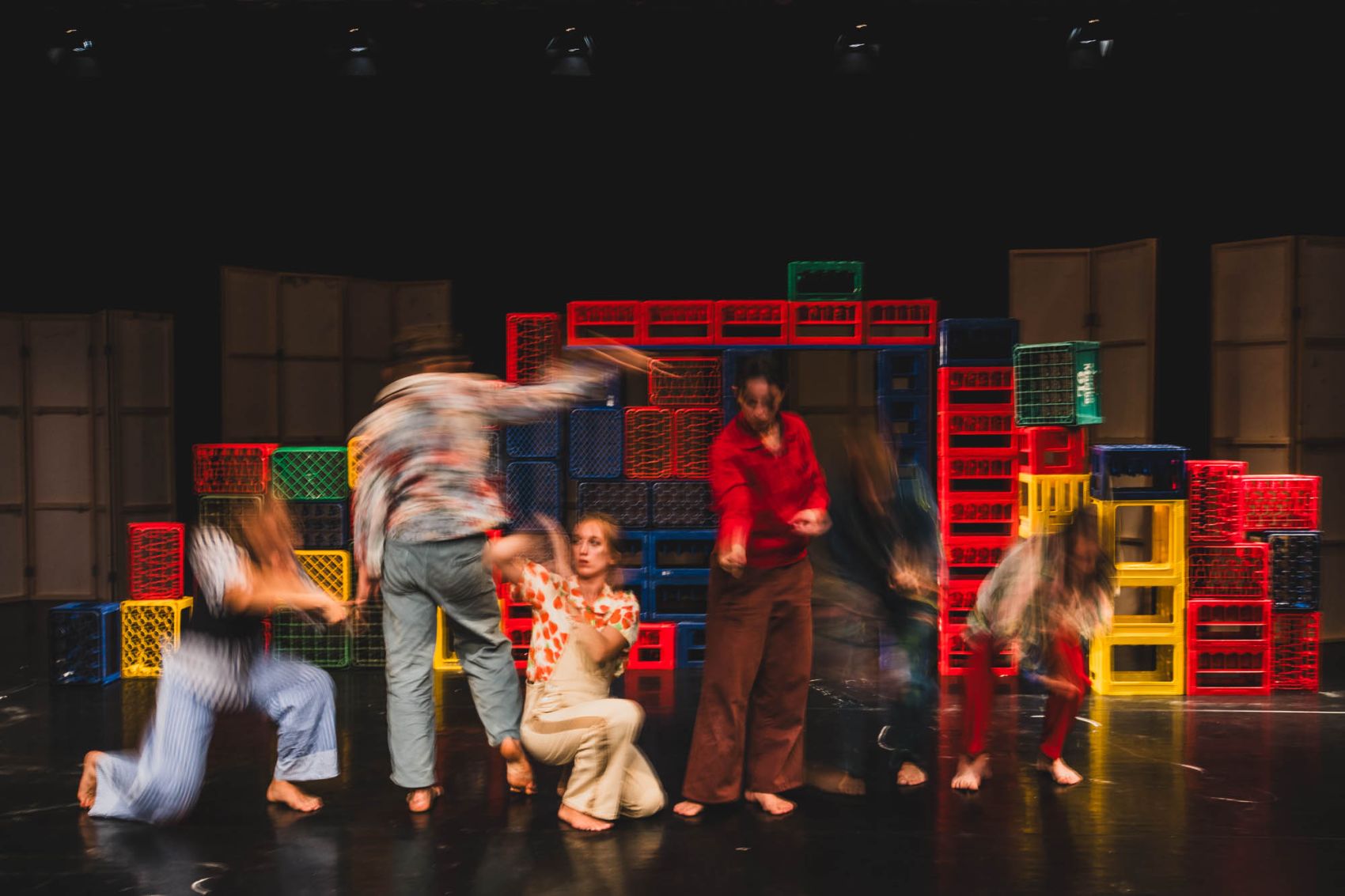 Nowhere Like Here (chor. Francesco Scavetta). Photo by Naomi Pongolini
In my previous report, I pointed out several different senses of the term decentralization: not only can we speak of decentralization of art production and art display, which we should try to think together as well as separately; but we can also understand decentralization as part of a larger trend (in philosophy and performance arts, arguably also in UX design), including the decentralization of the relationship between performers and spectators, the decentralization of points of view and the decentralization of the mind-body or brain-body dualism (sensing-feeling-thinking continuum) (a very common representation of this thought is the image of the mycelium). We can think this as part of a larger trend of breaking the perspective, which may be thought of as a pivotal visual problem of (post)modernism.
In my previous report, I mostly spoke about the decentralization of art display, as opposed to the decentralization of art production; I pointed out that Vitlycke is a performance centre located at the periphery of Sweden and on the outskirts of a forest; but also that it strives to repurpose – so to speak, decentralize the historical meaning of – and old correctional facility (Vrangsholmen). But if we speak production wise, the performance Nowhere like here offers us a better example. The performance connects six different dancers from different countries and from different dance backgrounds; all of them traveled to Vitlycke to join a two-month residency which resulted in the performance based on structured improvisation.
Structured improvisation is a performance approach often based on so called »scores«: »verbal propositions, usually relating to physical, bodily or movement notions, rather than being narrative or psychological«.¹ Since scores are supposed to free the dancers of narrative structures, we can also think of them as potentially subversive of the historically maintained relationship between theatre and dance. As Andrew Hewitt points out in his book Social Choreography, dance (theory) has historically been categorized and institutionalized as a subcategory of theatre (theory);² and the discourse of modern dance – which is different in the European and the Anglosaxon traditions of modernism – can be thought of as a history of challenging this very relationship.
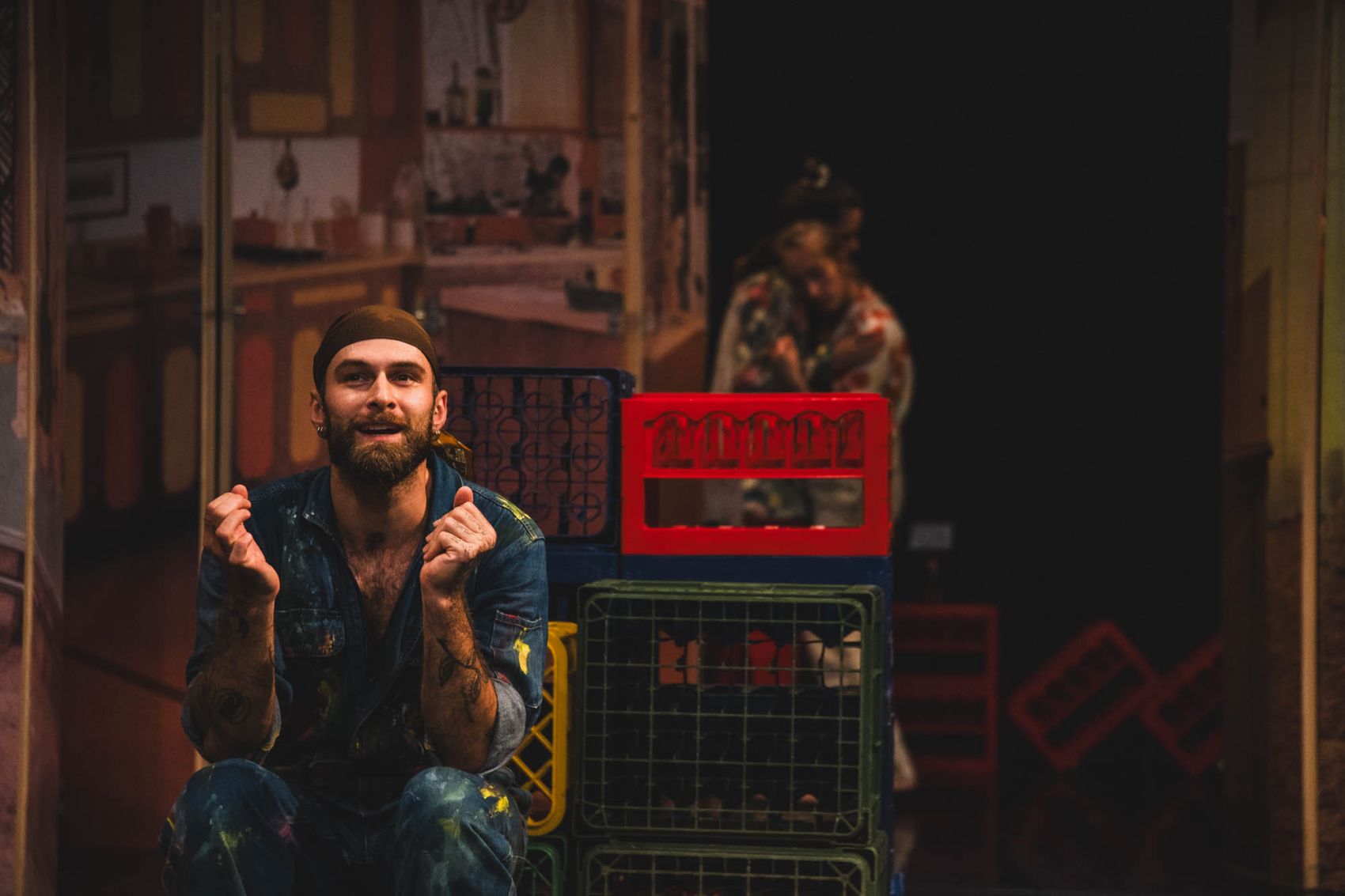 Nowhere Like Here (chor. Francesco Scavetta). Photo by Naomi Pongolini
However, as Hewitt also notes, equally problematic is the portrayal of dance improvisation as something that automatically frees the dancer from the hegemonic structures of movement-meaning, established by hegemonic dance forms such as ballet. While we can support the tendency of decentralization of movement patterns away from a bourgouisie standard, we should also be wary of the portrayal of improvisation as a completely unmediated form that allows for the expression of the »freedom of the self«. As Hewitt points out, the European bourgoisie culture of the 19th century was caught in a paradox which still haunts us – and the art of dance: as much as it wanted the steps, postures and gestures to look natural, it also tried to codify them, to assign them specific meanings, therefore undermining the desirable naturalness of their occurence.
In my opinion, we can spot this very paradox in the performance Nowhere like here: six dancers from six different countries and and performance contexts, improvise, but because they are put into a narrative context they start »speaking the same movement language«, in the process losing their specificities, falling into similar movement patterns thereby neglecting the imaginative power and the specificity of the singular body. The bodies are somewhere between being theatrically characterized (a bit like commedia dell’arte characters) and being neutral shape-producing momentum-following bodies of modern dance.
The performance seems to be playing around with various different senses of the term ‘home’. However, the concept of home is also presupposed by being aestheticized. The performance is very much portraying home as a warm space, full of nostalgic references to the past. But nowadays, many people do not have a home, and the rents are skyrocketing. This sense of home is left out. Through the aestheticization of home, »home« is no longer a question, but seems more like an idealization of a certain past, when everything was more connected. In this interpretation, the concept of home, as well as the improvisational score, begets the meaning of an idealized past, to which we can or can not return; and the dancers’ own position of essentially being away from home gets sidelined.
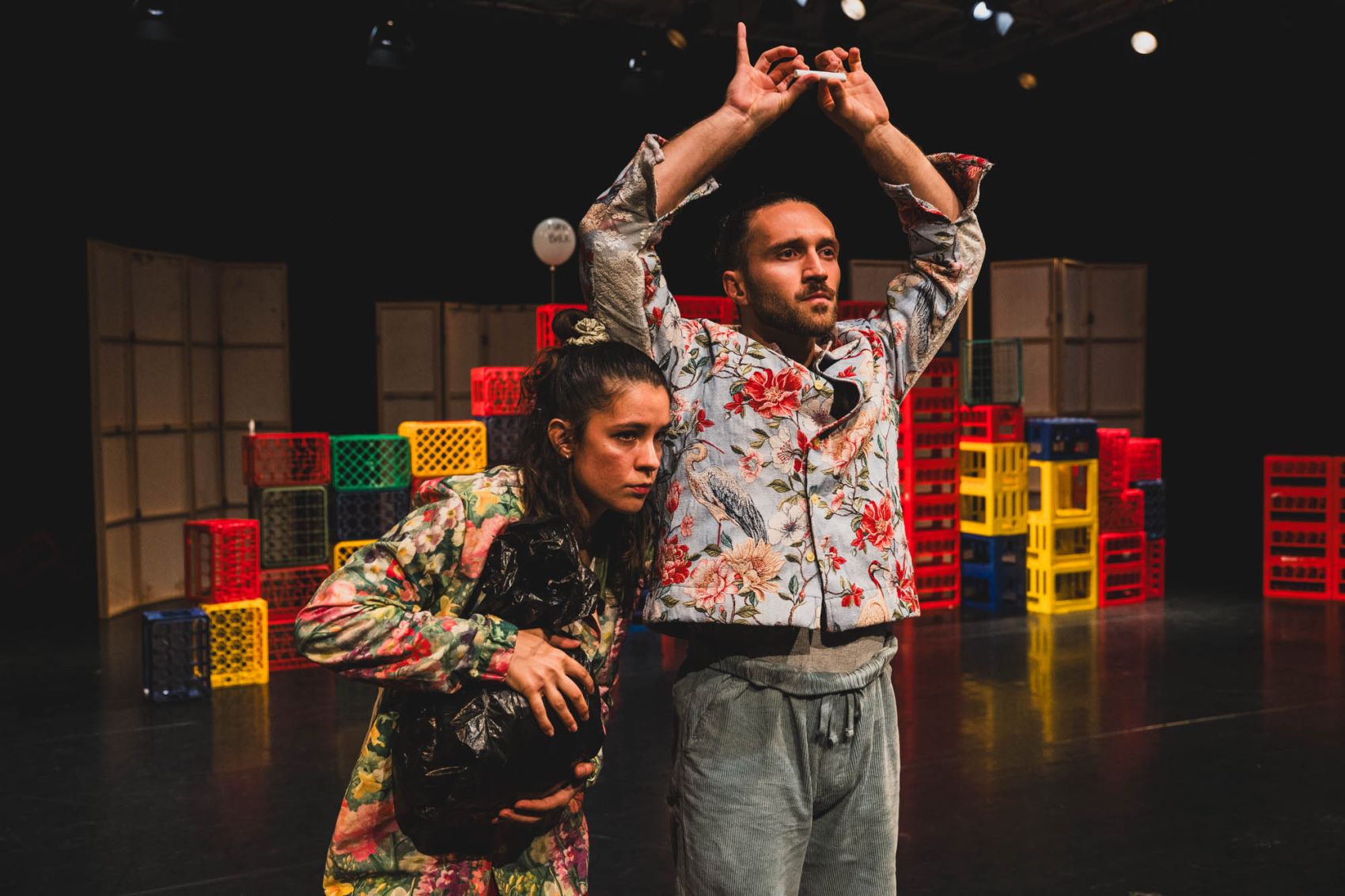 Nowhere Like Here (chor. Francesco Scavetta). Photo by Naomi Pongolini
This is exactly what I mean by the »idealization« of decentralization. We could spot a circular argument: a decentralized world is represented as a solution to the modern crisis of loss of connection, but at the same time it is also the driving force behind it, since people need clearly delineated conventions and contexts in order to be able to produce new meanings. If we apply this to the performance: in order for something new to emerge, a difference needs to be produced; in the improvisational score, kinaesthetic empathy often diminishes the difference, instead of highlighting it and making it a productive force; if the score is not clear enough, if it doesn’t contain a clear structure of rule creating and following; if it does not deal with meanings and qualities, but takes the »chiasmatic« inbetweenness as its presupposition, it can take away the specificities of individual dancers and thereby stay at the level of merely performing difference – in this case, as a constitutive moment of »home«.
The debate of whether globalization primarily produces homogenization or diversification and the creation of novel forms is by now a classical debate in modern sociology. More than trying to make a statement though, I am trying to show that this sociological debate can be deduced from the dance performance; which further shows that dance as an art form is highly relevant for modern social analysis and critique; not only through the themes and representations it produces, but also through embodied meaning, inherent in the expressive apparatus of choreography.
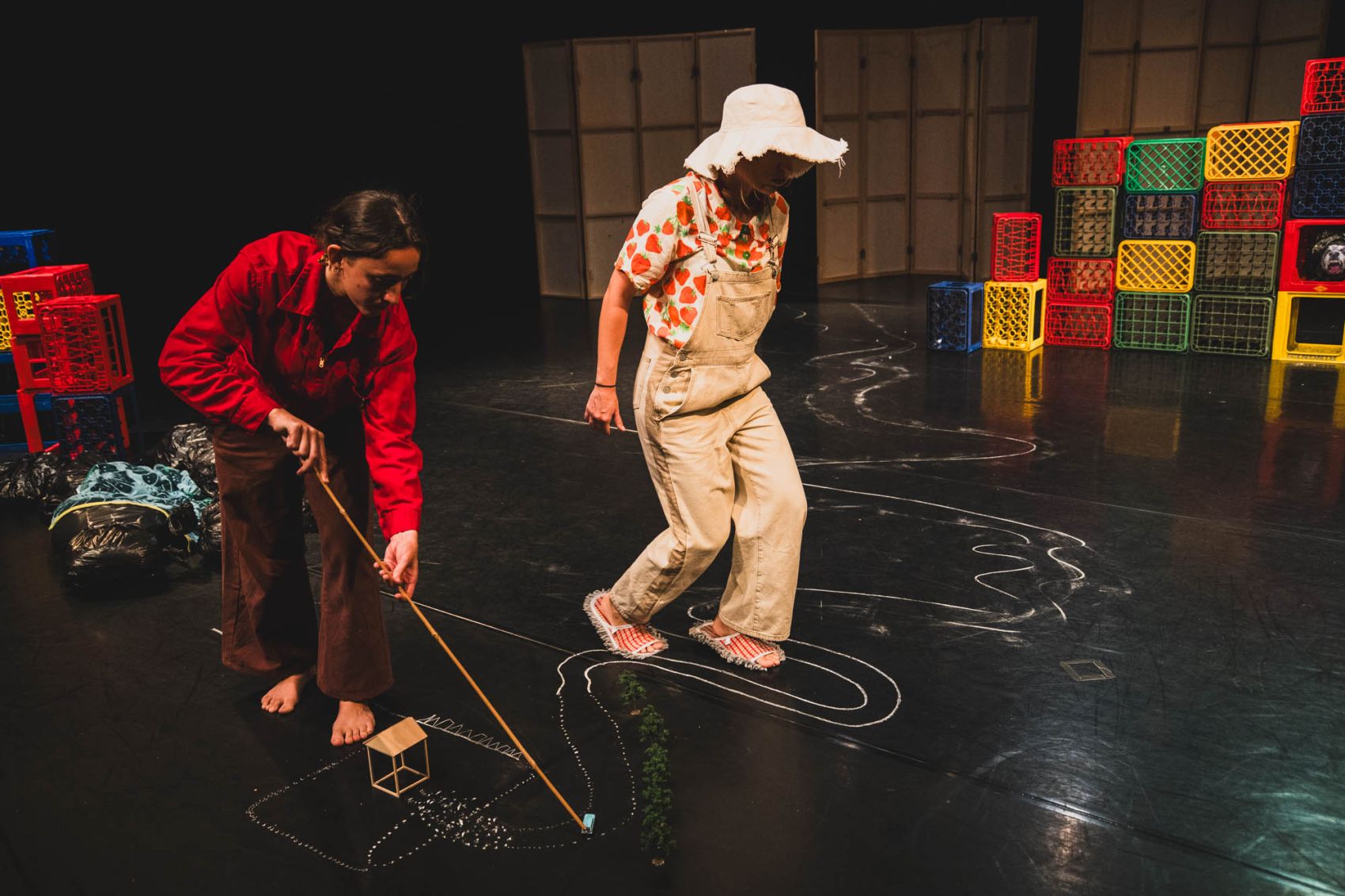 Nowhere Like Here (chor. Francesco Scavetta). Photo by Naomi Pongolini
While it does seem that the dancers, more often than not, fall into repetitive movement patterns, which are only semi-motivated at the narrative level, the performance does try to make us aware of the aforementioned problematic, primarily with two means: firstly, by using the metastructure of a performance within a performance (in the end, people get invited on stage and watch a filmed miniature version of everything that we have seen together in the performance); and secondly, with a discursive scene in which the performers are making contact with the audience by interchangeably inviting them on the stage (into their metaphorical home) and rejecting them. The invitation takes the form of: »you are all invited, especially if you are a …«, and the performers have to finish the sentence by using a word that starts with a certain letter (decided in advance) – for instance, (L), »especially if you are a lesbian … if you like Lana Del Rey… if you like lollipops…« – which seems a bit banal but gets the point across. At one point, they invite somebody on stage just to then deny him entrance. While this seems to be a statement about identity politics, it should be contextualized in a clearer manner, otherwise it can come across as a bit banal.
Whether we like or not the aesthetic and the narrative, the performance does open up a field of conversation; at times smoothly, at times a bit forcedly or awkwardly. In my opinion, dance performances help us develop sensibilities around important topics, not by being served these topics on a plate (as some theatrical productions might do) but by challenging us to really delve into the embodied meaning of the performance. At the same time, it is important to have a critical attitude towards the modern »embodiment« ideology, which tends to essentialize and presentize the body thereby negating the role of critique and public discussions; at a closer look, it seems to walk hand in hand with the modernistic emphasis on the embodied presence of the performance, understood as »fleeting«, a transcendental imprint of time in space, to which all words are merely accidental.
1 Olivia Millard, »What’s the score?: Using the scores in dance improvisation«, Ausdance, https://ausdance.org.au/articles/details/whats-the-score-using-scores-in-dance-improvisation (last access: 10. 12. 2025)
2 Andrew Hewitt, Družbena koreografija. Ideologija kot performans v plesu in vsakdanjem življenju, Ljubljana: Maska, 2017
Jaka Bombač is a philosopher, writer and performing arts critic whose interests lie both in the performing arts themselves and in their inevitable entanglement with philosophy. He is based in Ljubljana, Slovenia. In 2025 she received a Critic’s Stipend in the frame of the international project Beyond Front@: Bridging Periphery and visited 24th Drugajanje Festival.
This text was written by Jaka Bombač within the framework of the Beyond Front@: Bridging Periphery project.

