
Author: Jaka Bombač.
In september, I visited the HERE Festival in the Vitlycke Centre for Performing Arts. The festival took part throughout September, during four weekends. In this short report, I will focus on two performances I saw during the first weekend of the festival: Dance Becomes Her, a lecture performance created and performed by the dancer and performer Lilian Steiner; and Guerilla, a dance performance performed choreographed by choreographer Renan Martins and performed by the well-established Swedish dance ensemble Cullberg. Thematically, I will focus on the subject of decentralization, which I will try to additionally develop in my next report from Drugajanje as well as in my final report.
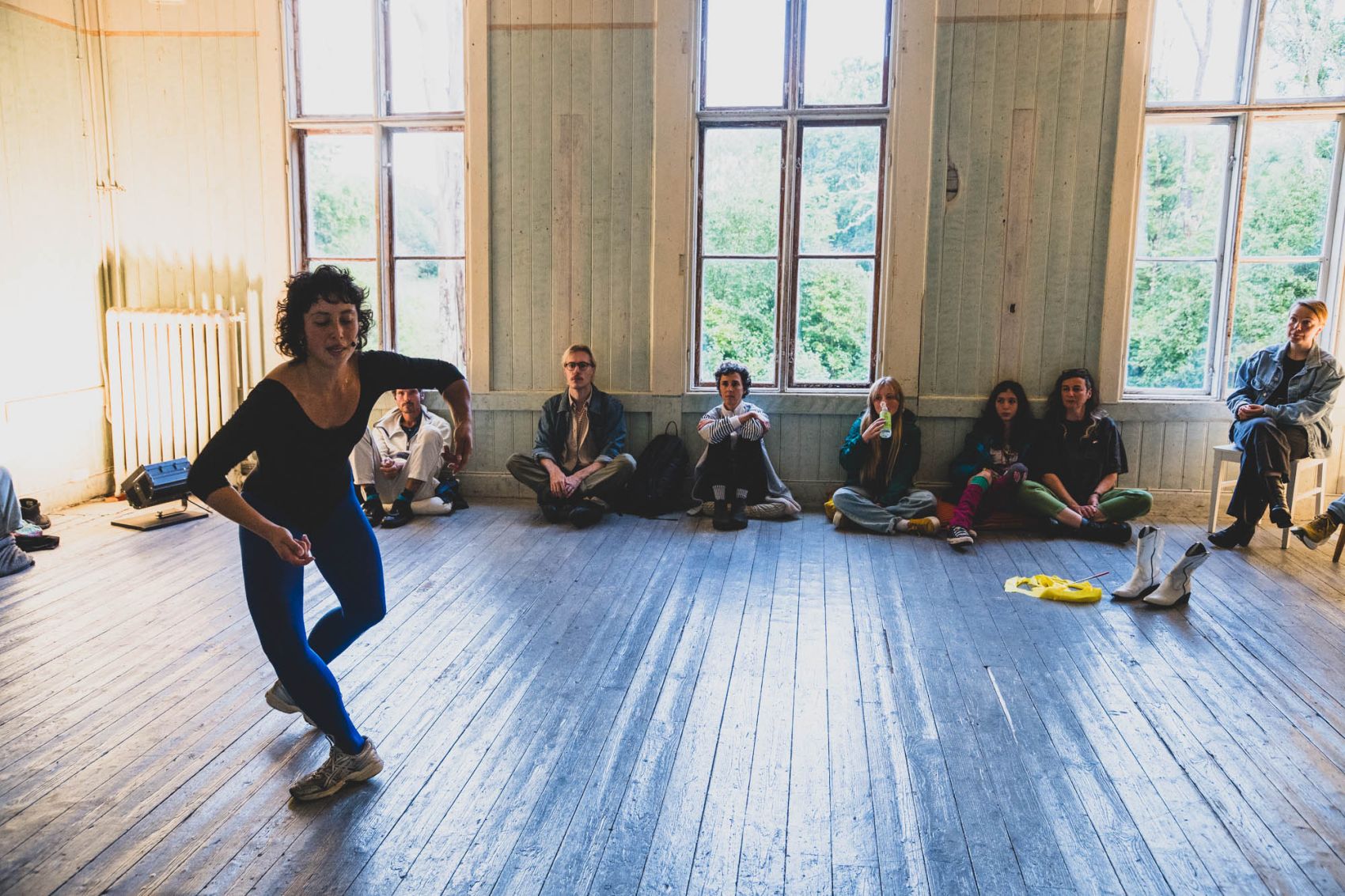 Dance Becomes Her (chor. Lilian Steiner) – 13 Sept. 2025. Photo by Naomi Pongolini
Vitlycke is a very specific performance site, located on the edge of a forest in the Tanum region near Gothenburg. It offers us a very good example of the recent striving to decentralize art production and curation and art display. We should think of these separately as well as together. While decentralizing art production offers artists more chances to connect with other artists worldwide and get acquainted with a different culture, probably also aesthetics and work ethics; decentralizing the display of art aims to move art from bigger cities to smaller cities and even villages, which offers more people to see art and therefore engage in the modern art culture.
I will add another layer to this debate by trying to show how the attempt to bridge the center–periphery dualism is part of a wider trend, visible in both mentioned performances – not so much thematically as in the use of various procedures and formats. As Susan Leigh Foster notes in her book Choreographing empathy, this dualism was deeply rooted into Feuillet’s dance notation, one of the very first dance notations, which temporally coincided with the creation and printing of first colonialist geoeconomic maps called »chorographies«.¹ After briefly describing and critiquing the performances, I will problematize the idea of decentralization, focusing not only on its emancipatory potential (epistemic justice) but also on some of the potential backlashes (romanticization).
Lilian Steiner’s lecture performance Dance Becomes Her took part in Vrangsholmen, a former correctional facility. This is a good example of repurposing historically problematic spaces for novel purposes. When we enter the facility, we can still smell, see and sense the remains of the past; Vrangsholmen is part of an older epistemic regime which understood people as essentially correctable, as Foucault notes in his works. We can understand performance art – and in my opinion dance especially, since it deals primarily with human bodies and their perception and representation – as an aesthetic form which can »move« through the spaces of the past and uncover them as well as reconstitute and renegotiate their meaning for the future.
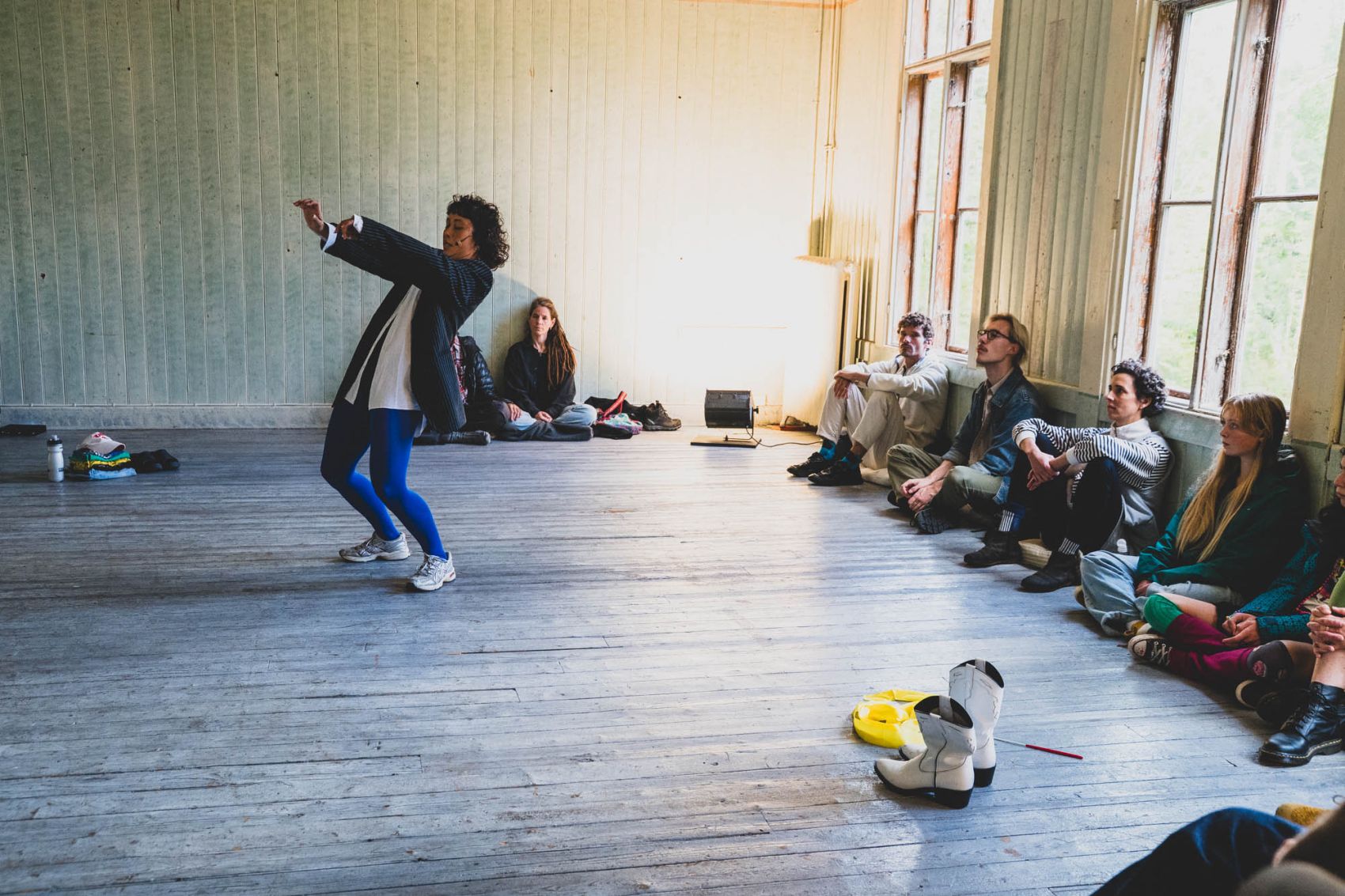 Dance Becomes Her (chor. Lilian Steiner) – 13 Sept. 2025. Photo by Naomi Pongolini
Because the space itself carries such strong historical meaning, it first seemed to me that the performance, aesthetics aside, is not thematically fitting, since it deals very narrowly with the topic of dance. It is a dance lecture focused on the topic of dancing, choreographing, trying to speculatively broaden it into an almost metaphysical question. Does it then demand a more theatrical context? Was it adapted so as to fit the context? On the other hand, the format itself – a lecture performance – is challenging some of the epistemic presuppositions that were historically used as justifications for »othering« in institutional facilities such as Vrangsholmen, and are still problematic as regard to the »practical philosophy« which hold that retrospective judgments about the events of the past are informing the shaping of the future.
As Lucia Rainer writes in her book Lectures and Performances in Art and Academia, the format of lecture performance shows us that knowledge is continually created and simultaneously challenged; that it is not a »factum«, but »occurs within the ken of activity as an encounter that is interfused by presence«. Furthermore, knowledge is not exclusively linked to the scientific field, since »knowledge practices are uniquely embedded within the manifold praxis of the epistemic cultures of a social field«.²
The performer is simultaneously dancing and speaking (using a microphone to make the speech clearer), trying to illustrate her words with movements and actions. Even though her movements are not always directly illustrative of her words, they often form a 1-to-1 correspondence. So I ask myself: what is the point of repeating the same concept twice – an Ockhamian fallacy –, if not merely for making it more legible and accessible? Is not movement so much more potent when it frees itself of meaning?
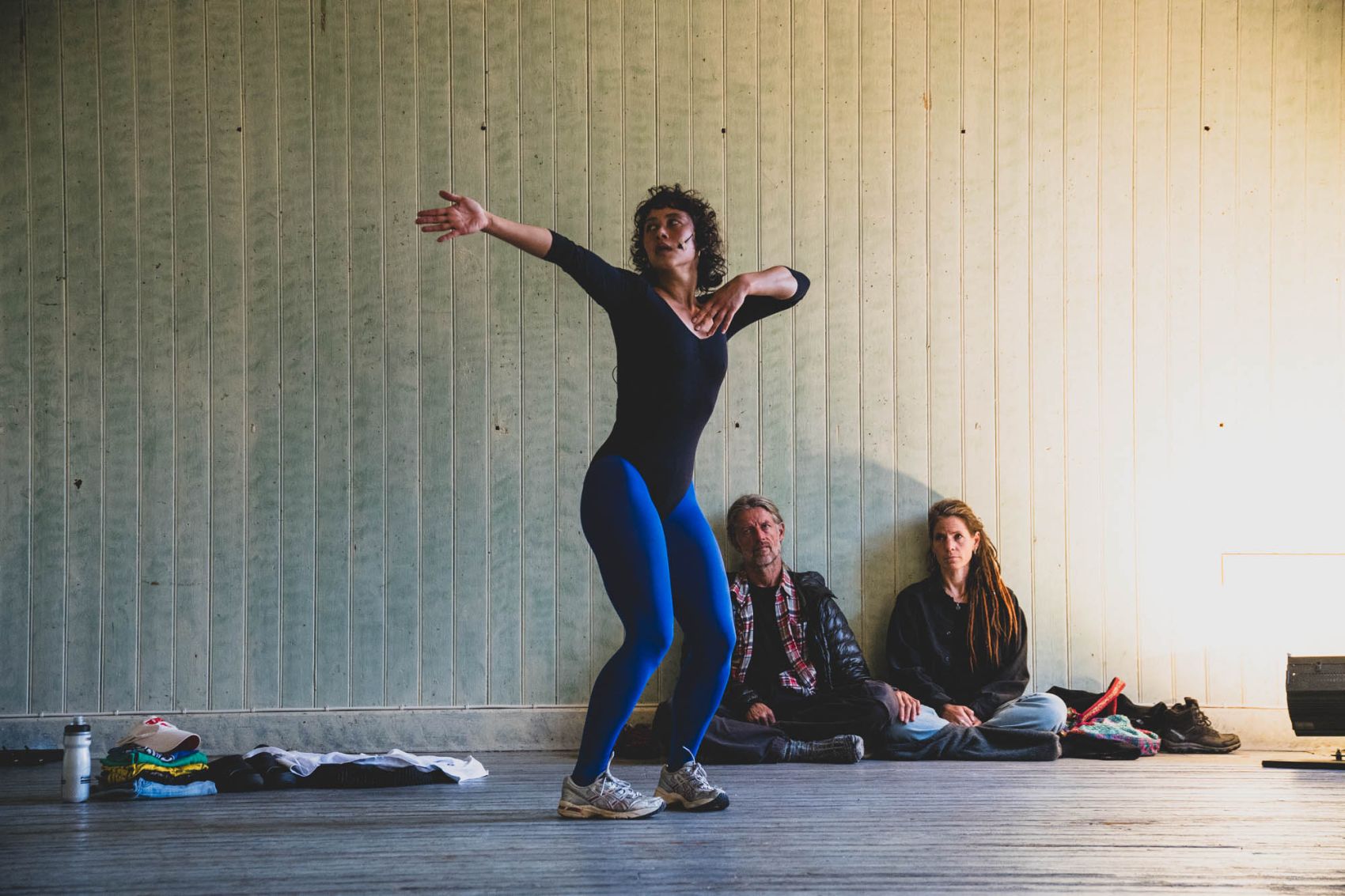 Dance Becomes Her (chor. Lilian Steiner) – 13 Sept. 2025. Photo by Naomi Pongolini
However, the multimodal correspondence approach does seem fitting in the context of showing that – as Rainer notes – »knowledge co-legitimizes itself in and through images and visualizations«.³
The movement-images, produced in the performance, are not always illustrative of the words; sometimes, they are used as rhythmical connectors, sometimes as a way of making contact with the audience. The performance has a mimetic dimension to it, and there’s almost no pauses in the performer’s movement – a continous prose being written in and through her body. Inbetween the clearly represented concepts, contours of »nascent« meaning emerge, reminding us that meaning is continually being constituted and reconstituted – not so much individually, by a solipsistic individual trying to transcend the languaged world, but moreso by various speech communities challenging and renegotiating the formerly established rules (as is well known to historical linguists and social linguists).
We cannot step out of language. Meaning is constantly being born and reborn. Society is in a constant process of meaning (re)negotiation. The world is not a fixed datum, but a constantly transforming process. We could read the performance in both of these senses of transcendence: even if the singularity of the performer on stage carries the meaning of an individual meaning-maker, she is also continuously making reference to the audience and in one scene she even invites another performer on stage.
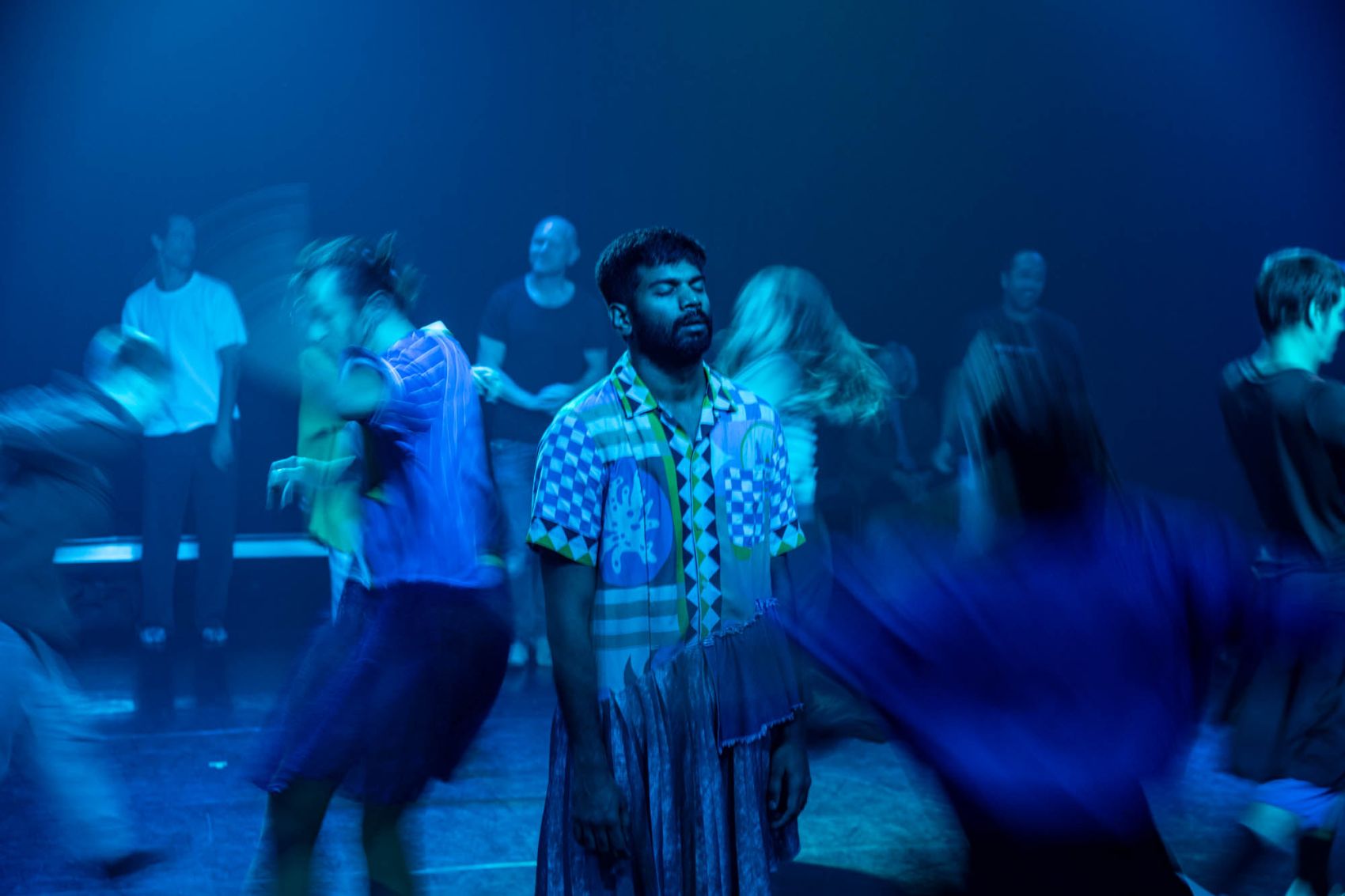 Guerrilla (chor. Renan Martins) – 14 Sept. 2025. Photo by Naomi Pongolini
If Dance becomes her can be seen as focusing on the »nascent« quality of meaning and therefore on meaning decentralization, Guerilla can be seen as focusing on the decentralization of feeling, thereby feeding into the problem of the sensing-feeling-meaning making continuum, which pervades modernistic philosophical discourse as well as modern dance. The performance takes place in Vitlycke center. We are asked to enter the central hall in two groups. When entering the hall (as part of the first group), the dancers are already on the stage. They invite us to join them – some of them on rollerskates, others are walking in a calm manner, making explicit eye contact with the audience. A calm ambient music is played live by a DJ, placed on the side of the stage.
One of the dancers approaches me and asks me if he can hold my hands. I agree as he guides me to the center of the stage and follows up with another suggestion: »close your eyes and hear the sound of my voice«. Constantly checking if I am comfortable, he gives me a few somatic suggestions and asks me a few questions: Sense my palms touching yours. Feel your weight. Feel your surroundings. What is going on around you? Can you see it with your eyes closed? What sensations can you feel in your body?
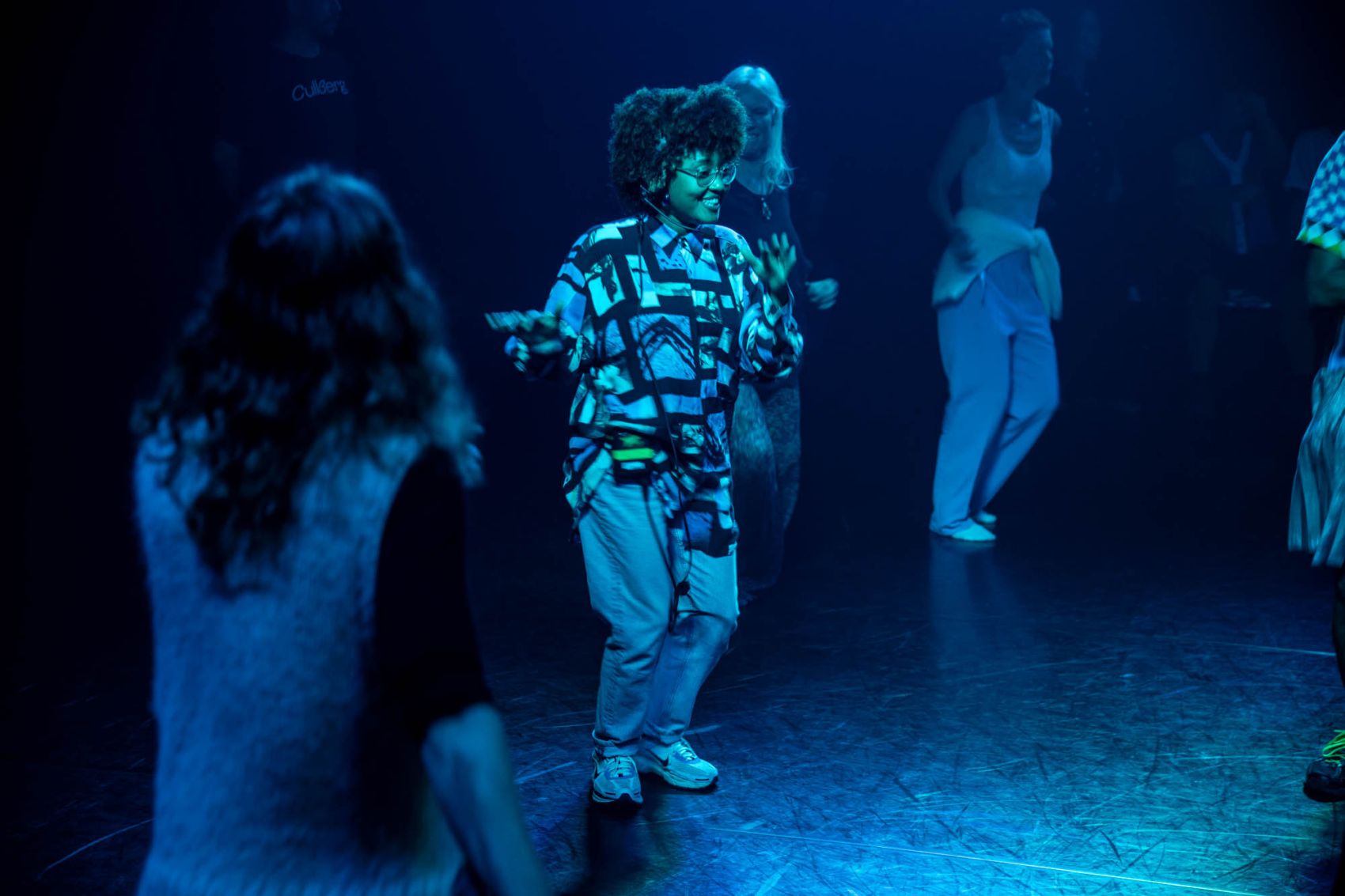 Guerrilla (chor. Renan Martins) – 14 Sept. 2025. Photo by Naomi Pongolini
After this somatic tuning, the dancer takes me back to my seat and I watch the other group going through a similar tuning practice. After a few minutes, I am invited by another dancer to join a larger group of six spectators. In a gentle tone of voice, she asks us to put our arms over one another and start moving to the rhythm of the music. Gradually, more and more beats are being added to the ambiental basis. As the dancer is instructing us to start rocking our bodies synchronously to the rhythm of her counting, the DJ starts producing beats more and more congruous to this rhythm. We get the feeling that we are not following the music, but creating the music with our bodies. After a few minutes of repeating this movement pattern, we are asked to open our eyes. To our surprise, a party has begun while our eyes were closed: spectators are now performers, dancing wildly in their own rhythms, while the dancers serve as reference points, sticking to a few movement suggestions which help the spectators not get lost in the infinite possibilities of what a body can do (or not getting stuck in the same pattern).
This approach contains at least four tactics of decentralization: firstly, the decentralization of the performers-spectators divide; secondly, the aforementioned decentralization of sensing-feeling-thinking (establishing a continuum); thirdly, the decentralization of point of view, since each of the spectators has a different point of view and a different experience; and lastly, the decentralization of performance structure, since fixed scenes, danced by the dancers, are interspersed with interactive scenes in which the audience takes part.
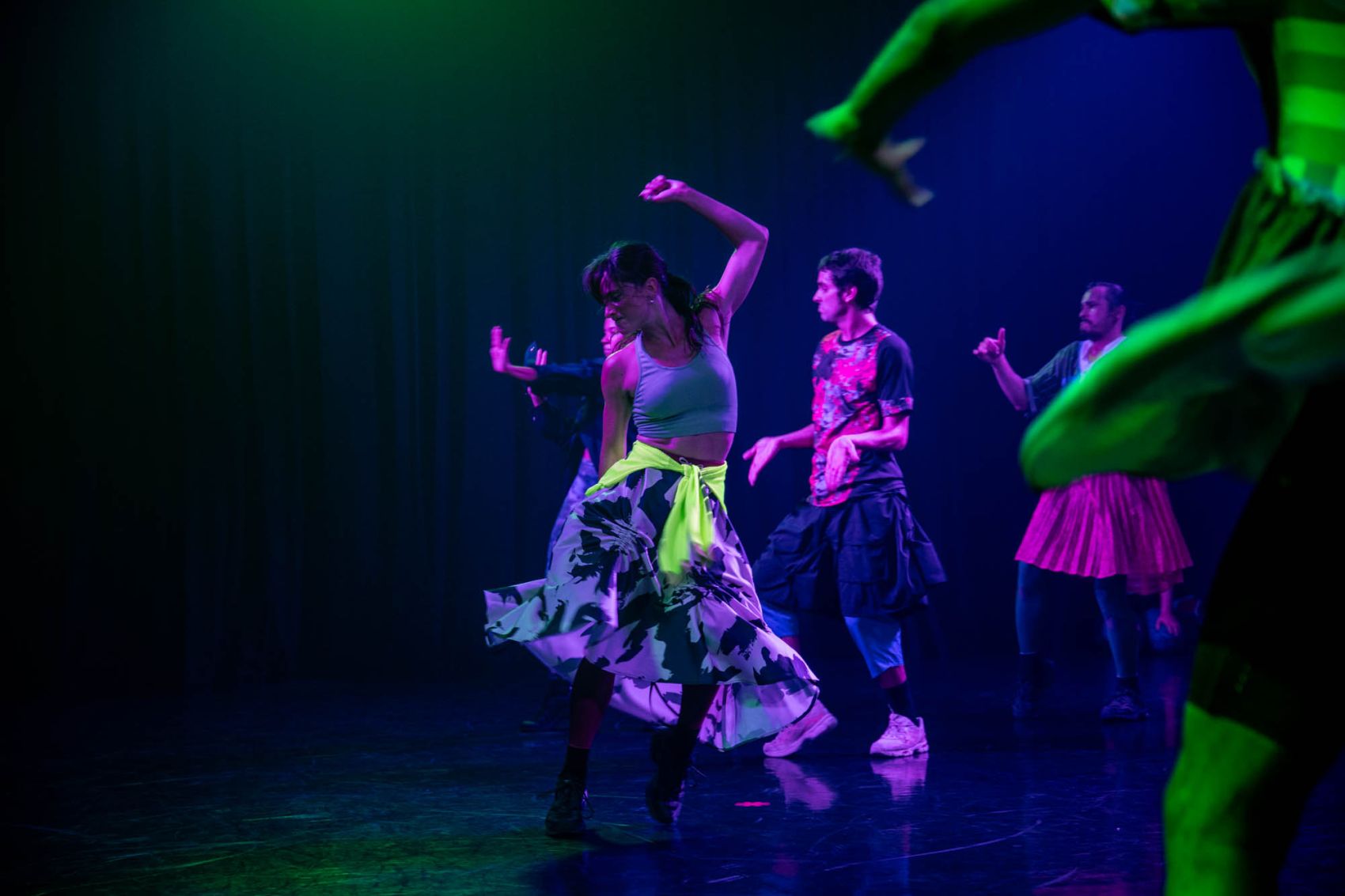 Guerrilla (chor. Renan Martins) – 14 Sept. 2025. Photo by Naomi Pongolini
The performance becomes a sort of kaleidoscope of images bursting from different points of view. We are continuously seeing and being seen from different points of view; static watching melts into dynamic co-habiting; an ecstatic space is produced not just with the use of underground aesthetic, but by letting us continuously switch perspectives and thereby temporarily losing our sense of self. While ecstatic spaces, typical of countercultures of the past, are disappearing from many cities, and Guerilla is a good reminder of this, we should also stay critical towards different ways of establishing this sense of community in performance contexts. The ritual setting of Guerilla implies a certain transcendence of human connection and movement; from the community of senses emerge a community of subjects. This sense of emergence can be seen politically problematic, since it implies a certain immediacy of communing, typical of modern embodiment ideologies, which tend to often diminish the importancy of the rational and linguistic aspect of self- and community-forming as well as the social and economic context of our subjecthood.
1 Susan Leigh Foster, Choreographing Empathy, London: Routledge, 2011, str. 77.
2 Lucia Rainer, On the Threshold of Knowing: Lectures and Performances in Art and Academia, Columbia University Press, 2017, str. 10
3 Ibid.
This text was written by Jaka Bombač within the framework of the Beyond Front@: Bridging Periphery project.

