
Author: Nora Čulić Matošić.
From the moment I first saw the promotional photos of the latest piece conceptualised and choreographed by Francesco Scavetta and having read that it deals with ‘home’ as a connotation to various themes, I kept inadvertently misnaming Nowhere Like Here with Nowhere Like Home. It doesn’t help how that phrase strongly reminds me of Wizard of Oz and Dorothy’s words that eventually ‘brought’ her back to Kansas. ‘There’s no place like home…there’s no place like home.’, she keeps repeating with her eyes closed as she magically finds herself back home in her house, back with her auntie Em and uncle Henry. The ‘home’ or ‘here’ on the stage does have some magic to it in the beginning, the scenography by Scavetta and Luciano Goizueta consists of two main ‘construction’ materials: the empty plastic multi-coloured beer crates and tall window-dressers or screens that are on the one side white or ‘empty’ and on the other display a printed drawing of a single room inspired by art-deco style, kind of posh looking. The residents or this place are six dancers that are each from a different country that took part in the Beyond front@: Bridging Periphery project and they are Margareta Firinger, Magalí Camps, George-Alexandru Pleșca, Jerneja Fekonja, Michał Przybyła and Laura Tóth.
 Nowhere Like Here (chor. Francesco Scavetta) – Budapest, Hungary – 18 Nov 2025. Photo by Gábor Dusa
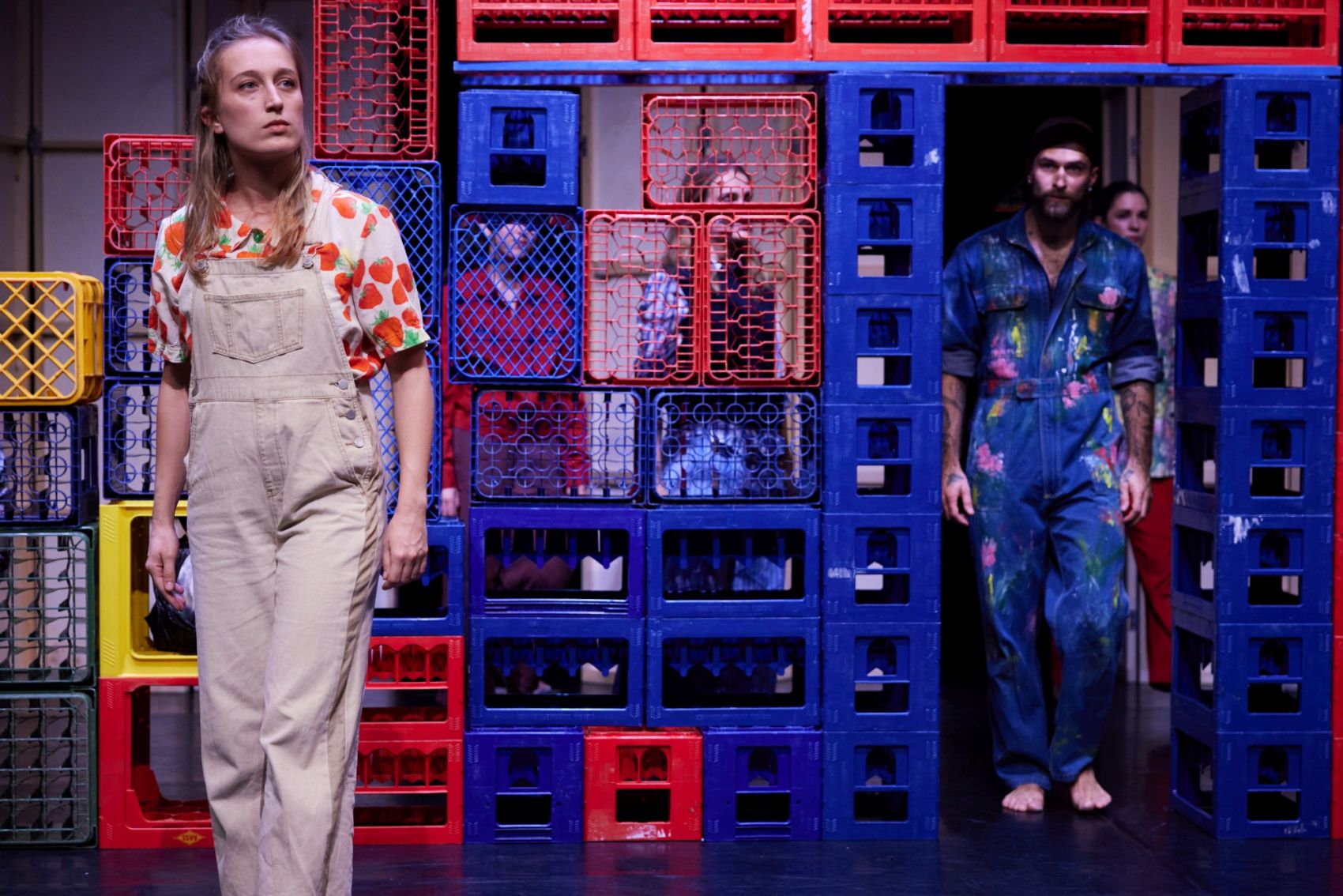
The beer crates dominate the scene during the first half of the play. At first, they are assembled in a tall wall, in front of the white screens, hiding them and the dancers. It represents a border, a fence between the performers and the spectators which will later be slowly deconstructed during the choreography. There’s also a ‘second’ stage that is always placed on the side from which the audience enters the auditorium – it’s a miniature model of a mountain village or ski resort, possibly the imaginary place where ‘here’/’home’ is set. And even though it is miniscule compared to the live stage, it seems to give a more expanded look of where this constructed house is.
 Nowhere Like Here (chor. Francesco Scavetta) – Budapest, Hungary – 18 Nov 2025. Photo by Gábor Dusa
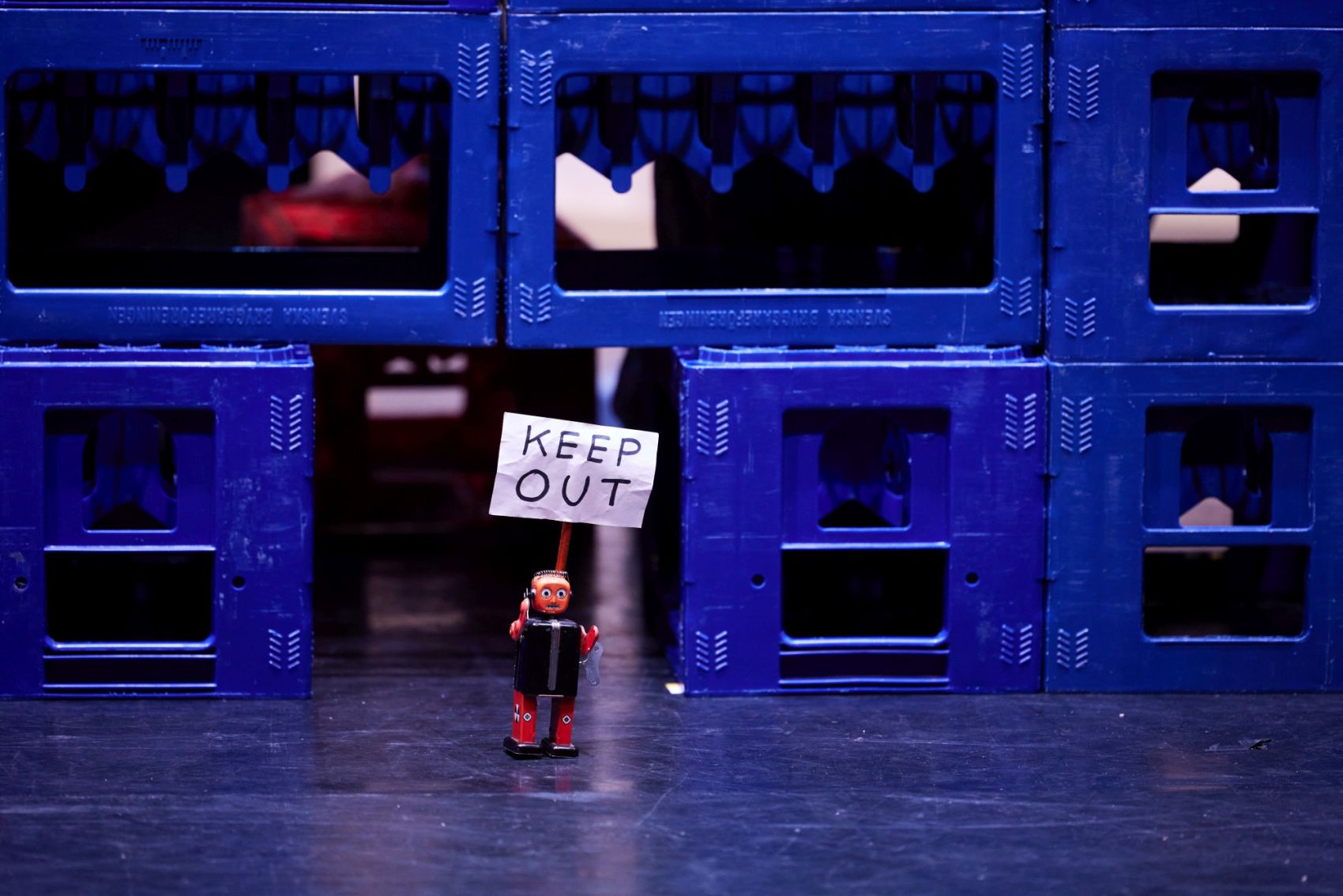
The dancers make their presence known by making sounds gargling water firstly, seemingly communicating secretly so the spectators don’t understand them. Suddenly, a black trash bag flies in front of the crate-wall and then other bags follow. The music i.e. the white noise is slowly amplified and we hear gargle noises again but now it sounds more like singing in a simple, child-like melody. Between the ‘main doors’ in the middle of the crate-wall on the floor, a small mechanical toy shows up and carries a little banner that says ‘keep out!’. Then, behind the crate-fortress on the left, a balloon pops up with ‘turn back’ written on it. Another one pops up that says ‘now’, but this one is held up by Fekonja, keeping it from the ground by blowing air through a blue toy pipe. It seems like we, the audience, are trespassing and aren’t wanted here. Another dancer shows up, Przybyła and is dressed in a bathrobe with a towel around his head. His costume brings up an image of a housewife or a mother that is taking care of herself and watches outside as the kids, other dancers are slowly appearing from behind the scenography. As he’s standing close to the pile of trash bags, there’s rustling inside one of the bags and something inside it is making it move a bit. He’s interested in it briefly, but pays little attention to it. When he leaves, another dancer, Pleșca who’s wearing a blue suit bottoms and a top with flowers, approaches the pile and imitates the movement that might be causing the rustling. Tóth is also wearing a floral jacket and her movement is careful but playful at the same time, she’s hiding her face while Firinger is walking around the stage wearing a large hat and slippers for cleaning dust, her footsteps are really shot which resembles a geisha walk.
 Nowhere Like Here (chor. Francesco Scavetta) – Budapest, Hungary – 18 Nov 2025. Photo by Gábor Dusa
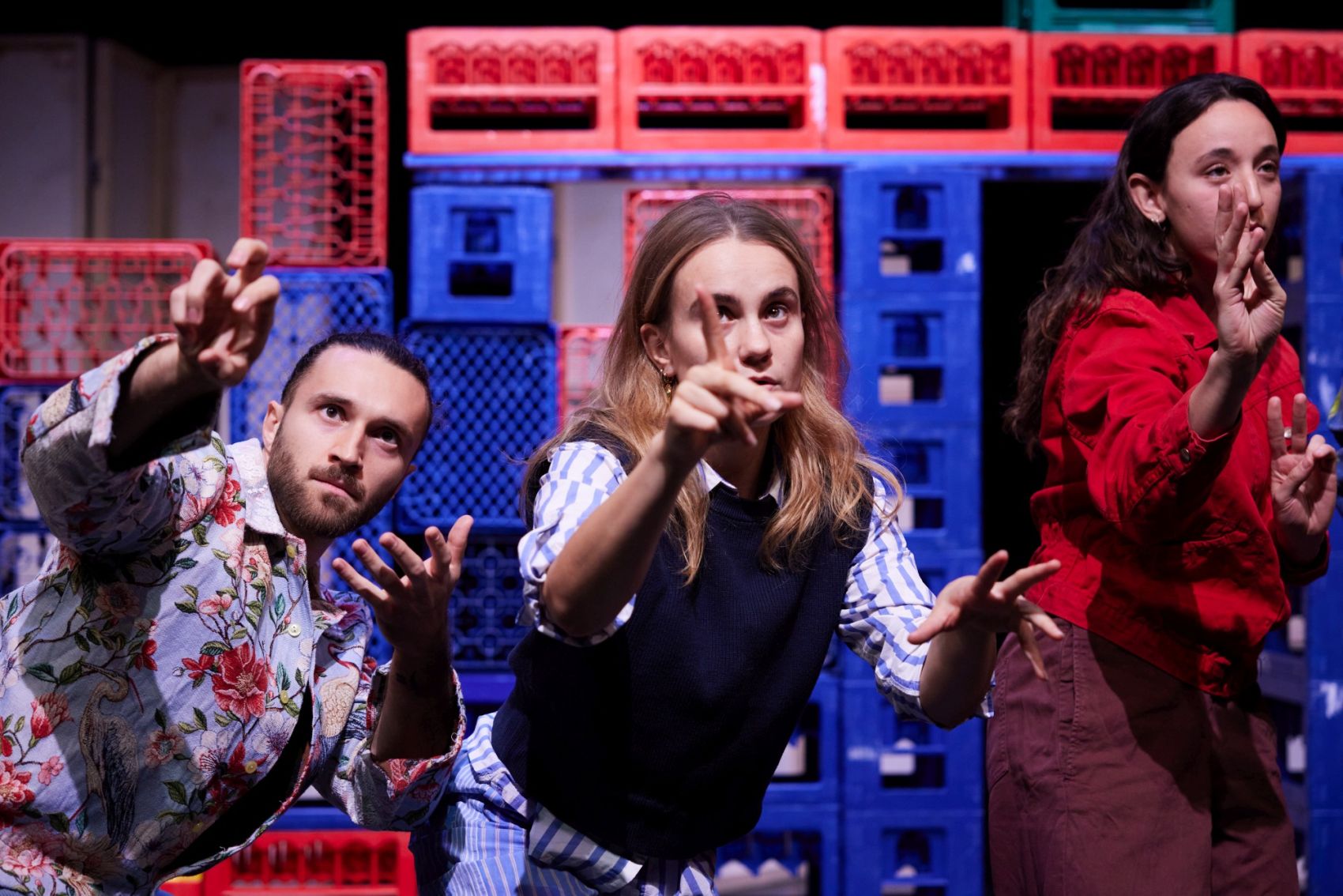
Everyone from the ensemble is now present on the stage and are engaging with different objects which scatters the spectators’ focus to multiple bodies and sequences that are impossible to follow through entirely. With the dancers slowly opening the stage more with their solos, they all look like children playing on their own. This is emphasised when Pleșca takes the figurines from the model on the side and places them around the stage, while the rest of ensemble rearranges the crates and take the wall down slowly. The music now consists of an easy techno beat and everyday rustling house sounds. However, there are still signs of non-welcome – a ball with a dog snarling with its teeth is revealed from one of the trash bags and set on a crate. At a point, all six of the dancers are standing in front of the audience on the proscenium. They are moving carefully and calmly while presenting a large key in gelatine as another invitation to their place. I notice how hands and fingers dominate they movement now, with dancers often moving while pointing their fingers in a single direction, their arms fluidly moving in the rhythm of an alarm from the background.
Nowhere Like Here (chor. Francesco Scavetta) – Budapest, Hungary – 18 Nov 2025. Photo by Gábor Dusa
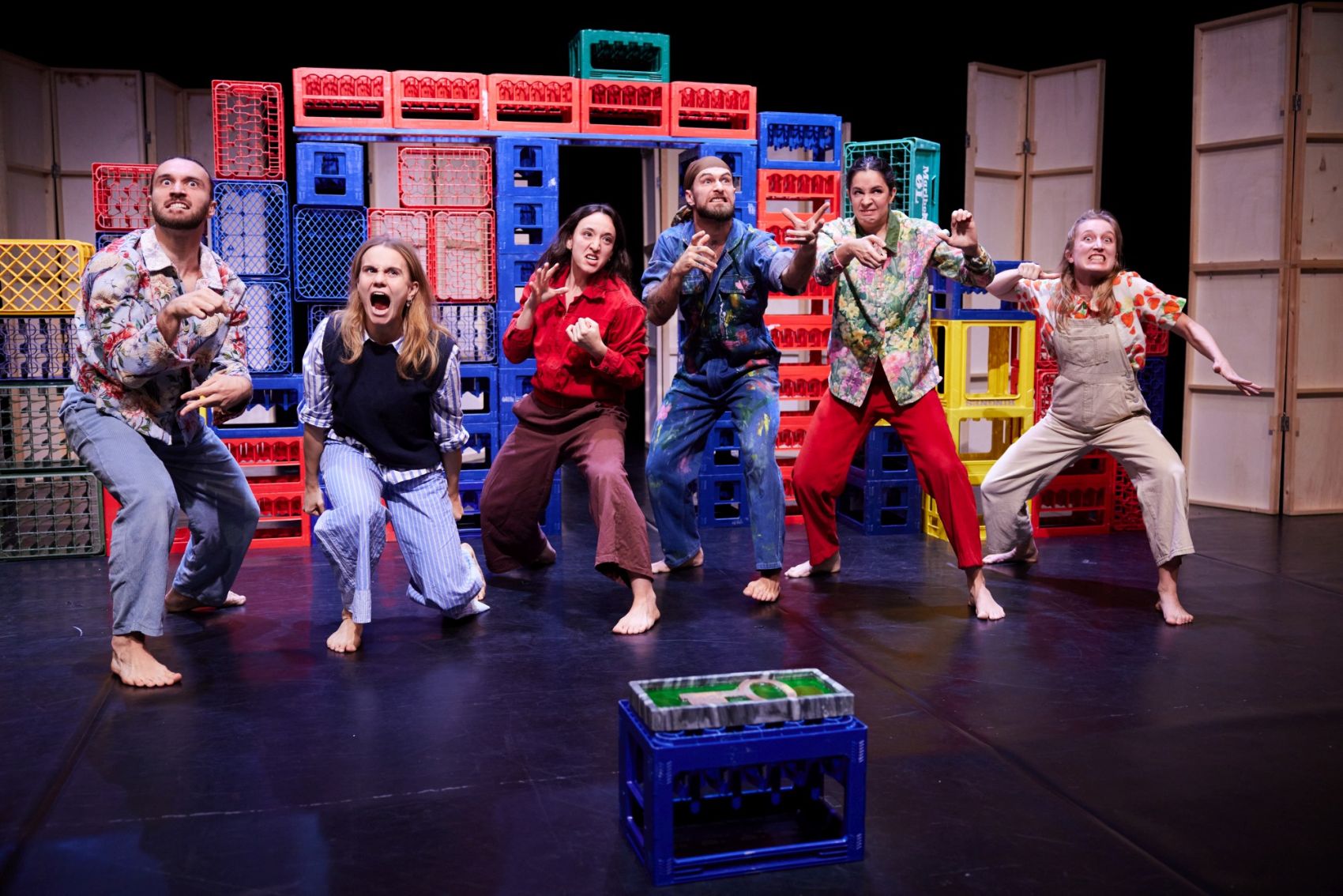
However, we are again met with a soft hostility when, after presenting the key, the ensemble is making face grimaces as if they are trying to scare us and this was very reminiscent to Maori’s haka dance meant to intimidate the opponent that is practiced to this day, particularly in sports. In groups, the crate-buildings are deconstructed and reconstructed on the sides of the stage as the trash bags are thrown back behind the window-dressers which are now placed in to the front. The music is faster and the movement follows that too, the rhythm exchanges between slow and quick is frequent and stretched out, fuller. Also, the atmosphere is more playful – you can see the dancers laughing and smiling, they are moving closer to one another and look friendlier which is especially shown with the before-mentioned emphasis on the straightforward arms that are mostly pointing in a single direction. They look like air-hosts pointing towards the exits on a plane, their arms aren’t just attracting our attention but also each other on the stage. For the final non-verbal invitation, they are presenting their open palms towards the audience, before opening and setting the screens on the ‘room’ sides.
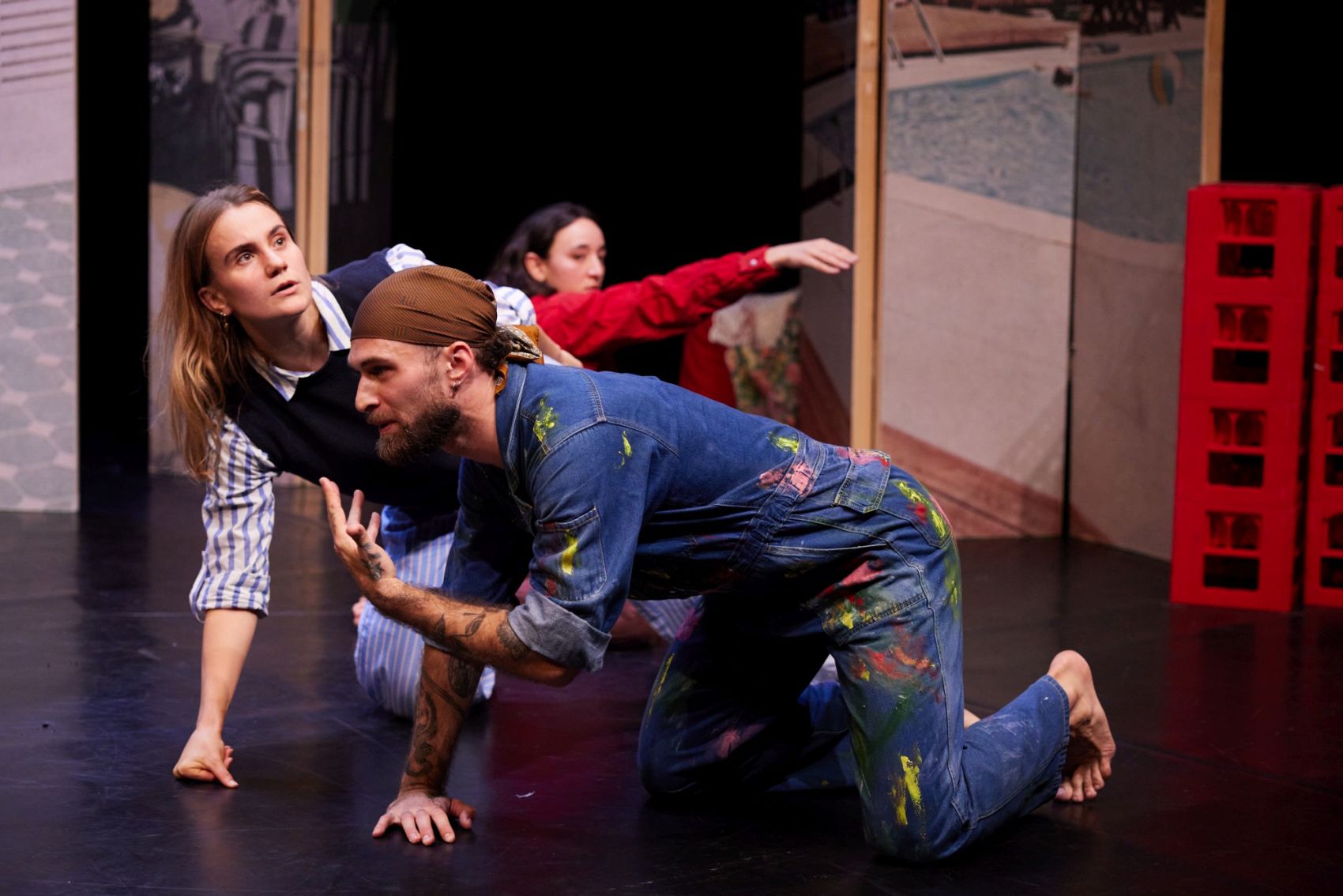 Nowhere Like Here (chor. Francesco Scavetta) – Budapest, Hungary – 18 Nov 2025. Photo by Gábor Dusa
They welcome us in English to their new home and inviting us for dinner. We are given a short tour and rules to their perfect house, all while ignoring some parts that the ensemble doesn’t want to talk about it. The already established game of mixed signals continues as the dancers keep finding excuses to withdraw the invite, saying we aren’t on the guest list and adding various requests guests should follow and identity-boxes their must fill. The highlight of this manipulation in a single legitimate invite from the audience. They all insist on this bit until someone shows a genuine interest to take part, only for the dancers to collectively and quickly turn them down. The insisting on the invite intrigued me because I’m used to seeing the audience not engaging with the performers or taking their time to accept. I imagined they would move on in case their invite wasn’t accepted, so this interaction took me by surprise. After the great denial, dancers are finding excuses to further deny the audience, with mentions of renovation and other engagements, listing more requirements and conditions under which we may come to their home. During this dialogue exchange, the screens are shut back again and are now forming a little house. Several crates are placed on the stage for some members of the audience to sit on the stage – their invitation is now real, private and individual, while the model of the ski resort is brought inside the house.
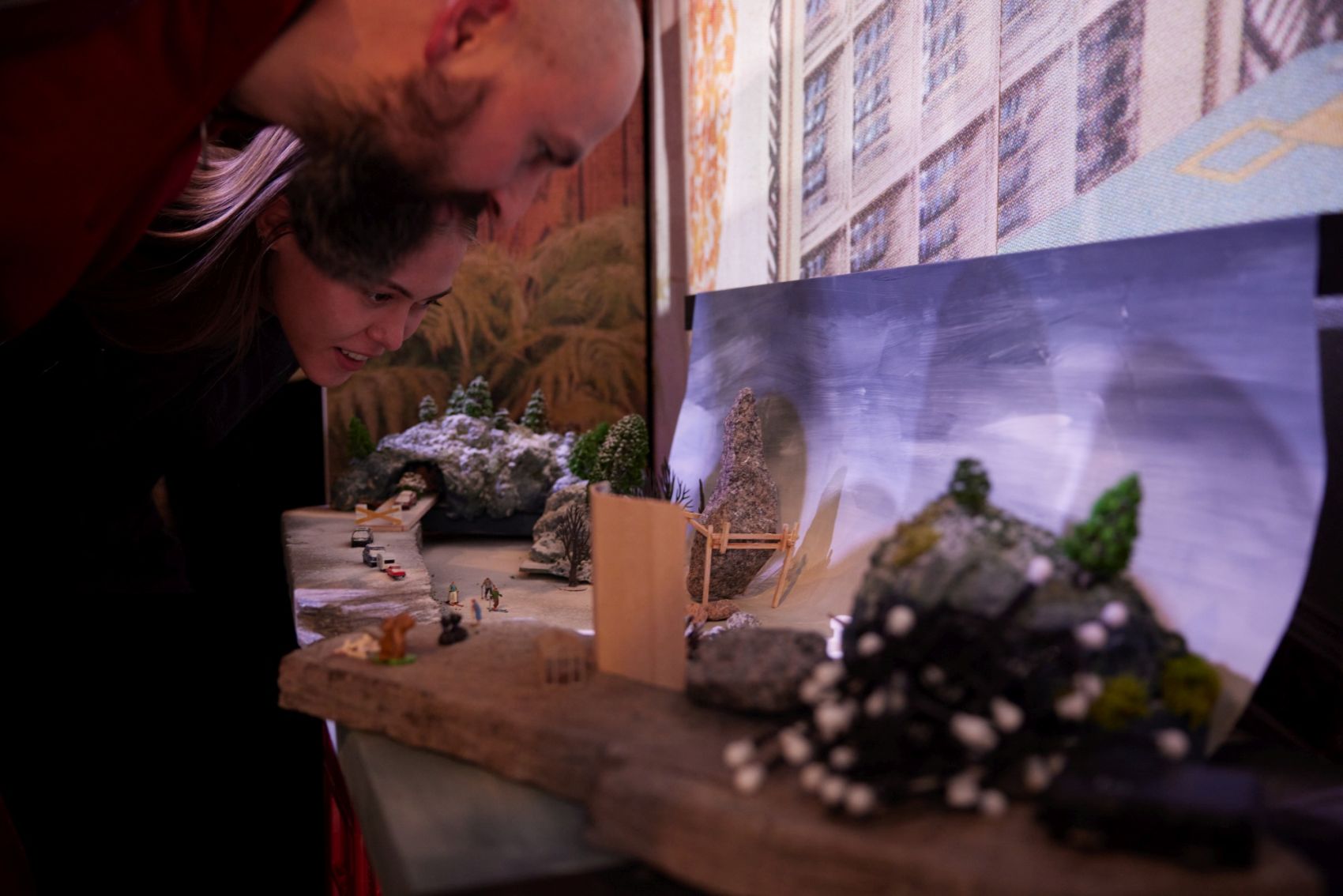 Nowhere Like Here (chor. Francesco Scavetta) – Budapest, Hungary – 18 Nov 2025. Photo by Gábor Dusa
The piece ends with a video projection on the built house of the ski resort model that is filmed in detail which makes it larger than it seemed at first, admittedly more distant glance. Slowly, the ski resort starts to resemble the play’s scenography and – not only does it look like the scenery we’ve just seen – when the camera zooms out, we see that it was the dancers that were stacking and animating the little figurines. They look towards the camera, paying us one last gaze before the image fades out, as does the light inside the house. In the end, the Nowhere Like Here left me a bit underwhelmed and puzzled. Choreography wise, I enjoyed the flow of the movement and the score’s rhythm, the ensemble altogether too. However, I believe it needed more character and perhaps tension amongst dancers because personally, I wasn’t that invested in their actions and it left me with a feeling of vagueness which is almost impossible to believe due to a very elaborate scenography. It would seem that the stage design was overly dominant over the dancers so, instead of it complementing the score – it absorbed it and left very little space for choreography or narrative to stand out.
This text was written by Nora Čulić Matošić within the framework of the Beyond Front@: Bridging Periphery project.

