
Author: Karla Mesek.
Although the title of the performance may not reveal much, or perhaps nothing, about the performance itself, I choose the title as an entry point into reflecting on the performance “Kata strofa” by Matea Bilosnić. In Croatian, kata is a word that denotes a set of moves in the martial art of karate, and strofa is a set of verses that form a kind of lyrical whole. Combined, these two words make katastrofa, a catastrophe. The word catastrophe generally denotes a sudden event with devastating consequences; however, it is also used colloquially to characterize something that has left a negative impression on us for various reasons. While researching the meaning of the word catastrophe, I came across the theory of catastrophe in mathematics. As far as I understand, it means sudden and large changes in a system that occur due to small changes in circumstances. To me, that idea seems applicable to the performance as well. In that context, I find it interesting that the word catastrophe can be broken into two words that both signify some kind of whole. So, what is a catastrophe on stage?
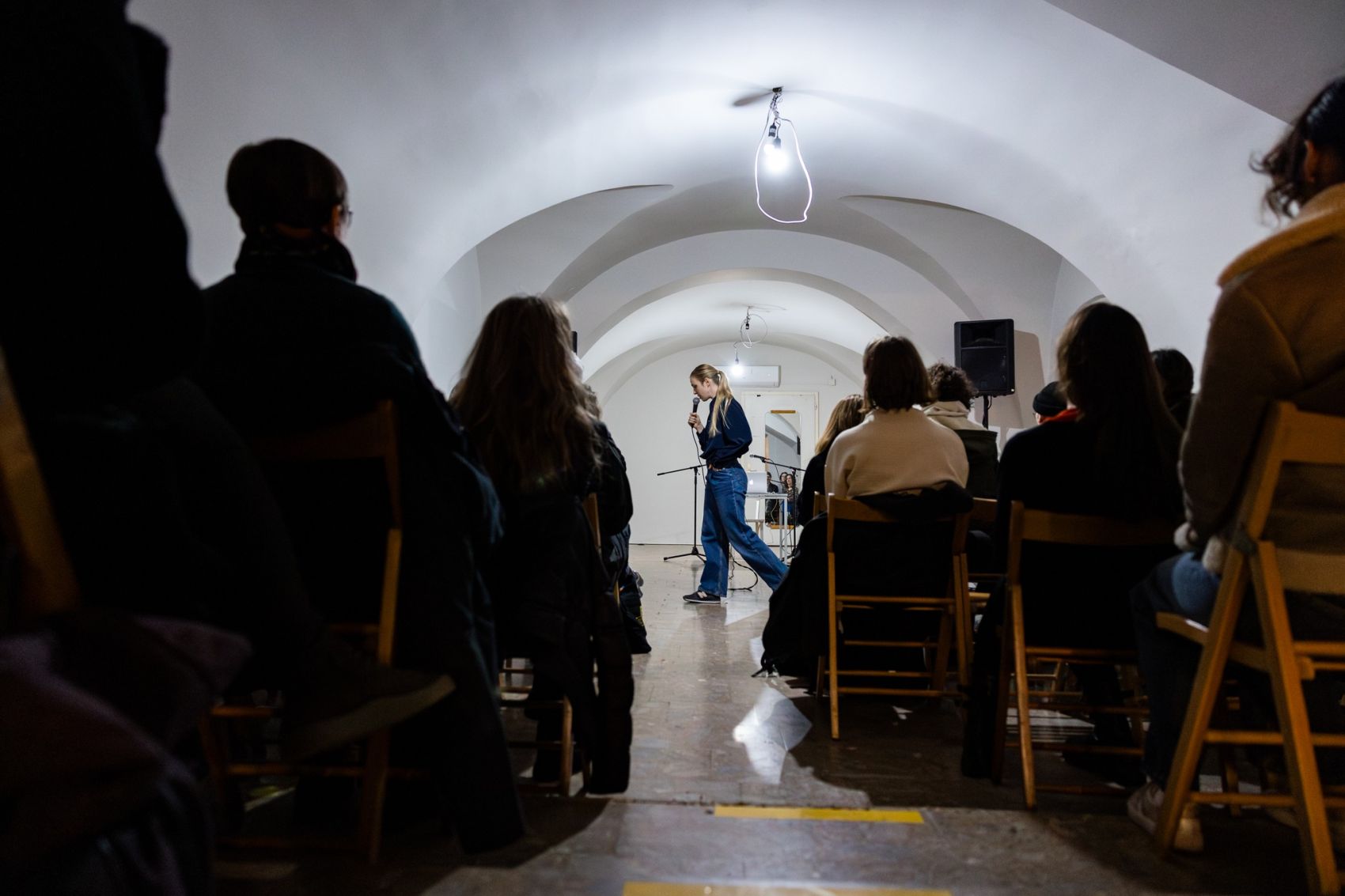
Matea Bilosnić: Kata Strofa, at the 23rd Drugajanje Festival in Celje (November 2024). Photo by Lea Remic Valenti.
After the performance, I thought about what we consider a catastrophe in the performing arts. It’s a word used to describe something we don’t like, something we consider a complete failure, flawed in idea, execution, or both. When I don’t like a performance, I like to think about why I don’t like it because it seems to me that the very thing we don’t like, reveals what we believe performance art should be. Failure is only possible if there are conventions and expectations. Matea negotiates precisely with some conventions and expectations, both her own and those of the viewer. She performs a dance solo, so short that it raises the question of whether “Kata strofa” can be considered a dance performance. That is the first and maybe the most significant “failure” of the performance. The rest of the time, she recites the text and uses technology to modify her voice and to create a soundscape.
Entering, standing, presenting, representing – what am I representing?1
Without going into a chronological description of the performance, I will highlight the acts that seem significant to me: duplication of action with description, usage of technology, and transparent negotiation with expectations.
On the floor
On all four
I am looking for more
Expecting
What are you expecting?2
Describing actions she performs is a duplication of signs, an underlining of what is already obvious to us. The actions that Matea performs and describes are very basic. Describing these actions emphasizes the basic settings of the performer’s presence on stage and the basic settings of the structure of the performance in the context of expectations – the performer is a living body on stage, a body that has the ability to move or speak, a body that represents something, and the performance has a beginning, middle, and end. Although at the levels of text and actions she questions expectations, on a certain level Matea satisfies all of them.
Were you expecting this?
Wanting this?
Hoping for this?
Are you bored by this?
Are you intrigued by this?3
Usage of technology is an important part of the performance. At times it makes the work function more like a sound installation than a dance performance, especially during the sequence in which, while using two microphones and a looping device, Matea brings the performance to the moment of culmination. I even thought of technology as a performer or Matea and technology becoming one, especially at that moment of culmination because it becomes impossible to separate Matea’s voice from her recorded voice.
Should we end this? How are we gonna end this?4
The negotiation of expectations becomes most dominant at the end of the performance, when Matea raises questions about the ending and offers the audience a range of possible endings. She ends by leaving the room: it’s the most radical ending. If there are no more performers, does that mean the end of the performance? What about technology?
In the book Exhausting Dance: Performance and the Politics of Movement, Andre Lepecki states that every choreographed questioning of the understanding of dance as something inseparable from movement does not only function at the level of disappointing expectations, but also as an act of criticism with far-reaching ontological consequences. 5 In other words, for expectations to be disappointed at all, some expectations must exist, and for expectations to exist, there must be a certain understanding of the essence of something. According to Lepecki, procedures such as reduction and abolition of movement open up space for thinking about contemporary experimental dance practices as practices that question the ontology of the practice itself, but also its politicality in terms of the production of meanings that can function as a critique of representation. 6 Is “Kata strofa” a critique of representation? It might be. It might be even a critique of public events. What are we expecting from a performance being selected by experts for a performing arts festival? Is what Matea does enough?
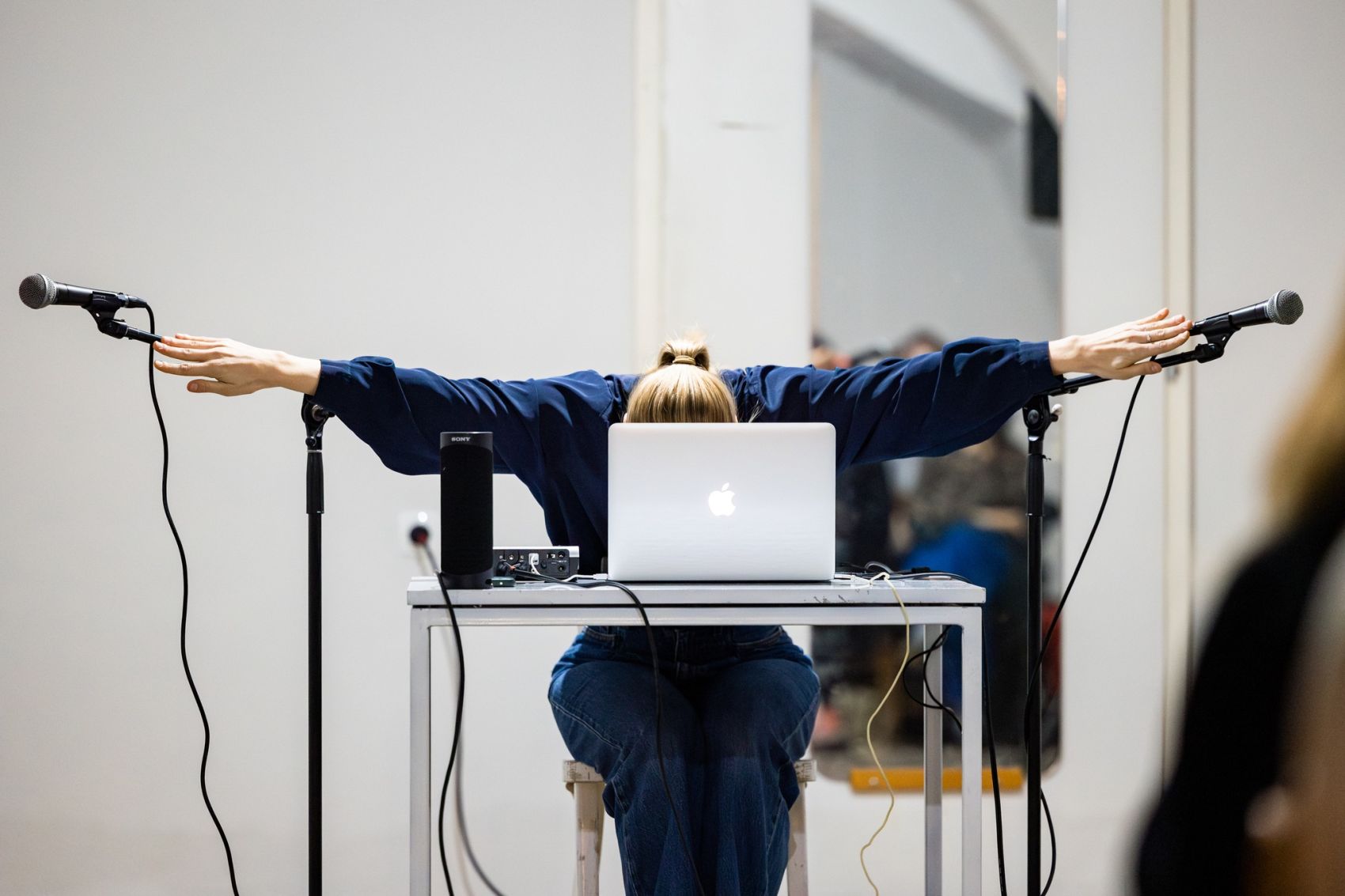
Matea Bilosnić: Kata Strofa, at the 23rd Drugajanje Festival in Celje (November 2024). Photo by Lea Remic Valenti.
After the performance, we had the artist talk with Matea. I like these talks because they provide insight into the artist’s thinking process rather than the exact meaning of the work. Matea stated that when she started working on “Kata strofa” she wanted to make a big dance piece and how in that context what she ended up making was a catastrophe. As an artist myself I can identify with that feeling of failing at something you want to produce during the process not because of your inability to produce it the way you imagined, but because of questioning its purpose. Both
in artistic research and research in art, failure can be productive. According to Matea’s words “Kata strofa” came as a result of an artistic research and she treats it as a sketch for the work she made later, “Never alone”.
A few weeks after seeing “Kata strofa” in Celje, I had the opportunity to see “Never alone” in Zagreb. In relation to “Kata strofa”, “Never alone” seemed much more layered but less as a critique of representation. In its simplicity and transparency “Kata strofa” seemed almost like a fraud, but a good one. One that raises questions about the system itself.
———————
1 Text from the performance
2 The same
3 The same
4 The same
5 Lepecki, Andre (2004) Exhausting Dance: Performance and the Politics of Movement, New York and London: Routledge, page. 1.
6 The same, page. 16.
This text was written by Karla Mesek within the framework of the Beyond Front@: Bridging Periphery project.

