
Author: Jaka Bombač.
»Nature is that which we observe in perception through the senses.«
Alfred North Whitehead, The Concept of Nature
Sitting on the bus leaving for Krakow, I felt like I have already seen the performance that I was about to see. It came as a glimmer of intuitive insight or, moreso, a remnant of my basic acquaintance with the history modern art. Everybody knows that four seasons is a notoriously problematic term or motif, not only because it was so often depicted or referenced in classical as well as modern art from Vivaldi to Arcimboldo to Chekhov, but also because we seem to be living in a time in which there is no four seasons – or at least a great many people seem to be talking about this.
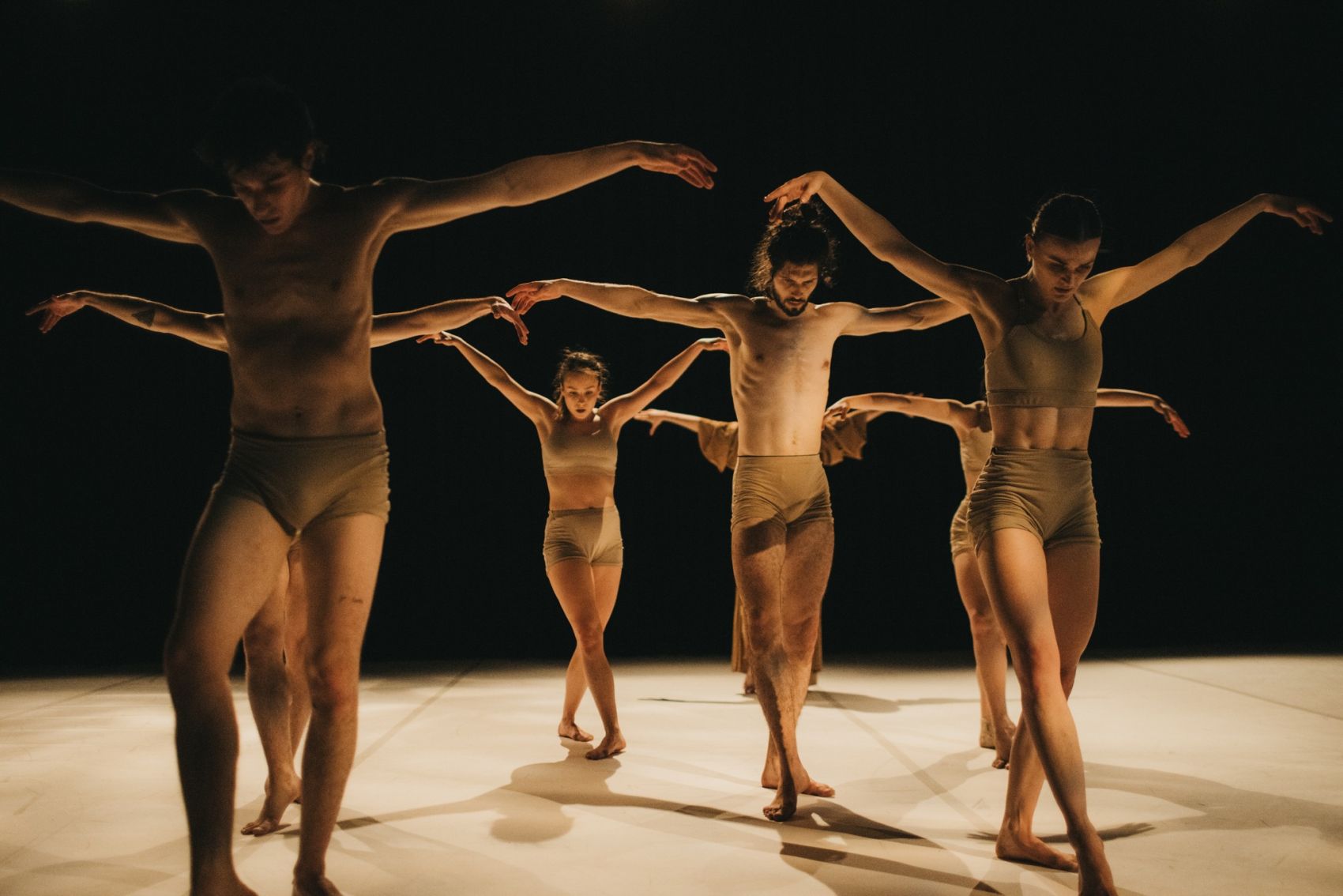 Central Europe Dance Theatre – Four Seasons by Maciej Kuźmiński. Photo by Grzesiek Mart.
I do not need to be a nature activist in order to understand the importance of nature’s cycles – around the world, various species are mistiming their hunting, breeding and sleeping seasons, which will most likely result in their extinction. When my own sleeping cycles are disrupted, I can feel it straight away. Also, when the seasons switch I experience a short period of tiredness, malaise or anxiety, which are probably due to the adaptation to the new conditions. But I also know that the concept of the self-regulation of nature has been historically misconstrued, idealised, reified or associated with concepts such as the state, the woman or the correct way (the word for »of course« in Croatian is »naravno«, which we could also translate as »natural«).
All these seem like random introduction ramblings, starting introspective remarks, but I will try to show in these next few paragraphs how they are in fact a very clear and concise entry point into the performance Four seasons by Maciej Kuźmiński, which actually references many symbols of the natural world and in my opinion also implicitly employs a certain stance towards them. In fact, I have seen the performance twice, first in Cricoteka in Krakow and then about a month later in Stara mestna elektrarna in Ljubljana; the second time around I also moderated a discussion taking place after the performance, in which a few people have questioned me about the determinateness of my entry point. »You do not need to interpret the performance according to the director’s intentions«, one said, and another added that I could as well »focus on the materiality of the performance«.
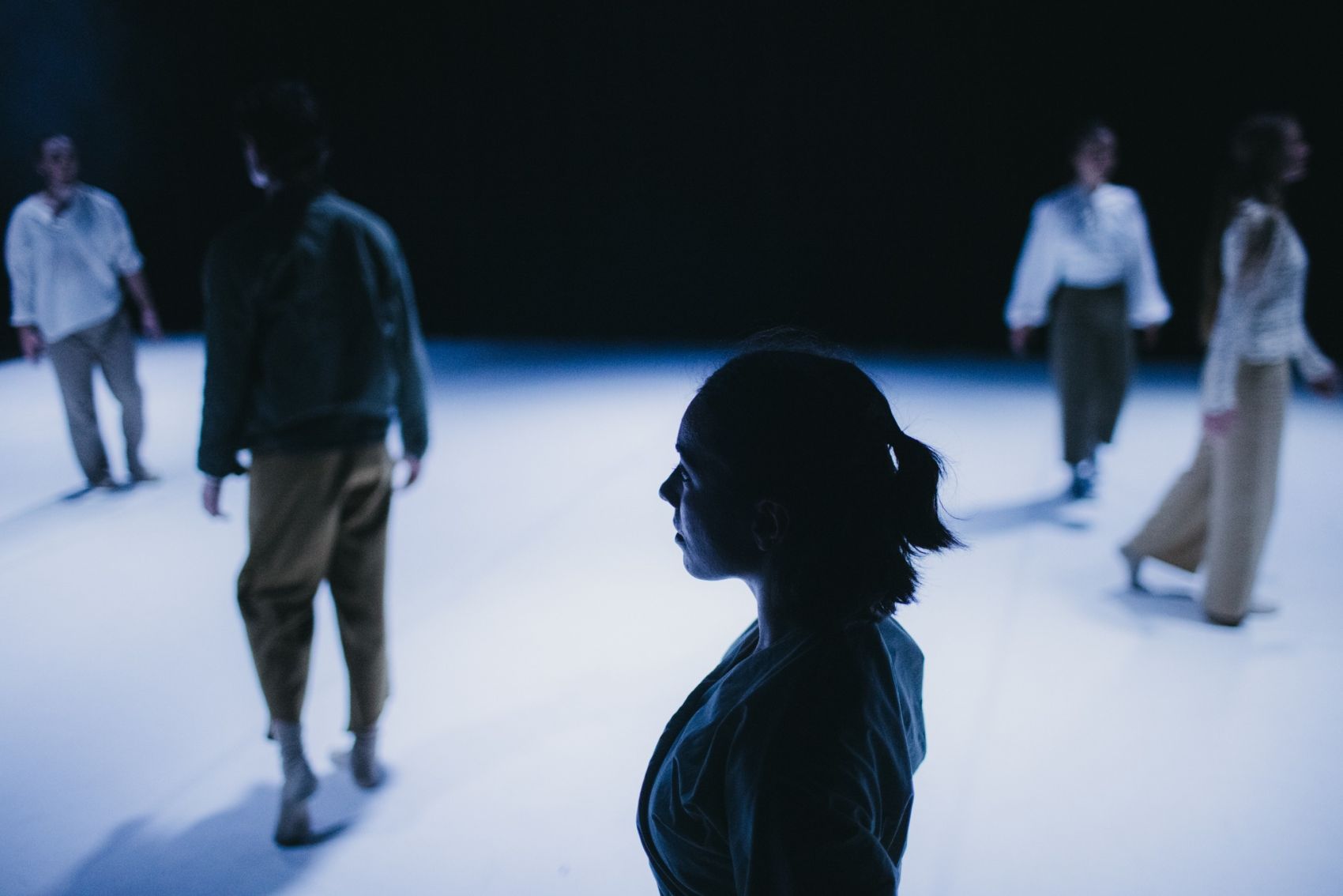 Central Europe Dance Theatre – Four Seasons by Maciej Kuźmiński. Photo by Grzesiek Mart.
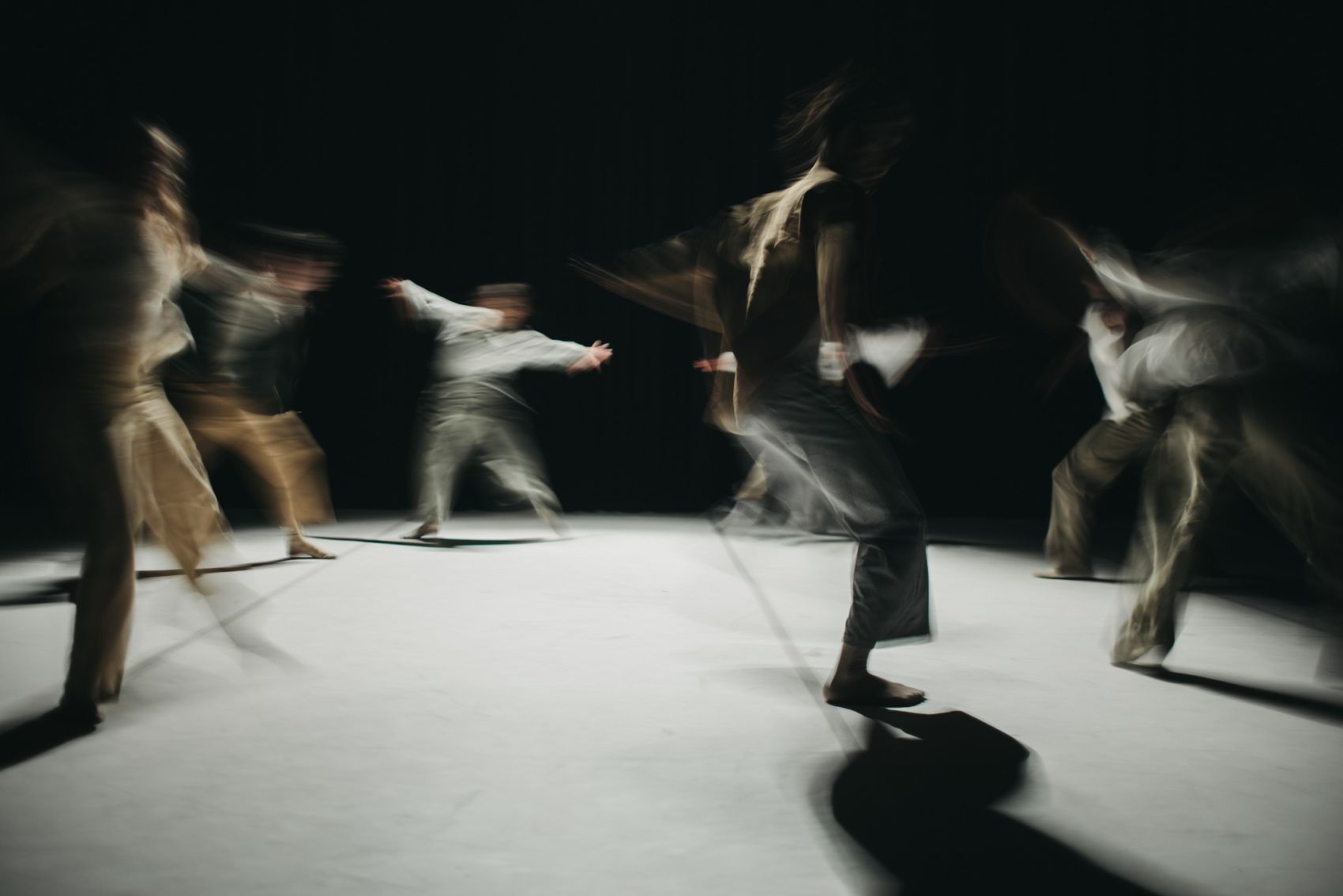
One younger participant, a student of one of the dance academies hosted by Bunker, then asked me »where in all of this I even saw nature«, to which I replied, everywhere, but I should have replied everywhere and nowhere, because in fact I only saw representations. In the first scene, we hear the first beat of a sunny, blooming jazzy song while the light narrowly focuses on the centre of the stage. A dancer is lying on the white dance floor, making his way up, with fluid hand movements, resembling sprouting, towards the vertical position. Through this movement pattern, he establishes a seeming multiplicity of the directions of the sky, since each part of his body seems to become a microcosm, respondent to the same physical laws than all the rest but cut away from the common center of movement and therefore from the common spatial orientation. Later on, this complexity-in-simplicity pattern continuously passes from the level of the group to the level of the individual body.
The jazzy song stays with us endlessly looping and repeating, but the stage action is constantly changing, even when many of the motifs are being repeated: the sprouting movement pattern, passing between frontal orientations towards eight directions of the sky, continuously switching between the horizontal-vertical axis of reference or bodily intentionality, continuously passing between simplicity and complexity (solo to constellations and then back again), interrupting regularities of movement or orientation of individual dancers in group constellations (harmony turns to disharmony and then back again), and last but not least, ceaselessly referencing circular shapes and bucolic motifs.
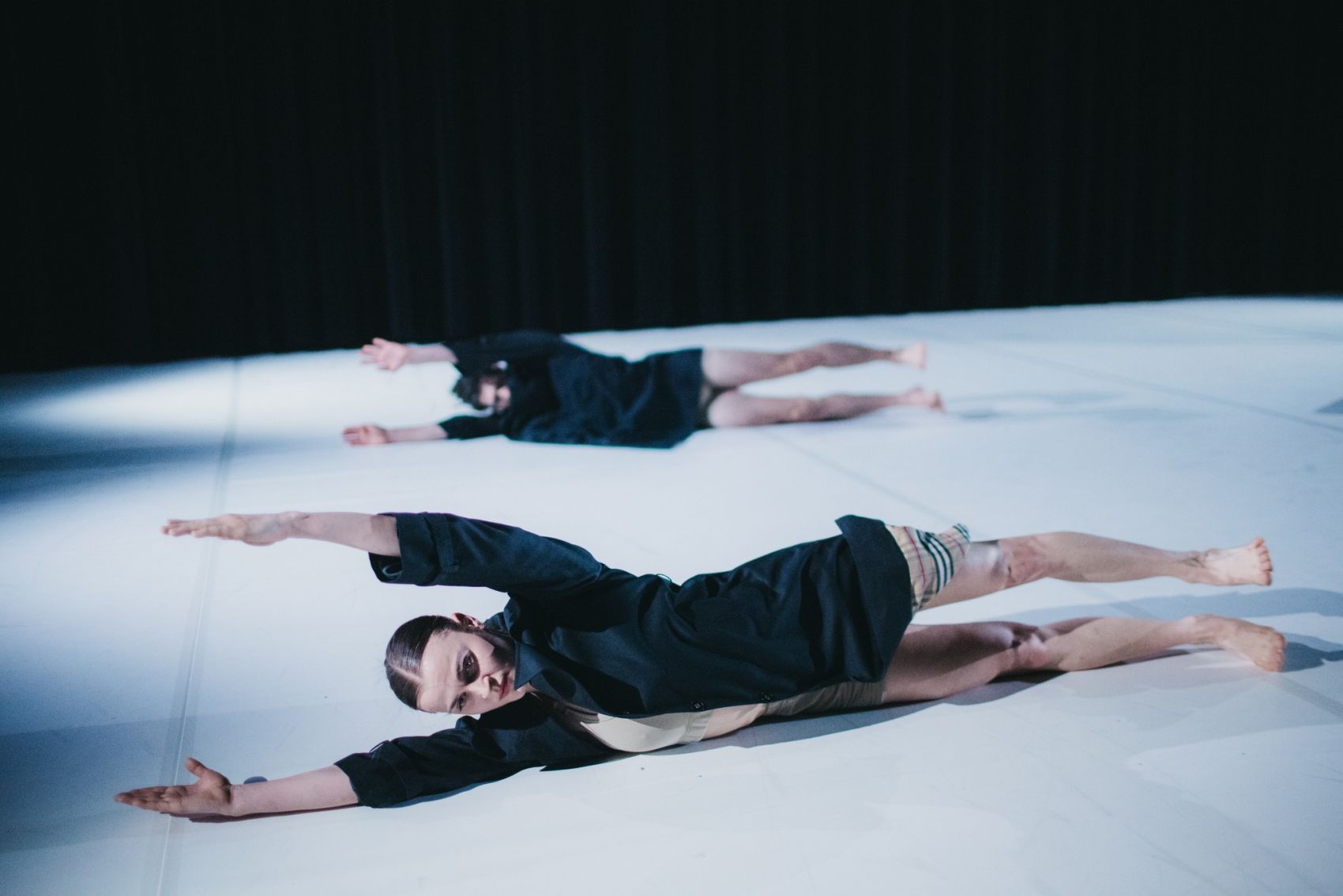 Central Europe Dance Theatre – Four Seasons by Maciej Kuźmiński. Photo by Grzesiek Mart.
Furthermore, the individual seasons are very explicitly separated with specific markers (especially the emergence of circular shapes and addition of new bucolic motifs), so even if we want to concentrate on the materiality or on the motion, this fixed choreographic rhythm keeps on reestablishing the narrative. After the initial scene with only one dancer, other dancers accumulate on the stage one by one, and gradually in rhythmical increments adapt to the synchrony of the unit, only to then again gradually desynchronize, but never into complete chaos. After the third desynchronization or so, another dancer is left alone on the stage, standing with his back bent backwards, so that the upper and the bottom parts of his body are oriented on different axes; his feet firmly on the earth, his gaze towards the heavens. This time, the other dancers do not accumulate on the stage one by one, but emerge all at once, and with such a sudden surge of energy the field is again synchronized, the solo dancer animated, revived. While this does produce a nice dynamical effect, it also seems very vitalistic, and I would love to see a bit of that other side of nature, which is death, since in nature everything seems to be thriving and dying at the same time (like cells which continuously die off and new ones are simultaneously produced, or cells that take on a different function when another cell, meant to execute that function, dies off).
But there is no death and dying in Four seasons, and moreover, there is not one single pause, since all of the movements are constantly being enmeshed into other movements. While this has a good aesthetic effect in certain well-timed scenes, it gives neither us nor the dancers any time to breathe and to make sense of what is going on. This might have been intended: giving us no time to think might have been used as a strategy to move us deeper into our sensuous and bodily self, and through it into the rhythm of the tides. But for the dancers, the choreography seemed to be too demanding or too unnatural, as they were mostly catching up with it instead of claiming it as their own, which also showed on their faces and in their lack of communication. Whenever the choreography was not ideally caught up with (by the dancers as a group), the tension on their faces became apparent; because the face was not explicitly choreographed, it was prone to express the inner feeling and stress of a highly physically and conceptually demanding choreography.
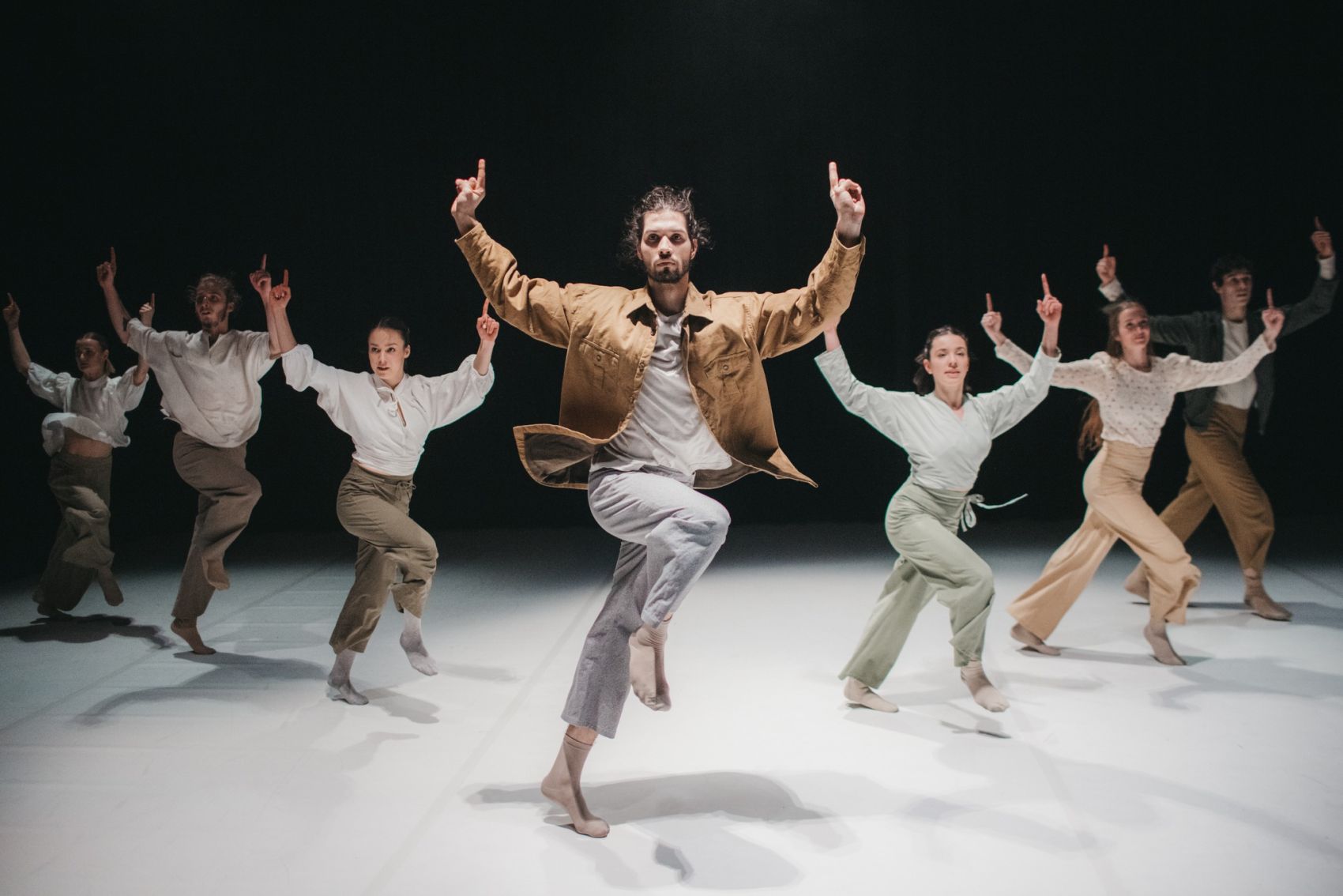 Central Europe Dance Theatre – Four Seasons by Maciej Kuźmiński. Photo by Grzesiek Mart.
There was actually one dancer that succeeded in making the choreography »his own«. But this was a different show, because this dancer’s (Marcell Hován) movement drew attention to completely different aspects of dance. Because he was so relaxed with the choreography, which he might have not even personally liked, but was just able to appropriate, he seemed to be alive – instead of representing life. His life, his style, let through the choreography, instead of melting with it.
The temporality of the piece seems firmly conditioned by its thematic horizon. At first, the markers make it seem like we are watching the continuous becoming of the four seasons, but the temporality is seemingly not circular, because the ending of the piece seems to be in no particular relation to its beginning. Furthermore, another parallel temporal track seems to be established with the introduction of traditional-looking costumes and inclusion of folk dance material into the otherwise contemporary choreography. On the one track, we are watching seasonal change, on the other, the unveiling of the romantic ideal of the continuity of species (apparently introduced into modern philosophy by Leibniz): plant life is becoming human life, horizontal is becoming vertical, the natural – the cultural.
 Central Europe Dance Theatre – Four Seasons by Maciej Kuźmiński. Photo by Grzesiek Mart.
The concept of nature is always problematic, as it is inevitably intertwined into a web of other concepts. We often think of nature in spatial or geographic terms (forest, sea, mountains) or in symbolic terms (nature as woman, nature as state), but in modern discourse nature is just as often thought of as direct perception or enmeshment into the field of experience (the body in this case is just a certain partial perspective on nature while the scientist is herself part of the phenomenon she is witnessing). In conclusion, I would broadly agree with Heike Kuhlmann, in one of the rare articles on this topic, who writes that nature should not be thought of so much as an objective space as a discourse. She continues that »the representation of nature stands out from other themes treated in dance« (because of the explicit presence or presencing of the body) and that therefore »the use of nature in dance can be regarded as a ritualistic element«. While the general rise of rituals in dance is of course not bad in principle, we are called to contextualise it, since ritualism often reappropriates old traditions without putting them into a broader context and into a relation with the contemporary, which might have broader cultural and ideological implications.
This text was written by Jaka Bombač within the framework of the Beyond Front@: Bridging Periphery project.

