
The final report of the Dance Critics’ Residencies and Stipend Programme is now available. This comprehensive document traces the journey of emerging dance critics within the Beyond Front@: Bridging Periphery project.
The report provides an overview of three international residencies held in Budapest, Krakow, and Celje/Maribor, followed by a year-long mentoring and stipend programme. It highlights the professional development of six selected critics from Hungary, Romania, Slovenia, Croatia, Poland, and Sweden, featuring firsthand reflections on regional dance scenes, international networking, and the impact of sustained editorial support.
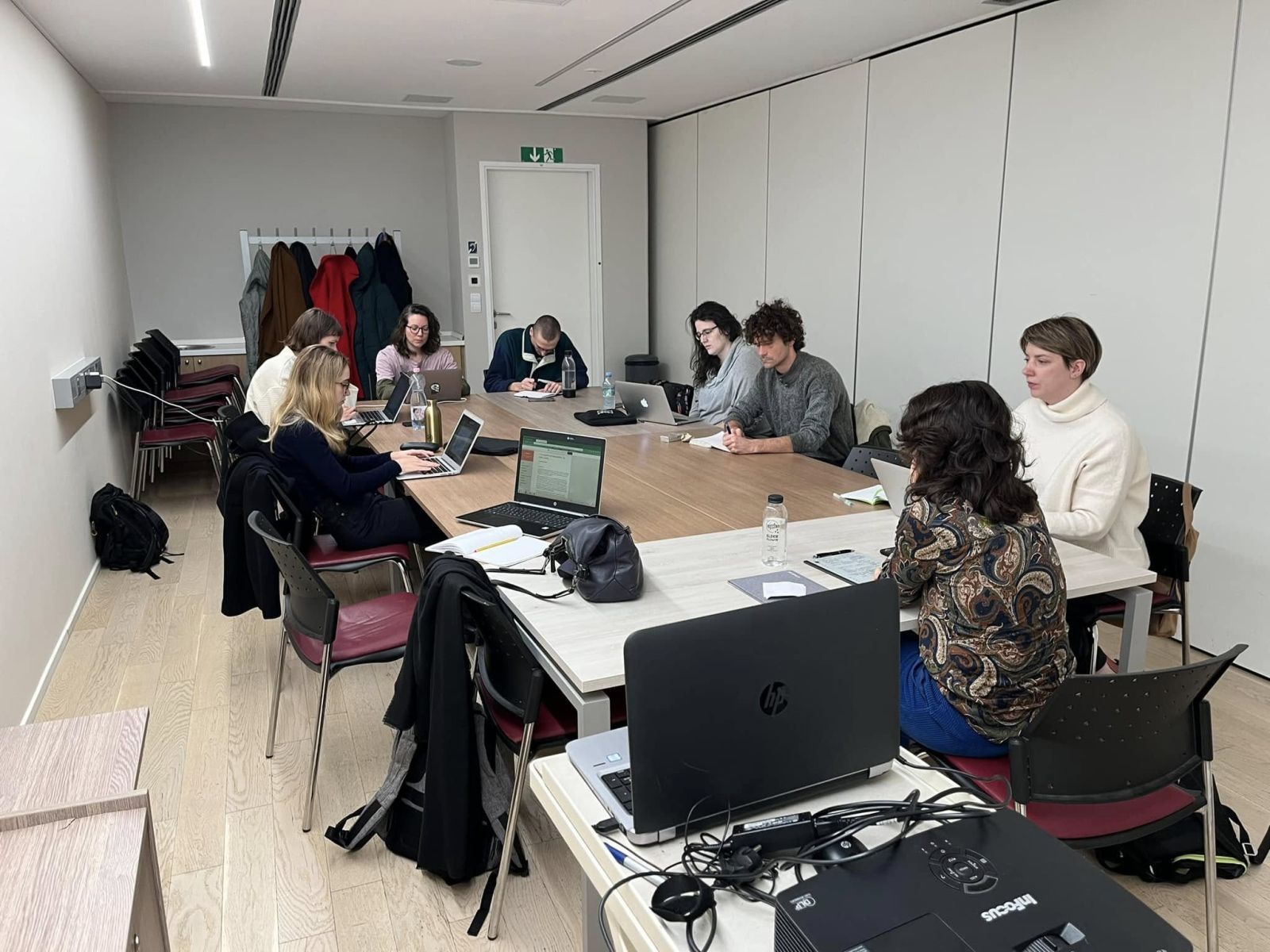 Dance Critics Residency – Drugajanje Festival – Celje, Slovenia – 11–15 Nov 2024
Beyond analysing the programme’s artistic and educational outcomes, the report also offers recommendations for the future development of dance criticism and critical discourse in Central and Eastern Europe. The full Final Report is available below for online reading.
A downloadable PDF version is available here: D10.1 Final Report (PDF)
Final Report about the Stipendium
Dance Critic’s Residencies and Stipend Programme
Beyond Front@: Bridging Periphery project
Author: Tamara Bračič Vidmar.
Programme Description
The Critic’s Residencies and Stipend Programme is part of the international project Beyond Front@: Bridging Periphery, implemented by partner organisations from Hungary, Slovenia, Croatia, Poland, Romania and Sweden with the aim of supporting the development of contemporary dance and its critical discourse in the region.
The Dance Critics Residencies and Stipend programme builds on three Dance Critics Residencies – five-day workshops held in three different partner countries, connected to partners’ artistic events. The first Critic’s Residency took place from 15 to 19 November 2023 in Budapest, Hungary, during the Sissi Autumn Dance Week (SŐT7) organised by Central Europe Dance Theatre. The second Critic’s Residency took place in Krakow, Poland from 19 to 23 September 2024, during the Rollercoaster artistic programme organised by Krakow Dance Theatre. The third Dance Critics Residency took place from 11 to 15 November 2024 during the Drugajanje Festival in Celje and Maribor, organised by Bunker.
The residencies combined historical, theoretical and practical approaches to dance criticism. Participants studied relevant literature, explored key moments in the history of contemporary dance, attended performances, took part in collective discussions and produced critical texts in both conventional and experimental formats. The programme was led by experienced critics, editors and mentors Pia Brezavšček, Ana Fazekaš, Joanna Leśnierowska, Bush Hartshorn and Alicja Müller.
Following the residencies, selected participants received the Critic’s Stipend, which enabled them to attend festivals and partner events in several countries within the Beyond Front@ network and to publish critical reflections on the works they encountered. In this way, the programme integrated education, practical experience, international mobility and professional networking, offering sustained support for emerging dance critics.
The critics receiving the Critic’s Stipend were Emese Szabó (Romania), Zuzanna Berendt (Poland), Emese Kovács (Hungary), Jaka Bombač (Slovenia), Ingeborg Zackariassen (Sweden) and Nora Čulić Matošić (Croatia).
They visited partner festivals and public artistic events organised within the framework of the Beyond Front@ project and wrote critical reflections on the programmes as a whole or on specific performances. The Critic’s Stipend is a one-year programme, during which the renowned dance critic, editor and mentor Pia Brezavšček accompanied the critics, discussed their critical reflections with them and supported the editing of their texts.
After completing the Critic’s Stipend programme, all participants shared feedback with the project partners. The following sections summarise the key outcomes and participants’ reflections.
Professional and Artistic Value
The programme provided participants with mentoring, resources and editorial support that strengthened their critical writing and professional confidence. Participants consistently described the programme as a rare and highly valuable professional opportunity, particularly due to the scope of international travel and the insight gained into different regional dance scenes.
“For any critic, such extensive travel and the equally rare opportunity to gain direct insight into the dance scenes of neighbouring countries made this fellowship a uniquely meaningful and invaluable professional experience.” — Emese Kovács
For some participants, the programme represented a rare opportunity to deepen their knowledge of dance history and criticism while situating their local scene within a broader regional context.
“My journey with the Beyond Front@ project started in September 2024 in Krakow with a week-long residency hosted by Krakow Dance Theatre. Alongside other fellow critics and colleagues, I enjoyed my time and learned a lot from our dear mentors Alicja Müller and Pia Brezavšček. This was one of the few opportunities I had since starting this journey to educate myself on the art of dance, its history and critical writing.” — Nora Čulić Matošić
At the same time, the programme enabled participants to reflect on developments in their own national contexts.
“In the last two years, I’ve witnessed a slight but important development on the Croatian dance scene with more visibility, fruitful productions and education towards more critical discourse.” — Nora Čulić Matošić
The diversity of artistic contexts encountered through the programme enabled participants to develop a broader understanding of contemporary dance practices across Central and Eastern Europe.
“Each destination offered different artistic experiences, and together they formed a picture of how independent dance is moving, surviving, and innovating across Central and Eastern Europe right now.” — Ingeborg Zackariassen
Contribution to Professional Development
The Critic’s Stipend had a significant impact on participants’ professional development. Several participants reported that the programme enabled them to strengthen or resume their work in dance criticism and to consolidate their theoretical and analytical skills.
“The programme unquestionably contributed to my professional development – more specifically, it enabled my return to the field of dance criticism.” — Emese Kovács
“Participating in the Beyond Front@ project during 2025 has been deeply valuable for my artistic and journalistic practice.” — Ingeborg Zackariassen
Participants also highlighted the long-term influence of the programme on their critical thinking and writing practices.
“This knowledge and experience I’ve conducted over the last year will most definitely influence my writing and critical thinking when it comes to dance.” — Nora Čulić Matošić
Quality of Mentoring and Educational Framework
The residency component of the programme was highlighted as a core strength. Participants valued both the methodological structure and the openness of the mentoring approach.
“From one, we learned to embrace the boundless freedom and artistic potential of critical writing; from the other, we absorbed the virtues of precision and thoroughness.” — Emese Kovács
“The workshop was extensive, but not one-dimensional, since it was thematically and methodologically diverse. It included various different formats of learning and encouraged us to use various critical perspectives not only on individual performances but also on the historical dance discourse.” — Jaka Bombač
In addition, the subsequent editorial support was perceived as particularly beneficial for long-term professional growth.
“The collaboration with editor Pia Brezavšček had a significant impact on my critical career. Her suggestions and insights helped me view dance from new perspectives, allowing me to express fresh critical voices in my writing.” — Emese Szabó
Participants emphasised that sustained editorial collaboration was one of the most valuable aspects of the stipend period.
“The most important part of the scholarship was working on my criticism writing with wonderful Pia Brezavšček. Her editing tips and comments helped me improve my writing and focus more deeply on the movement and performance as a whole, all while taking in the emotional aspects of the performances too.” — Nora Čulić Matošić
Depth of Artistic Engagement
A notable advantage of the programme was the possibility to follow selected works across different contexts and over time, allowing for more reflective and informed critical analysis.
“One major advantage of the Beyond Front@ programme was the chance to see the same performance multiple times, follow its evolution across different stages and contexts, and to reflect on it in depth.” — Emese Kovács
Networking and International Exchange
The stipend enabled participants to attend multiple international festivals and develop a nuanced understanding of regional dance practices. The programme facilitated professional encounters with artists, organisers and fellow critics, leading to the creation of new professional relationships and potential future collaborations.
“I met many interesting writers, dramaturges and critics with whom I will keep in touch or even collaborate in the future.” — Jaka Bombač
“The stipend made these trips possible at exactly the right moment for me. It allowed me to build real connections, follow artistic processes, and collect insights that will carry forward into both my writing and my curatorial work.” — Ingeborg Zackariassen
“My scholarship-related travels were preceded by my participation in a several-day residency for critics… For the first time, I had the opportunity to spend time with other peers focusing on how we write and how we can enrich our practice.” — Zuzanna Berendt
“Later, in Ljubljana, I participated in the Beyond School programme series… Thanks to the shared programme stages that followed, we eventually became friends, and similarly warm connections developed with fellow stipend holders, Ingeborg Zackariassen and Jaka Bombač as well.” — Emese Kovács
Participants also noted the value of observing interactions between local and international artistic communities.
“I loved seeing the local dancers and artists engaging with international guests and hearing their thoughts and opinions on Zagreb’s dance scene and infrastructure.” — Nora Čulić Matošić
Differences in audience engagement between contexts were also observed.
“The Sissi Dance Week festival had a diverse programme… but I found there was more audience interest in attending the performances and discussions after them.” — Nora Čulić Matošić
Exposure to Diverse Practices and Contexts
Participants reported that the programme introduced them to a wide range of dance styles, performance formats and institutional contexts.
“Being introduced to different points of view, different institutional contexts as well as to different aesthetics was a very valuable experience. The premieres that happened at various festivals were highly diverse: from a very modernistic performance, based on avant-garde notations, to a representational performance; from a structured improvisation to dance theatre and immersive performance.” — Jaka Bombač
“My first stop was in Ljubljana for the Beyond School event… it was interesting to see students’ presentations which all differed in style and aesthetics. It’s always nice to see how each country invests in dance, not only as part of culture, but as education too.” — Nora Čulić Matošić
The decentralised structure of some festivals was highlighted as particularly inspiring.
“I loved the latest edition of Drugajanje because of its versatile offer of performances and the focus on introducing Slovenian high schoolers to contemporary arts. I find the idea to host the festival in multiple cities across the country and not just the capital inspiring, as it works on decentralisation of art.” — Nora Čulić Matošić
“During this time, I attended three festivals, and my travels resulted in critical texts devoted to the performances I saw there… I consider this residency to have been a very important experience for me as a dance critic.” — Zuzanna Berendt
Areas for Improvement and Participant Suggestions
While overall feedback was strongly positive, participants also identified areas where the programme could be further strengthened.
Participants noted that informal networking opportunities were unevenly distributed across events. Structured moments of social interaction, such as facilitated introductions or organised informal gatherings, were perceived as particularly helpful and could be
implemented more consistently. It was suggested that clearer integration of critics into postperformance events and social programmes could enhance professional exchange and visibility.
Some participants observed that the intensity and duration of international travel posed challenges when combined with existing professional and personal responsibilities. It was suggested that future editions might consider prioritising even younger participants or those with greater scheduling flexibility, or alternatively adjusting the programme structure to reduce logistical pressure.
“Several participants struggled to align the often week-long international travel with their everyday responsibilities, which at times resulted in cancellations or last-minute changes.” — Emese Kovács
Participants reported that writing and editing processes sometimes took longer than anticipated, affecting the immediacy of published criticism. Clearer deadlines and additional editorial checkpoints were suggested as possible ways to improve continuity and relevance.
Conclusion
The Critic’s Stipend programme has proven to be a highly effective tool for supporting the development of emerging dance critics and for strengthening transnational exchange in the field of contemporary dance. It offers a comprehensive framework combining education, practice, mobility and professional networking.
“I had the privilege of taking part in a rich and rewarding programme that offered a broad perspective on the region’s dance landscape.” — Emese Kovács
The programme not only supports individual professional trajectories but also contributes to a broader regional discourse on contemporary dance. It has also contributed to sustainability and continuity in the field of dance criticism, providing a model for combining mentorship, mobility and publication opportunities. With minor structural adjustments and continued support, the Critic’s Residency and Stipend programme has strong potential to further shape the cultural landscape of contemporary dance in Central and Eastern Europe.
You can also read the complete reports by the participating critics:
- Report by Emese Szabó
- Report from recipient of Critic’s Stipend as a part of the Critic’s Residency programme by Zuzanna Berendt
- Feedback on the Beyond Front@ Project and Stipend Experience by Ingeborg Zackariassen
- Beyond Front@ – Stipend for young critics report by Emese Kovács
- Beyond Front@: Bridging Peripheries, report on dance critics scholarship by Nora Čulić Matošić
- A short general report from the Critics’ Residency by Jaka Bombač

