
Author: Nora Čulić Matošić.
Even though it premiered more than a year ago (November 2024), the first time I’ve seen All’arme was in May this year (2025) as part of the 42nd Dance Week Festival in Zagreb. The piece was choreographed by Ginerva Panzetti and Enrico Ticconi and is produced by Studio Contemporary Dance Company (SSP) that’s based in Zagreb. After the first viewing, I was absolutely transfixed by the piece as a whole – from the dynamic performances by the all-female ensemble to hypnotising music by Hrvoje Nikšić and light design by Tomislav Maglečić. Deciding to write about this piece was a no-brainer, as was the choice to see it two more times – once in Istrian National Theatre in Pula in September and once more in Zagreb’s Dance Centre where I’ve seen it the first time too.
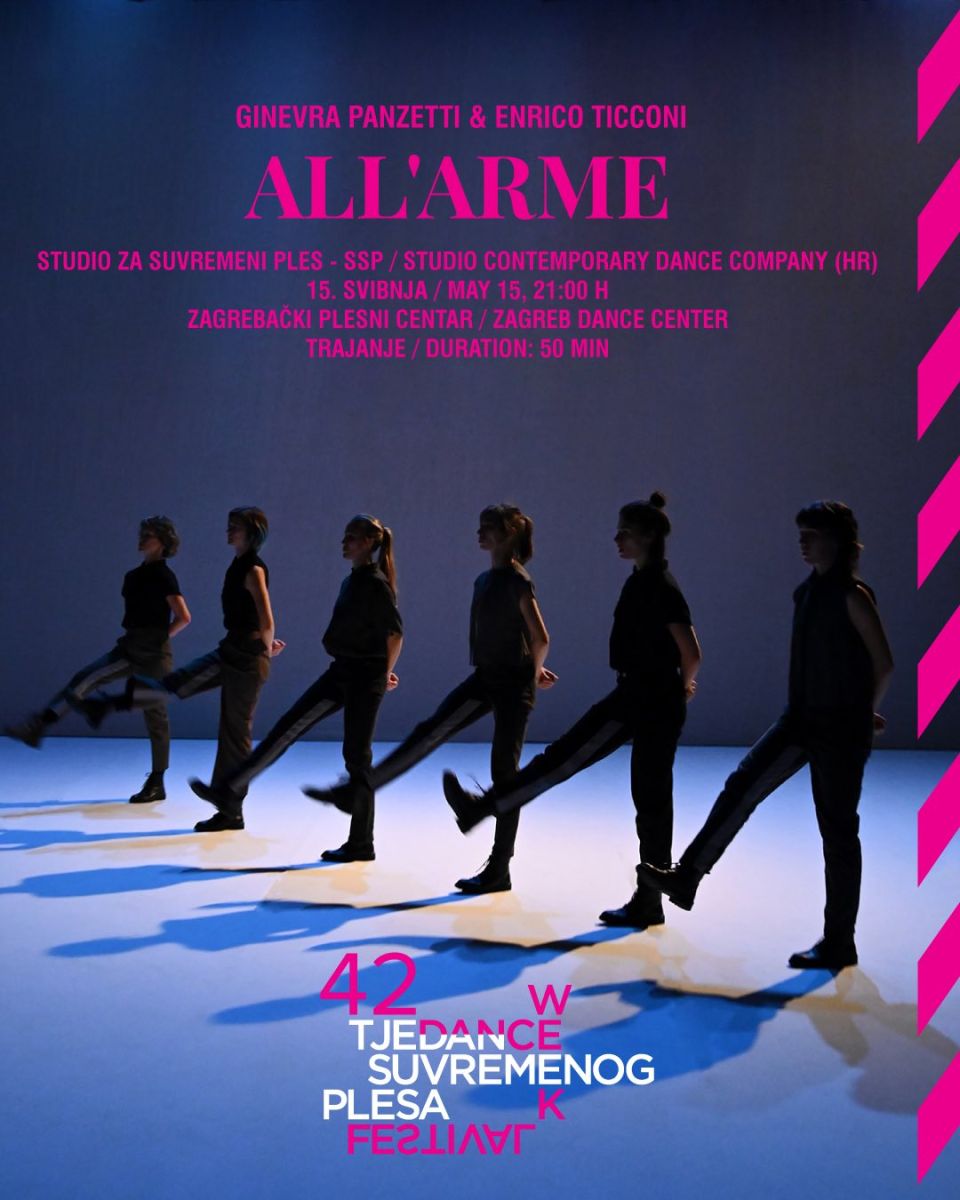
The title comes from the Italian expression ‘all’arme’ from which the word ‘alarm’ originates, and it’s literal meaning translates ‘to arms!’ – a cry of warning of an imminent danger, as it is explained in the play’s flyer. The piece effectively explores the thin line between the motivation for arming: is it really about defence or offence? Also, the masterful choreography by Panzetti and Ticconi is such a well-crafted study on ‘horde law’, a term that originally derives from Sigmund Freud’s theory of ‘primal horde’ from Totem and Taboo. Here, I want to use the ‘horde law’ to describe this social phenomenon in which the individual can be easily taken by the collective’s aggression towards the ‘common enemy’. I believe this can still be seen nowadays, especially since the beginning of the war in Ukraine, where many countries put more founding in the army and weapons. This is very interesting in context of Croatia where the current government plans to bring the mandatory compulsory military service back, starting from the first quarter of 2026. Therefore, All’arme is a perfect artistic and, in a way, anthropologic illustration of military behaviour and mentality, with an additional gender aspect as all of the dancers are female as mentioned before.
The ensemble consists of six dancers from the SSP company: Martina Tomić, Ida Jolić (who I’ve seen on my third watch) in alternation with Ema Crnić, Viktoria Bubalo, Marta Krešić, Filipa Bavčević and Nastasja Štefanić-Kralj. Although all of them wear uniform dark grey costumes with small variations by Tina Spahija, it was interesting to compare their appearances and bodies in terms of femininity and masculinity in the context of military posture. This is not to say that their body types or appearances influenced their performance, but more the impression of how masculinity, or even more curiously androgyny, plays part in how the dancer’s individual expression transfers into strict, unified, strong movement all of them had to channel.
The performance begins with lights off with what sounds like water running down the pipes in the background, slowly building the tension. Shortly after, a small light appears on the top of the auditorium, behind the audience. It’s coming from the small flashlight one of the dancers is holding in her hand. She carefully checks the stage, illuminating every bit of her way and knocking on walls and the white linoleum floor set on stage. Soon after, the other dancers join in inspecting the space, looking very focused in their action of checking the safety or searching for something. As the music slightly shifts to a white noise with rhythmic thuds, the choreography becomes more organized; dancers start to move in straightforward lines in duets, trios and even quartets, making it look like chess pieces that move by strict rules. The first part of the choreography has almost a mathematical logic to it, in the sense of chess like movement and constant rhythm of an army march. This impression continues when the dancers start to walk in circles as a group in unison, their hands changing their positions slowly and precisely while looking directly at the audience. Their face expressions are cold, focused, serious and controlled like their movements are, it was at times scary to look directly into their eyes. It’s becoming more hypnotising as the music becomes louder and it now sounds like marching or a beating heart.
However, there are many moments when the strict military posture breaks and the choreography takes a different turn. The lights are gradually dimmed and the dancers gather in a tight circle, with one of them in the middle. The one that is in the middle unzips their top, revealing a white t-shirt under it which emphasised with the flashlights from the other dancers and the UV light over them. This is done for each of the six dancers and every time it’s the same sequence: the one in the middle looks tired or maybe even on her deathbed, while the other look at her with fear and worry. These brief moments of intense fear for a comrade’s life works like an ominous threat that soldiers face, a shadow of peril cast over their life and safety. The small breach of white colour most likely signifies surrender as does the white flag in combat, but this is perhaps a more personal surrender of one’s life to a never-ending cycle of violence and war every participant will experience.
Other glitches in the army-like choreography include several more different sequences, like displaying fear and despair on their faces that they try to cover with their palms, but still continue to march in strict rhythm. There are also other moments in which one of them is singled out, when they can’t keep up with the marching and fall down in pain on their knees or in a fetus position. During these moments, the others show support and worry for their fallen colleague and try to help her get up. The light switches its colour from yellow to blue then back to yellow again with blue on the white fabric in the background. Finally, all of the dancers get in a single line on the proscenium, marching in place and making grimaces of sorrow and shame to the audience while doing what looks like a version of a ‘roman salute’. The music speeds up again, now accompanied with the sounds of a mob and it made my skin crawl with terror.
The rest of the sequences that ‘disturb’ the well-constructed score aren’t motivated by fear or insecurity but aggression and excitement. After the previously described scene that made me terrified, the dancers slightly move from a horizontal to a diagonal line and start to bow continuously. This movement grows with music that is shifting to a metal sound and they begin to head-bang in the rhythm until the formation totally breaks. One of them (Bavčević) falls to the ground and watches the rest of her ensemble who are now jumping all around the stage and banging their heads, some even letting their hairs down that were kept in an up-do. She watches in fear as her colleagues are taken by the madness of the upcoming war, displaying the feeling of helplessness against a strongly formed collective.
At last, the sound of an alarm is played, the lights are changing from red to orange in a slow pace, signalling danger. The dancers have calmed down too, their pace is slower now and they stand dignified until the choreography lightly descends to chaos again. Firstly, they are doing the two-step and following its rhythm with jazz hands and accenting the rhythm with their hips. Then, the two-step turns into simple tap dance steps, their arms are simultaneously raised in the air with their feet stomping and it looks like a celebratory ritual or an initiation. The movement is now very militant and masculine, particularly when they are hitting their chest with their arms, inviting the spectator to come at them and showing readiness to fight the opponent. In the midst of this, Bubalo does an impressive tap dance solo in the middle of the semi-circle the others have formed. At first, the others are approving of this short skilful bit, but quickly grow tired of it and form an even tighter circle around her, threatening her with stern looks and close firm stance.
The ensemble repeats the marching again but this time the movement is not so strict and firm, the dancers are now snapping their fingers and look like they are enjoying the rhythm. In pairs, they hold hands and spin around with one of their arms lifted, which was reminiscent of folk dances that again, emotes a notion of ritual. Unlike the previous mention of ritual in a sort of celebratory context, strength and aggression come into focus now. The music speeds up and we can hear the sound of determined cries which will later turn to the sound of a whip. This scene was also left a strong impression of me as now the violence shifts from outside to inside, between the dancers as the dominant movement becomes hard leg kicks in the direction of the other dancers that are on the ground. Again, they alternate in-between the offence and defence. While on the ground, they show struggle to get up and pain when the other’s legs kick on the beat of the whip. The omnipresence of aggression, even amongst the fellow comrades, emphasizes the cruelty that runs deep in militant structures which is often excused as a method to ‘toughen-up’ when in reality, it’s about taking our anger out on the weakest, including our close circle.
The performance comes to an end with a cabaret-like movement; the militant strict emotionless masculine posture switches to a more feminine, performative and expressive body language that at first seems like fun, but in fact conceals a more sinister, almost psychotic-like apathetic mentality. The emotions and expressiveness that was repressed at first, now comes out and brings more horror than the army tip-toe march that dominated the choreography. All’arme managed to precisely capture the ‘evolution’ of aggression in militant structures and the ambiguity of defence. It might not be show and exact moment when defence turns to offence, but it perfectly captures the slippery slope of the militant rhetoric.
This text was written by Nora Čulić Matošić within the framework of the Beyond Front@: Bridging Periphery project.

