
Author: Ingeborg Zackariassen.
Sissi was the nickname of Empress Elisabeth of Austria, who became the Queen of Hungary in 1867. A festival named after a monarch, albeit an eccentric one, carries a hierarchical logic that sits uneasily with the precarious, often anti-monumental realities of contemporary choreographers – perhaps particularly at the present moment, as the independent dance scene is struggling more than ever.1.
The opening of the 14th edition of the festival coincided with Bethlen Square Theater’s re-opening its doors to the public after an extensive renovation.
Instead, the audience stepped into a venue of visible stress rather than a welcoming art space. With the theater still in a state of assembly, the opening lacked a sense of arrival. Importantly, no red carpet or royal gestures are needed for the audience to feel welcome, but some simple social elements – like an operational bar and some music in the foyer area – could have shifted the atmosphere from provisional to intentional.2.
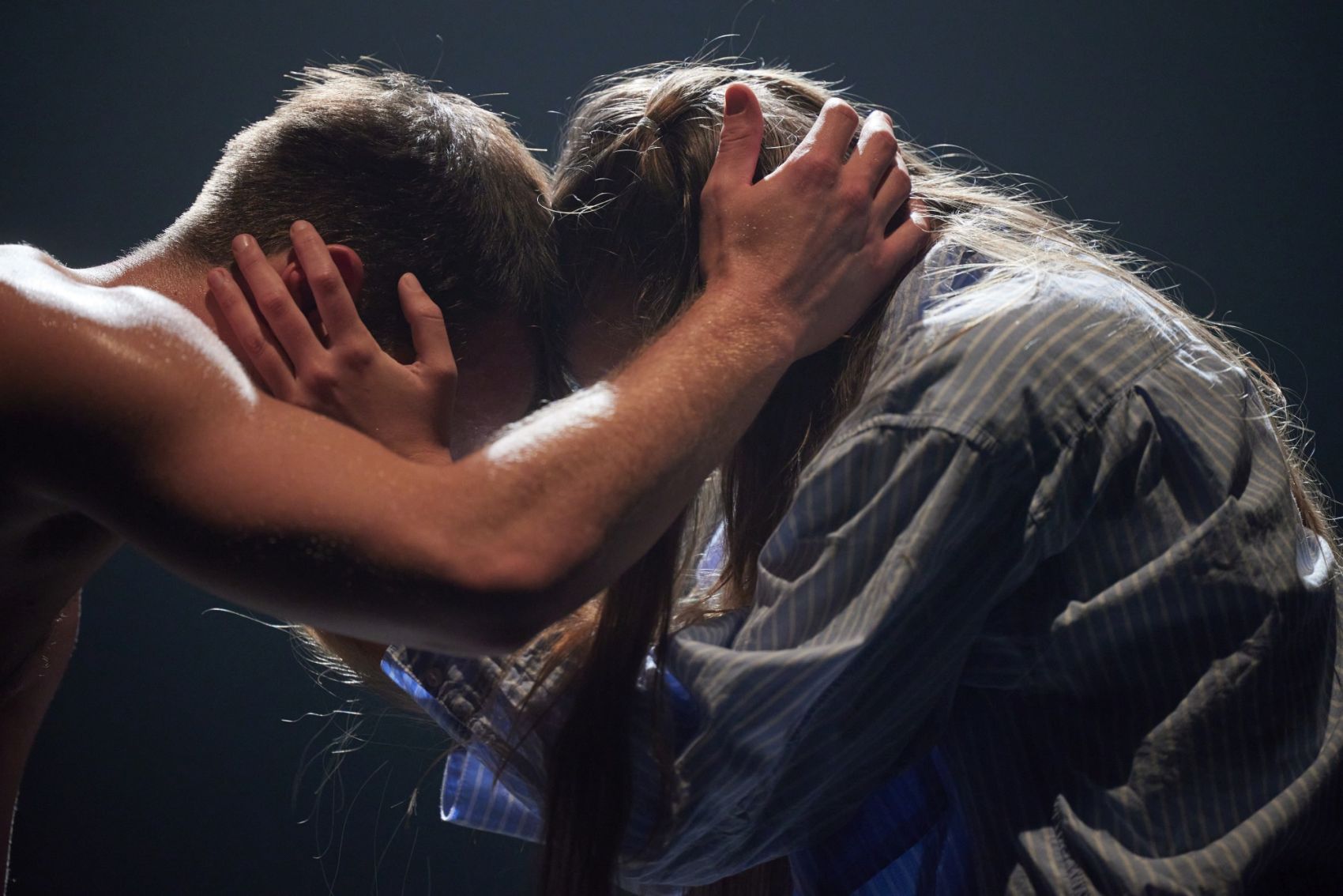 DancEUA – Choreo Sync by Central Europe Dance Theatre – Budapest, Hungary – 14 Nov 2025. Photo by Gábor Dusa
The opening night consisted of a lengthy collage of ten works by emerging choreographers from five different countries.3. Performed by the highly skilled dancers of Central Europe Dance Theatre, several of the choreographies demonstrated clear potential. Presented back to back, however, the accumulation of short works produced a confusing and ultimately exhausting encounter.
Although transitions were introduced to bridge the pieces, each segment retained the logic of a stand-alone work. Framed collectively as a single collage, the format could not fully resolve the fact that these choreographies were neither developed together nor conceived in relation to one another.
What could – and should – have been the project’s core, the artistic process, was reduced to only a few days of studio time with the dancers. This clearly limits opportunities for ideas to be tested, revised, or meaningfully embodied.
Emerging choreographers do not benefit from opportunities that replicate scarcity at a higher level; they require conditions that allow them to challenge and develop their ideas in sustained dialogue with the performers.
The decision to involve so many choreographers in a single collaged work prioritised breadth over depth. Especially in contexts of limited funding, a more responsible curatorial approach is to invest in process.
Trial and error, time in the studio, and sustained collaboration with dancers are the conditions under which contemporary choreography becomes professional practice rather than symbolic inclusion.
Notably, the aftertalk did not include any of the choreographers or dancers involved in the project, but focused solely on the project’s mentor, Márton Csuzi, who collaged the works and shaped their transitions – a curatorial choice that further reinforced a hierarchical approach to authorship.4.
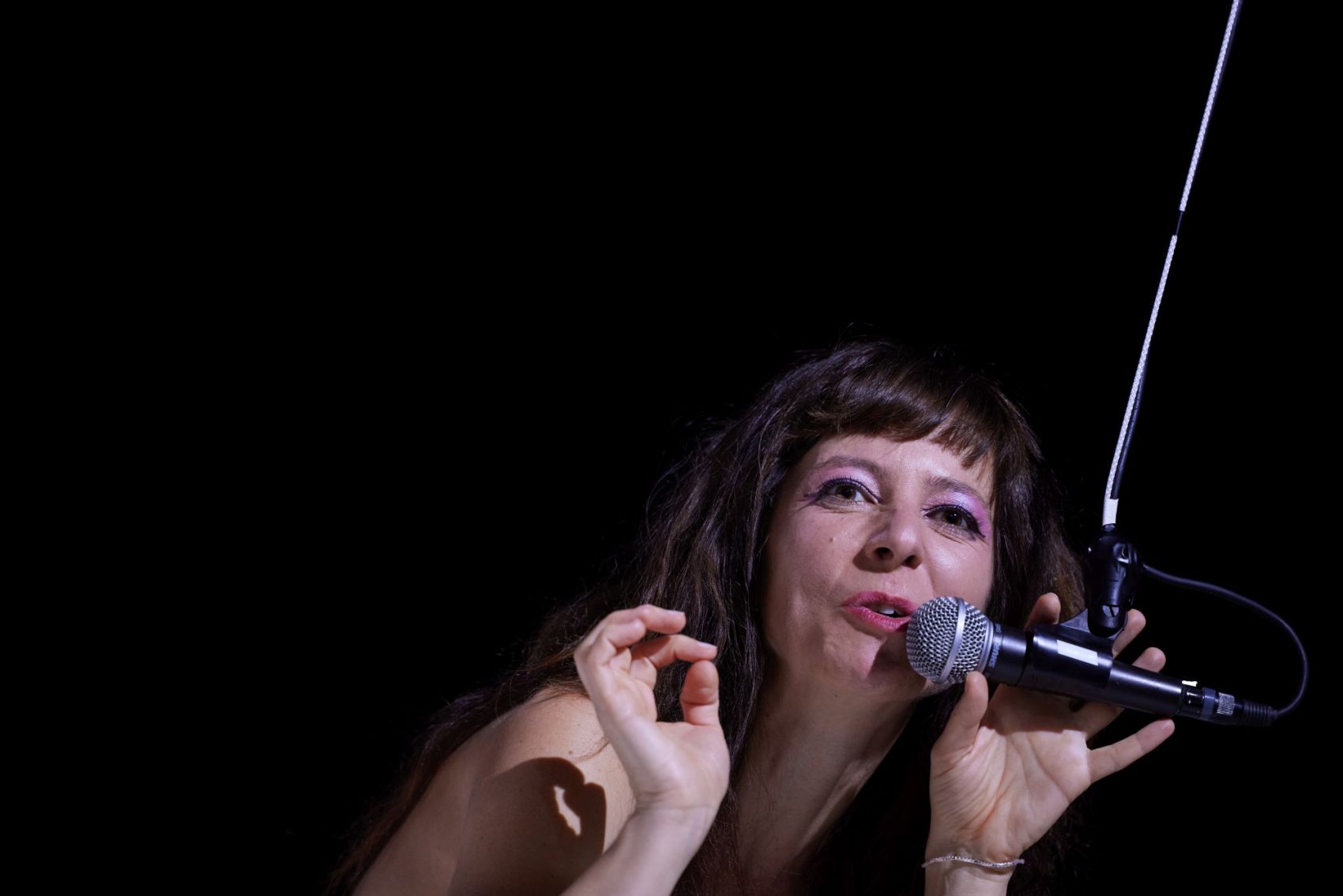 Dirty Dancing by M Studio (chor. Eryk Makohon) – Budapest, Hungary – 16 Nov 2025. Photo by Gábor Dusa
Eryk Makohon’s Dirty Dancing starts with a bang, moving abruptly from zero to full volume. Big hair and heavy metal collide with bourgeois silk dresses and shiny jackets, oscillating between cringe aesthetics and full-blown comedy.
The performers inhabit their stereotyped characters with precision, while Eszter Nagy stands at the centre as the self-proclaimed star and unmistakable gravitational force of the work. Her charisma– at once knowing and deadpan – recalls the mock authority of comedian Diane Morgan’s Philomena Cunk, transposed into a headbanging, rock-and-roll register.
Thoroughly entertaining, the work clearly appeals to a broad demographic. That the show is banned for teenagers raises questions about whether disproportionate moral responsibility is placed on the performing arts, particularly within a media landscape saturated with far less self-aware, uncensored material.
At the same time, the performance demands a certain degree of complexity, reflection, and maturity from its audience. This is especially evident when it provocatively flirts with the romanticisation of sexual violence, staged through the voice of a feminist-coded protagonist whose desire is framed as knowingly transgressive rather than naïve. As the work progresses, it increasingly embraces absurdity: death itself becomes a fantasised state, rendered through references to dance theatre and operatic excess, delivered with tongue-in-cheek theatricality.
Laughter flows, but at times it catches in the throat. The discomfort produced, and the shifting dramaturgical dynamic between stage and audience, reminds me of the precarious logic of stand-up comedy – where humour and provocation always risk misfiring. In this case, the persistent use of self-mockery frames critique in advance, leaving open the question of whether risk is genuinely invited, or carefully managed.
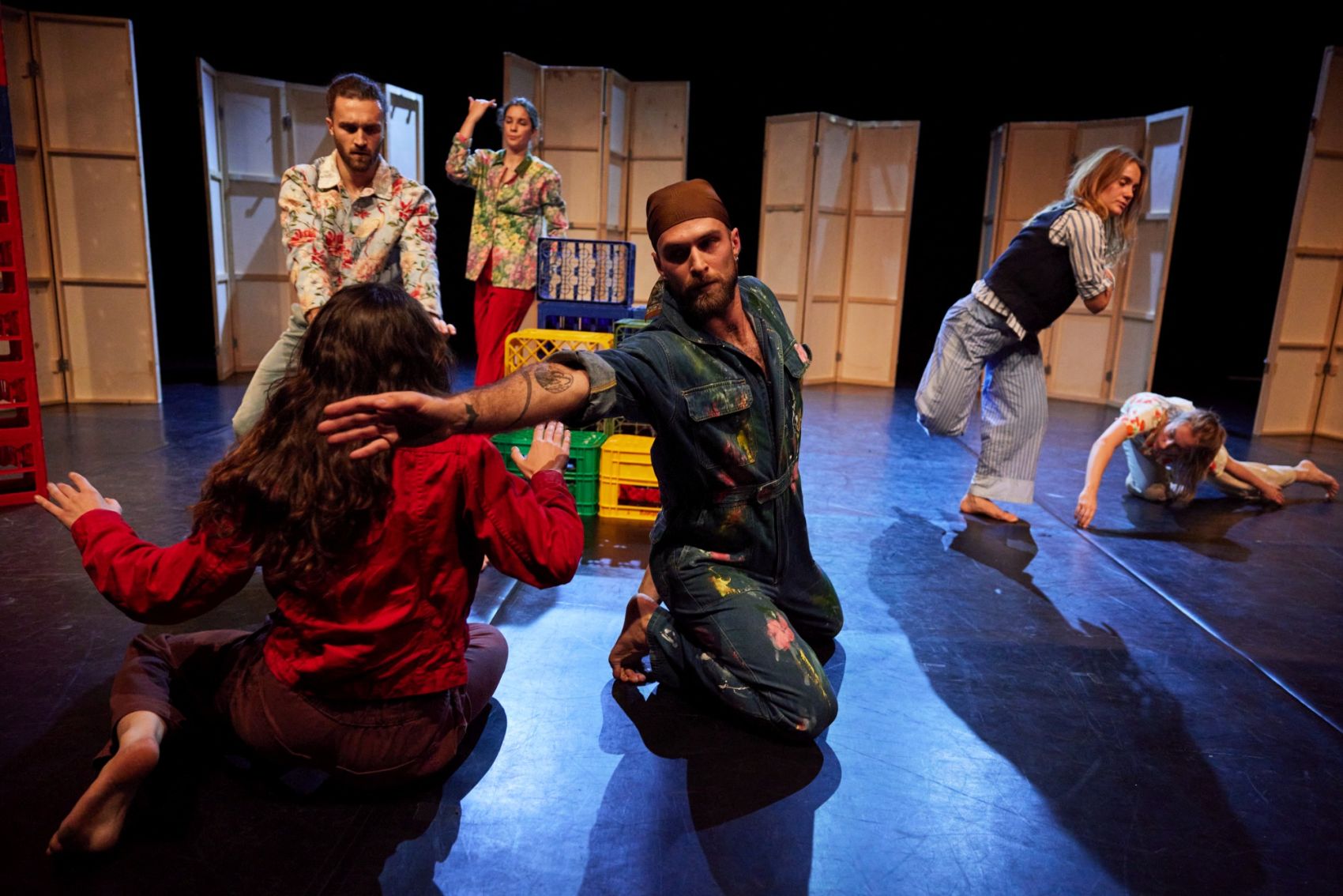 Nowhere Like Here (chor. Francesco Scavetta) – Budapest, Hungary – 18 Nov 2025. Photo by Gábor Dusa
Francesco Scavetta’s Nowhere Like Here unfolds within a scenography marked by a childlike naïvety, a harmony soon disturbed by references to political division – creating a deliberate dissonance between familiarity and exclusion.
Colourful beer crates function as modular building blocks, while small figurines are included as performers. A wind-up toy is sent in, holding a sign reading Keep out, a balloon is released with the warning Turn back now, and trash bags are thrown onto the stage from the other side of the divide – creating suggestive visual markers within the colorful lego-like landscape.
When the performers enter, they initially appear less as autonomous figures than as extensions of the scenography itself – enlarged figurines in curtain-like costumes, positioned between objecthood and presence. Later, when the dancers address the audience directly, they extend a verbal welcome that includes difference and deviation, belief and desire, articulated as an explicitly inclusive gesture.
Despite multiple changes in atmosphere and landscape – at times resembling the building and demolishing of communities – the dancers remain rather deadpan throughout, leaving the question of human affect deliberately open.
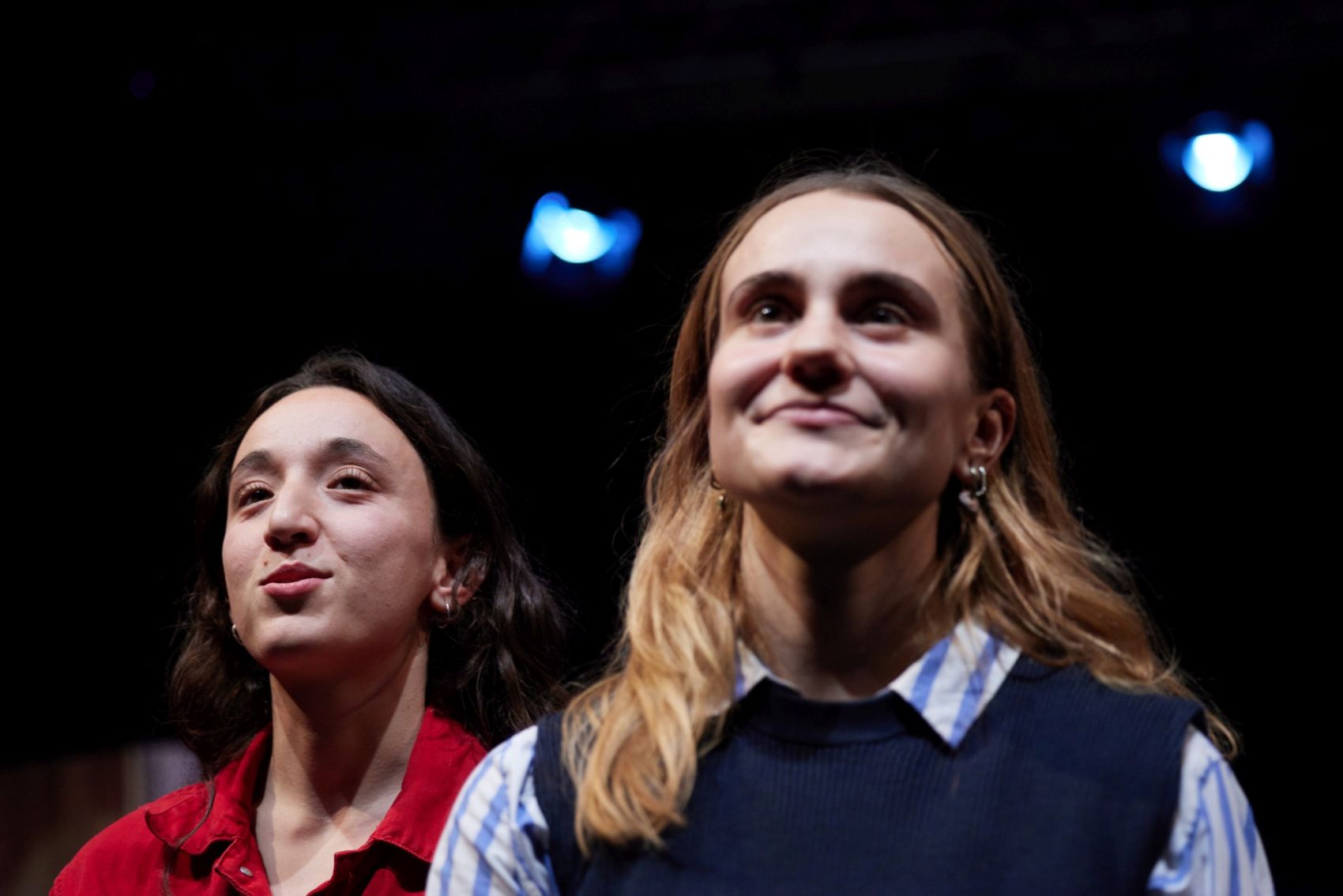 Nowhere Like Here (chor. Francesco Scavetta) – Budapest, Hungary – 18 Nov 2025. Photo by Gábor Dusa
Some audience members are invited onto the stage while a storyteller reveals a childhood memory – of trauma and indifference, of distance and time – later re-mediated through a stop-motion film projected onto the wall.
The piece concludes with the construction of a house, into which the performers retreat, reappearing on screen via live stream as they look back at the audience. The final image proposes questions of proximity and separation without resolving them.
Makohon and Scavetta are serious makers whose practices are grounded in long-term research and sustained collaboration with performers. Positioned within the festival, their works form a clear counterpoint to the compressed timelines offered to emerging artists – demonstrating how international exchange can operate through duration, continuity, and trust.
If Sissi Dance Week is to become more than a showcase of institutional partnerships, it will need to rethink how time, labour, and authorship are distributed. Supporting emerging artists is not a matter of quantity, but of conditions.
This text was written by Ingeborg Zackariassen within the framework of the Beyond Front@: Bridging Periphery project, which is co-funded by the European Union. Views and opinions expressed are however those of the author(s) only and do not necessarily reflect those of the European Union or the European Education and Culture Executive Agency (EACEA). Neither the European Union nor EACEA can be held responsible for them.
—
1 Editor’s note: The festival is named after Empress Elisabeth of Austria – popularly known as Sissi – not arbitrarily: Bethlen Square Theatre, which hosts the event, is located in Budapest’s 7th district, Erzsébetváros, itself named after the queen, and the festival is held each year around her name day in mid-November.
2 Editor’s note: The unusual atmosphere at the opening stemmed from the theatre’s ongoing renovations; the venue was still in a state of assembly, which affected the sense of arrival and overall experience, rather than reflecting the festival’s organization.
3 Editor’s note: As part of the DancEUA Creative Europe project (2024–2027), the Choreo Sync international residency program provided ten young choreographers – from Ukraine, Sweden, Croatia, Hungary, and Romania – with the opportunity to create short dance compositions through intensive collaboration with mentors and the dancers of Central Europe Dance Theatre. The choreographers of the Choreo Sync etudes were Daria Hordiichuk (Ukraine), Tetiana Znamerovska (Ukraine), Anna Borrás Picó (Sweden), Julia Ekvold (Sweden), Toni Flego (Croatia), Sofija Milic (Croatia), Réka Gyevnár (Hungary), Noémi Piller (Hungary), Dávid Dabóczi (Romania), and Vanda Stefanescu (Romania).
4 Editor’s note: The aftertalk’s exclusive focus on Márton Csuzi resulted from the other participants being unable to attend, not from a conscious curatorial hierarchy.

