
Author: Emese Kovács.
Life’s cycle never truly halts, and there’s little way to escape the grip of social pressure and embeddedness — at least, that’s what Maciej Kuźmiński’s dance performance, created for the Central Europe Dance Theatre (CEDT) in Budapest, seems to express. Although this review was initially intended to focus on the pre-premiere in Krakow (and subsequently Ljubljana), I find it necessary to address the final version and the choreographic adjustments made along the way. Having seen Four Seasons four times — from its rehearsal stage to the official premiere in Budapest — I have been able to closely observe the piece’s development.
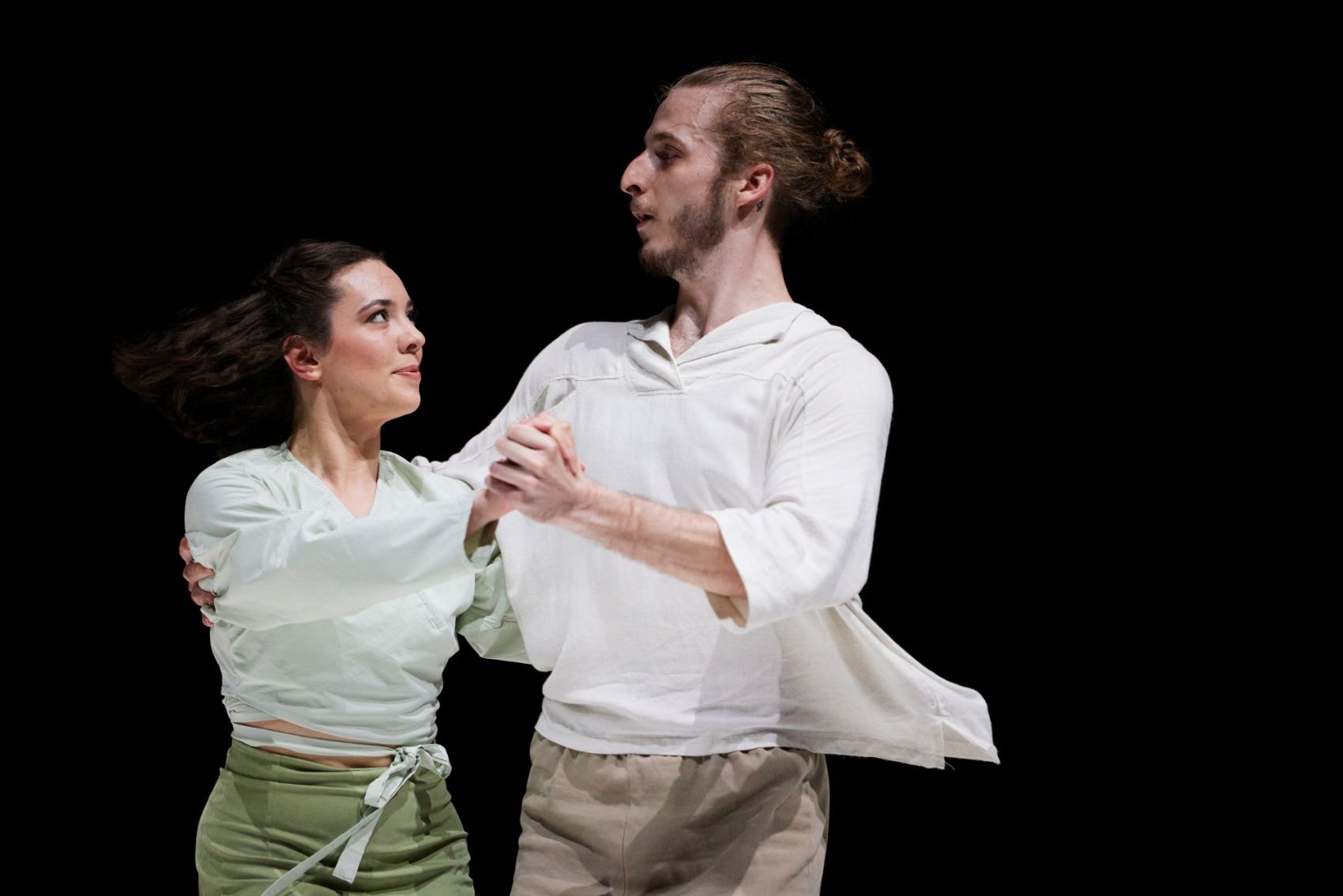 Four Seasons – CEDT (chor. Maciej Kuźmiński) – Budapest, Hungary – 24 Apr 2025. Photo by Gábor Dusa
Four Seasons is a co-production under the auspices of the Beyond Front@ project, which aims to bring together contemporary dance creators, dancers, dance students, writers and other professionals from the Central and Eastern European region with a view to possible successful collaborations. Even if not every professional encounter leads to direct collaboration, the regular opportunities to reconnect are themselves a significant outcome of this project. Beyond facilitating ongoing dialogue among participants, the format also enables repeated viewings of the same production — an essential condition for deeper critical engagement and a more layered understanding of the work. In the case at hand, the choreographer is Polish, known for his active presence across Europe as both a creator and educator, the dancers are Hungarian, and that is how I had the opportunity to attend the near-premiere in Krakow as a dance critic. I have been following CEDT for many years, but this was the first time I had encountered Maciej Kuźmiński‘s creative work. CEDT is a modern dance technique-based ensemble − one of the very few stable dance companies in Budapest − where the dancers usually perform rather aesthetic and fixed movements, there is little room for error, for difference, for otherness, for experimentation. However, I am pleased to see how much the company, based on more traditional foundations, has opened up in recent years, for example by regularly inviting foreign guest choreographers, supporting young artists and creating opportunities for less conventional collaborations and events.
In this particular instance, I had the unique opportunity to see the open rehearsal of the performance two weeks before the ‘pre-premiere’ in Krakow. I enthusiastically welcomed the fresh idea of an open rehearsal, which is a win-win for the audience and the creator (the aim was not hidden: to get feedback from the volunteers, both professional and civic, who attended), but most of all for the company itself, which is brought closer to its audience by this gesture. Then, in the rehearsal room of the SÍN Cultural Centre in Budapest, I was able to watch a movement flow performed in a tracksuit, which required a lot of physical energy and concentration. I was captivated by the spatial structure of the performance, the ease with which one shape transformed into something else, the way the dancers glided amongst each other, bringing to life a well-coordinated collective before my eyes. I saw them not as individuals, but as humanity, as society. Collective destinies, well-known human epochs appeared in front of my eyes. The cycle of the four seasons was represented as the stages of human life, and although the theme is quite general, the performance managed to transcend clichés thanks to the creative − fixed and well rehearsed − movement material. The frequent unisons, group movements, the above-mentioned coordinated changes of space, and the complete disregard for individual characters (and personality) made the dancers a unified mass. I thought that it was a choreographic decision that the individuals were so invisible in this performance, because of this human destiny, proclaimed as collective, and the social roles that could only be avoided bitterly (and with resistance).
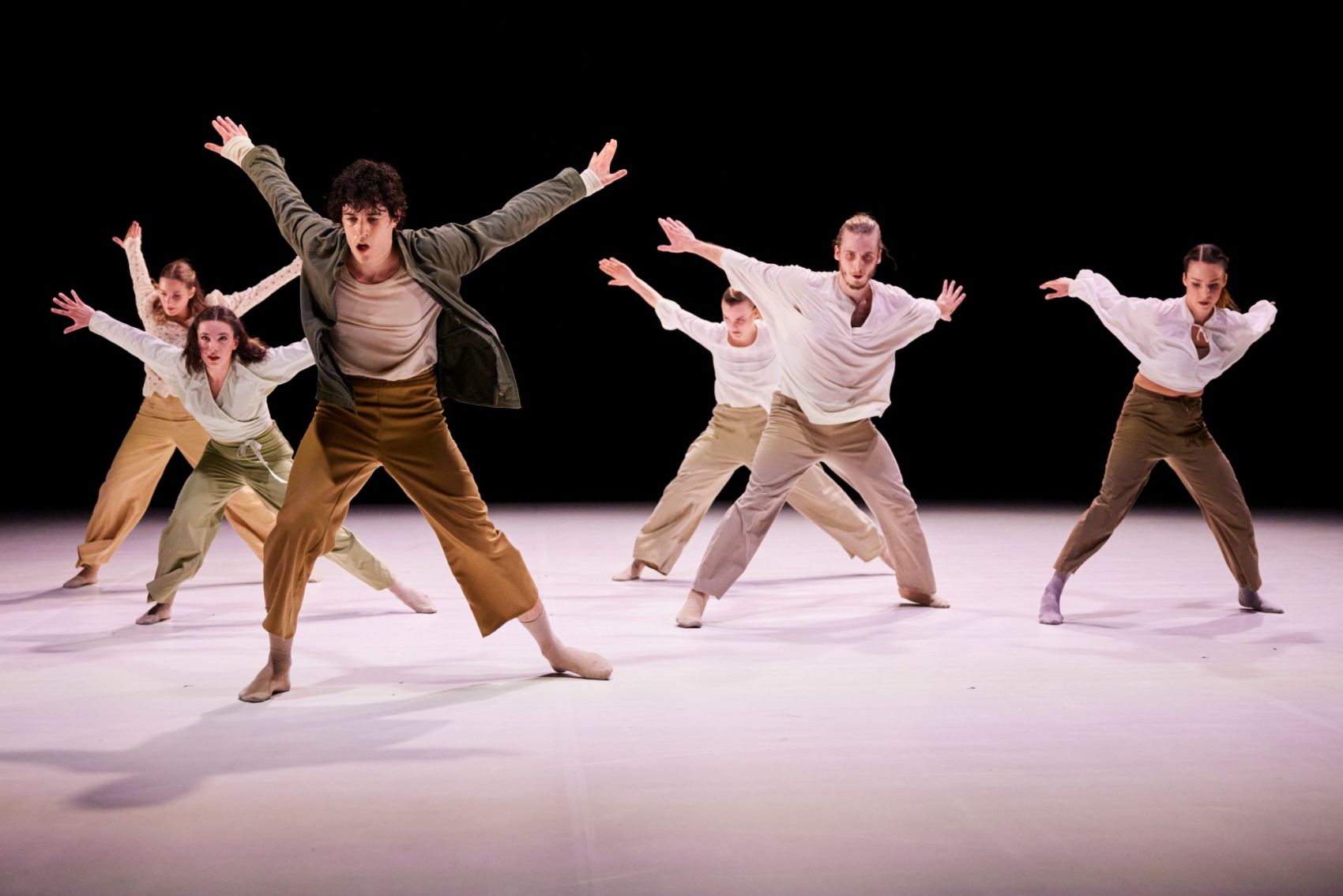 Four Seasons – CEDT (chor. Maciej Kuźmiński) – Budapest, Hungary – 24 Apr 2025. Photo by Gábor Dusa
I had not only access to the rehearsal itself, but also witnessed the conversations that took place after that. During the discussion, it was raised by the audience that what we were witnessing was like some kind of shared tribal ritual, a celebration of life, a hypnotic cycle, a repetitive whirl of gestures. Although we mostly talked about the positives, we also noted that we wished the framed structure had been omitted, and that the never-ending circularity, guided by a more powerful force than us (nature, life), was presented in a less didactic way. I added that, speaking of collective human destiny and the stages of our existence, I missed the representation of winter, and with it the slowing down, melancholy, loneliness, passing and death. And most of all: silence.
I was curious to see what they would incorporate from our feedback, whether our opinions would influence it, how much the performance would change over the two (and then more) weeks, and what extra content the costumes − created by the costume design students of Moholy-Nagy University of Art and Design in Budapest − would add to the movement. During the conversation, I found that Kuźmiński strives for clarity, clearly identifiable stages and meanings, in addition to talking about dance as a philosophy of movement. He didn’t seem to want unnecessary juxtaposition, he wanted non-professional viewers to be able to travel easily with the choreography. He has now taken on a more abstract theme and a pure dance expression, following his earlier works with a more political, complex theatrical language and larger sets, such as those related to war or the refugee crisis in Ukraine. His work was supported by Lili Stern as dramaturg, who here seemingly subordinated herself to Kuźmiński’s creative vision and has set her sights on public accessibility.
The performance begins in the spring, when human life is still ‘budding’, ‘growing’, ‘sprouting’. The semi-naked Marcell Hován’s near-ground solo, full of meticulous muscle games and isolations, is an effective opening scene, we see the man thrown into the ‘world’, as he awakens to consciousness, then more and more courageously breaks away from the ground, which provides security − and is covered with an intimate light show imitating interlocking ‘branches’, still vaguely staged at the pre-premieres, but nicely elaborated at the premiere in Budapest. The other dancers − clad in body-coloured underwear and barefoot − soon join his quality of movement, their bodies slowly opening out from their crouching positions near the ground, their arms reaching out like tendrils, undulating into space as they venture higher and higher. The organic, isolation-playing movement quality of the spring suits them all, their sprawling tendrils fill the space, breathing life into it, they become one with the undulation of the movements, their focus, their gaze is more inward, natural. Suddenly, a dancer in a puffy blouse and sand-coloured long trousers (Réka Gyevnár) appears, who immediately turns towards us, the audience, with a gesture that foreshadows her distinguished role from the others.
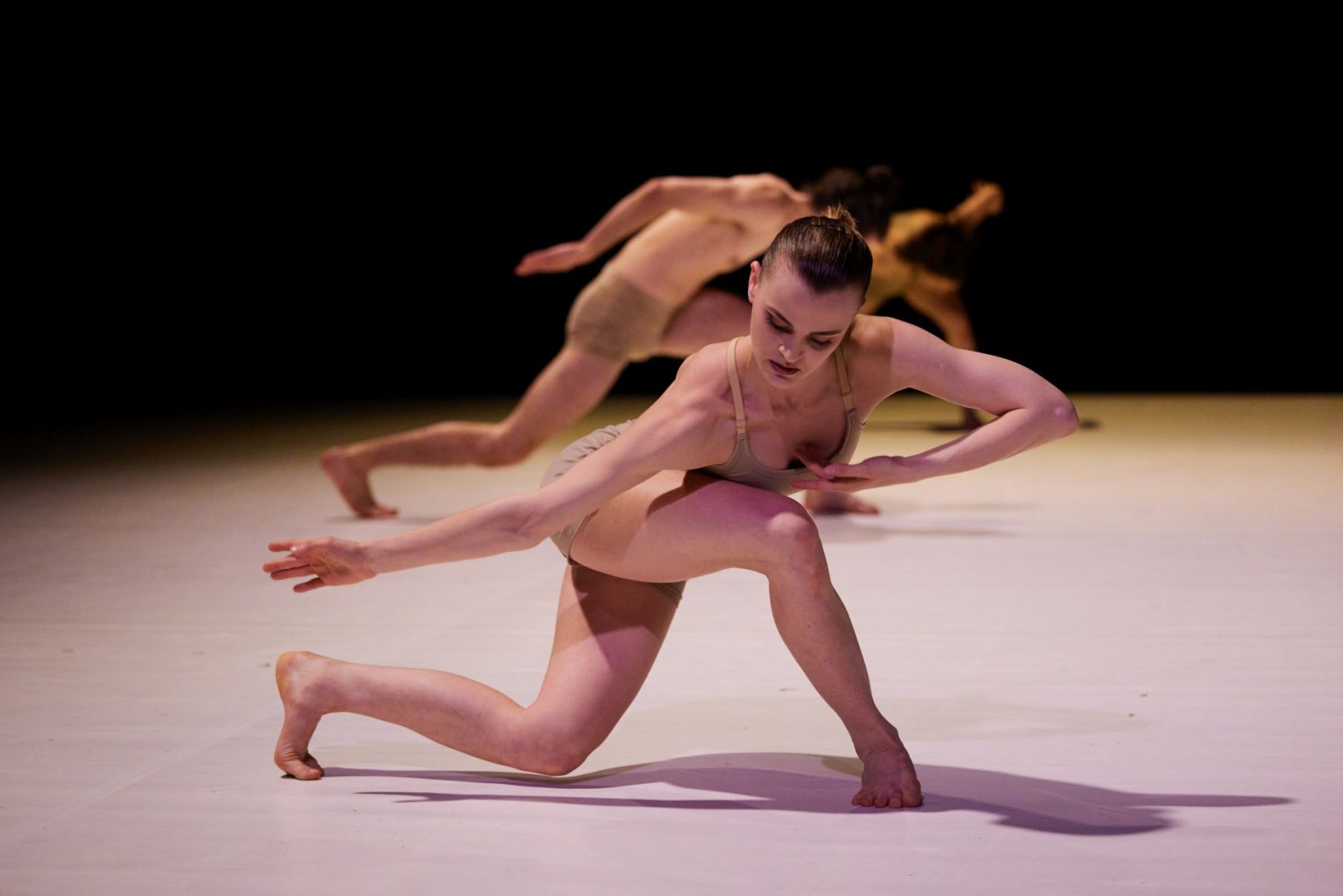 Four Seasons – CEDT (chor. Maciej Kuźmiński) – Budapest, Hungary – 24 Apr 2025. Photo by Gábor Dusa
For the upcoming summer scene, they all change into similar light tops, linen trousers in beige-brownish-pastel green colors and socks. While the clothes probably represent the social conventions and roles we assume after a carefree, free youth, the puffy sleeves, lighter, stiffer fabrics and less-flattering lines don’t breathe with the dancers’ movements, sometimes giving their bodies an unnecessary distortion. Here, the choreographer has drawn on Hungarian folk dance steps, inspired by the Hungarian dance house (táncház) movement. From a dramaturgical point of view, I find the use of traditional and very social, human invented movement language after the movement imitating nature of plants ill-considered. Until now, the dancers have become one with the sprawling movements, and now they are dancing facing outwards, showing off for us. For example, we see a girl duo dancing, in a liberated performance by Lídia Sinka and Gizella Noémi Nagy, which is replaced at the premiere by a more conventional heterosexual couple interpreted by Nagy and Edmond Kisbakonyi. The dancers do cifra steps, intertwine in a circle dance, woop, raise their arms, which are sometimes clenched into fists, sometimes pointing upwards. They play with motifs, exaggerate accents and shapes, and the steps sometimes lean toward funk and street dance. This is a refreshing and exciting approach and reimagining of folk dance, which can become truly relevant in a contemporary dance performance through such free rethinking and experimentation. Although, my eyes could do with even more of these shifts to achieve the desired effect and move beyond the traditional forms.
Their faces remain neutral at the two pre-premieres with only an occasional forced smile, but I attribute the stiffer presence to the concentrated premiere pressure and the movement sequences that require a lot of concentration. At the real premiere, the dancers try to put on a more cheerful face, and Gábor Kindl’ s clownish grin seems even too much compared to the others. There are not many direct connections between the dancers in the piece, one such moment is in the summer part, where two dancers at the back right of the stage seem to simulate an ‘erotic intercourse’ (at the premiere, these are the same two dancers who were just spinning together): they intertwine again, then lean on their arms and push their pelvises towards the sky, touching and strutting. At the pre-premieres, this image disappeared in the space and looked sloppy and contrived; at the premiere, the light helps them, but their ’emergence’ does not add to the play’s message, even though it underlines their dramatic selection of the couple from the crowd.
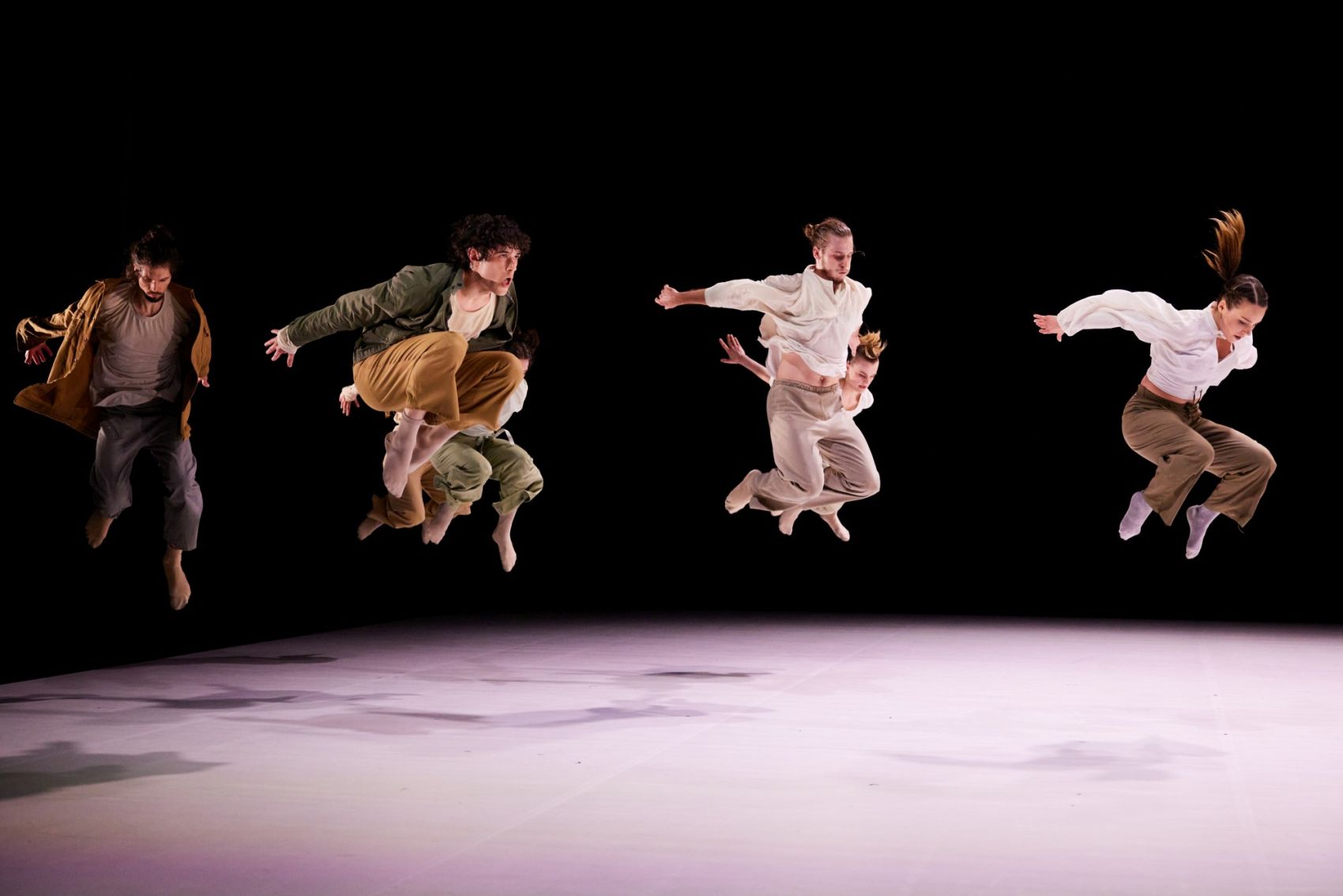 Four Seasons – CEDT (chor. Maciej Kuźmiński) – Budapest, Hungary – 24 Apr 2025. Photo by Gábor Dusa
As one might expect, autumn and mature adulthood follows, the longest phase of the performance, where the ‘reaping’, ‘mowing’, ‘harvesting’ and ‘collecting’ movements of the arms are emphasised, interspersed with much rotation. The sequences of movements are done repetitively, building up little by little from near-ground sweeping movements, becoming increasingly complex. I like this kind of cleverly organised minimalist choreography, when I feel that the choreographer is not trying to squeeze everything into a single scene, and is not forcing spectacular movements. It’s hypnotic, whether I’m watching from close up or from a distance (I deliberately changed perspective each time I watched the performance). At the same time, the non-stop whirl and repetitive movements also allow space for us as spectators to sometimes completely unwind, to reflect on our own lives, our own efforts, our own achievements. I did this so well at the Ljubljana performance that I didn’t even notice one of the dancers’ trousers ripping in the middle.
Kuźmiński’s handling of spatial forms is superb, the dancers transform almost imperceptibly from one shape to another as they perform the recurring, back-and-forth, reduced-language movement patterns in space, abruptly changing directions, like a well-functioning, professional machine. There is no stopping, the dancers go their appointed way. That’s why one of the most beautiful moments of the whole performance stands out from this constant march: the tall Hován suddenly picks up one of the dancers, Berta Pucsek, and holding her in his arms, they stand motionless while the others pass by. For me, this is the climax of the performance: the real physical connection in all the passing by, the immobility in the incessant movement, stirs and touches me, and becomes a profound and meaningful moment. But it lasts only for a few seconds, and then they, too, are swept along by the choreography. However, at the premiere Kuźmiński expanded this scene to three couples, but unfortunately with this decision the magic of the intimate moment was completely lost.
As I mentioned during the SÍN rehearsals, for me, winter would be brought to life on stage by a similar silence and stillness, or even by the next scene, which was already in earlier versions but has become much more emphasized and longer for the premiere: the dancers just stand in different places on the stage, looking in different directions, waiting motionless. It is a beautiful, intimate moment that allows the audience to immerse themselves in their emotions and thoughts. According to my initial expectations, this could symbolize older age, the approach of passing, taking a review of one’s life, letting go and winter as a season of long nights, cold silence, and waiting to be spring again, but the dancers soon dress in long black coats, which confuses me: perhaps it is not the previous stillness, but rather this that signifies the transition to winter? Kisbakonyi steps into the center of the stage, and around him, four dancers begin their intense, unstoppable combinations again. They are leaping up and down, squeezing every last breath out of themselves. Sweat drips from their foreheads. I was left with a personal sense that something was missing — though it may well be that the choreographer deliberately chose to highlight the continuity of life rather than its end, emphasizing the eternal cycle and the arrival of a new generation rather than closure or finality.
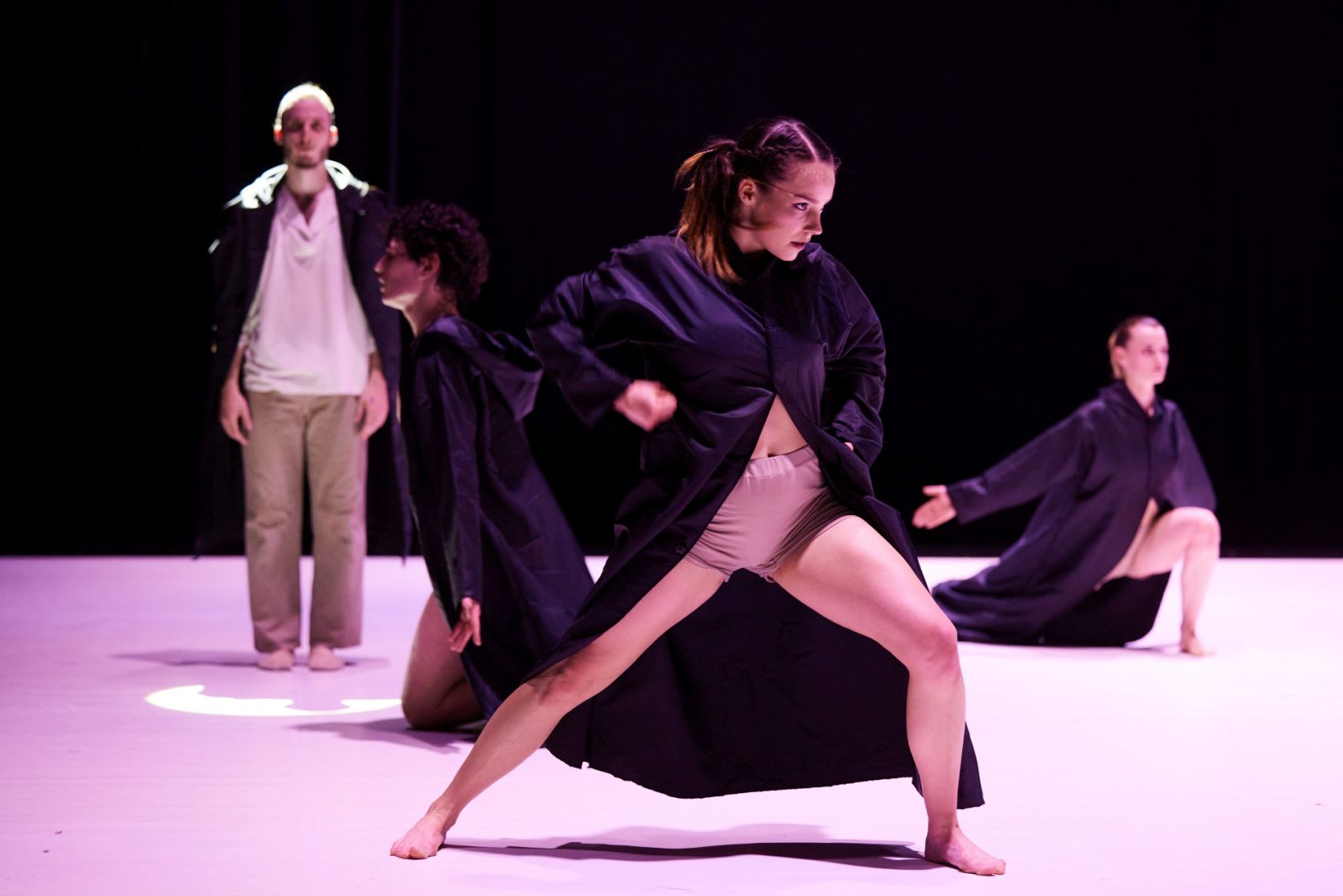 Four Seasons – CEDT (chor. Maciej Kuźmiński) – Budapest, Hungary – 24 Apr 2025. Photo by Gábor Dusa
Not only does the movement never stop, but the monotone, minimalist electronic music — possibly reminiscent of Steve Reich, though the composer is unnamed — swirls just as much throughout the performance, adding some barely noticeable darker tones as we near the end of the piece. There is no need for Vivaldi’s classical violin concerto cycle, the soundscape perfectly contributes to the sense of infinite circularity, and in itself would be enough to emphasise that it is about the circle of existence, which, seen from a distance, is like a great collective ride of tiny identical figures.
For the premiere, the choreographer has made a strong intervention in the final scenes of the performance. At first viewing, I was puzzled and couldn’t quite place Gyevnár’s suddenly feminine character, walking with stylish confidence in her long brown, sackcloth robe looking dress. The dancer steps forward in the space, standing out from the others, tiptoeing, looking ahead, her legs stretched out, her hands exuding elegance. Her serious, almost goddess-like presence draws the eye. I later learn that the inspiration for Gyevnár’s character is indeed a mythical Slavic goddess of life, the Earth Mother, Živa. Our feedback after the rehearsal seems to have been listened to to some extent by the choreographer: at the pre-premieres Gyevnár danced a ‘mother-daughter’ duet with protective, enveloping wings performed with Pucsek, with lots of symmetry. Only a shorter version of this was left for the premiere, performed with the ‘chosen’ female character, Nagy. In the first versions, Pucsek then repeated Hován’s opening solo, thus locking the performance into a framed structure, which was already criticised after the rehearsal in SÍN. Although Nagy also repeats a couple of movements of the solo at the premiere, the sequence is much shorter and less centralised. Then Gyevnár raises her arms to humble the others, now clad in their body-coloured underwear again, who lie around her, bowing before (goddess of) fate that controls their lives.
The lighting design, crafted by Mercédesz Selmeczi together with Kuźmiński, deserves special mention for its subtlety and dramaturgical precision — a notable evolution from the simplified version presented during the pre-premieres. It is meticulous, precise, a veritable repository of possibilities, beautifully accentuating scenes with bluish or warm yellowish hues and creating a strong atmosphere, even if I sometimes feel it is almost too spectacular, reminding me that it was in the rehearsal room, in the natural sunlight − and in rehearsal clothes − that I could best concentrate on and get involved in the whirl of movements.
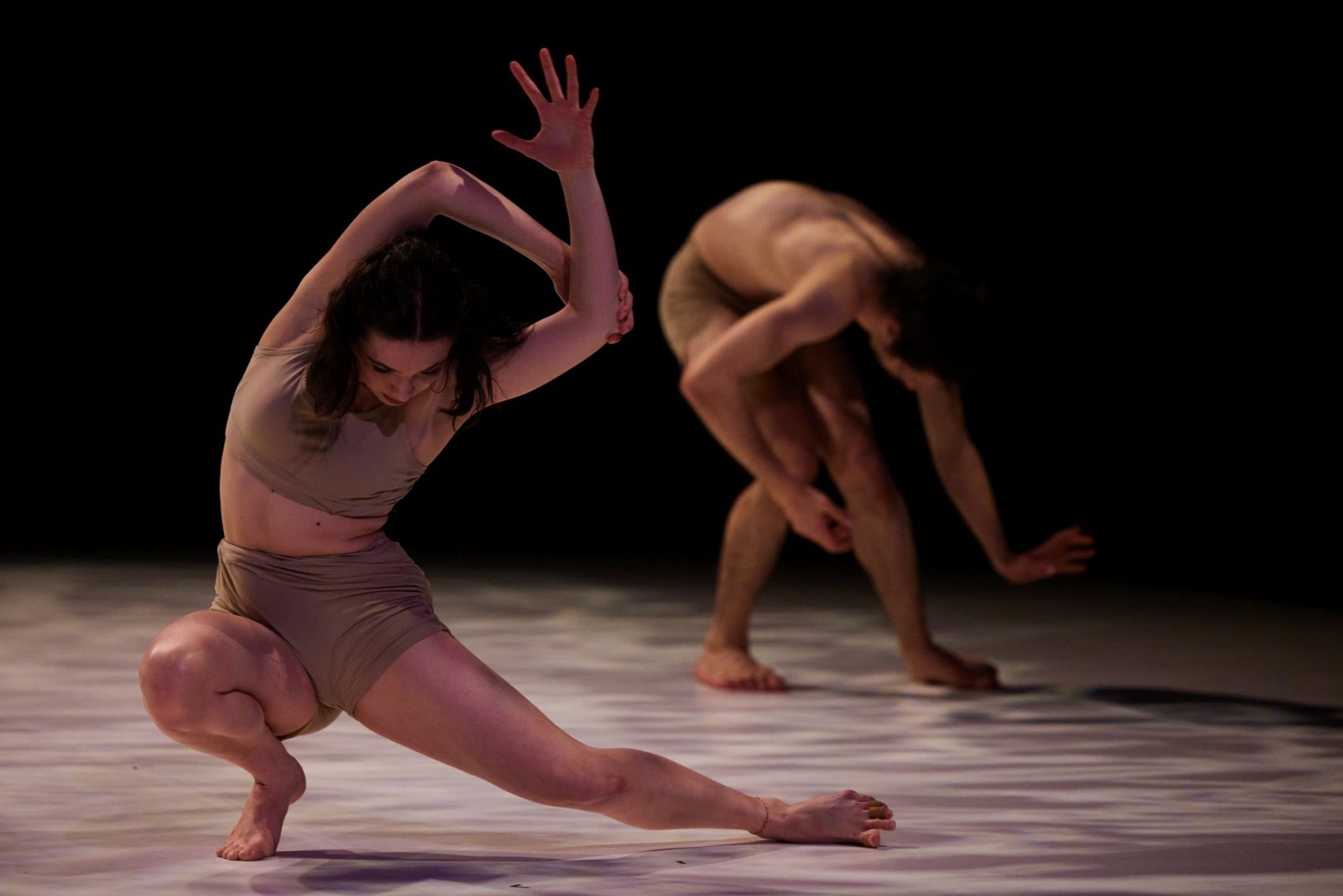 Four Seasons – CEDT (chor. Maciej Kuźmiński) – Budapest, Hungary – 24 Apr 2025. Photo by Gábor Dusa
As it turns out, seeing the final premiere in Budapest fundamentally altered my perspective — certain impressions I formed earlier no longer hold, underscoring just how much the piece evolved in its final staging. There is nothing inherently problematic about a performance evolving through multiple stages — even in front of an audience — and, as noted earlier, I greatly appreciate CEDT’s commitment to a dynamic and exploratory creative process. What I do find more concerning, both as a critic and as a member of the audience, is the way the Krakow performance was presented on several platforms as a full premiere, with no indication that it was a pre-premiere or a work-in-progress. Similarly, the Ljubljana presentation was not framed as a pre-premiere either. Yet if the work undergoes such substantial transformation by the time of its ‘official’ premiere, one must ask: to what extent is it meaningful — or even fair — to critically assess its earlier iterations as if they were complete? But on the other hand, is it ever possible for a piece to be completely finished?
This text was written by Emese Kovács within the framework of the Beyond Front@: Bridging Periphery project.

