
Author: Ingeborg Zackariassen.
Arriving in Zagreb in May meant stepping straight into the overlap of two collaborating festivals: Balkan Moves and Dance Week Festival. Packed audiences testified to a strong public appetite for dance—people simply couldn’t get enough of the festival atmosphere. Although several strong works were presented, the overall curation at times felt scattered—both because of the distance between venues and in terms of the selection. While the performers showed full commitment to each choreographic vision, some curatorial choices left question marks. In sharp contrast to the weaker works, it was pure joy to experience Jonathan Burrows and Matteo Fargion’s “Rewriting” and “The Unison Piece” – presented back-to-back – works that stood out as beautifully crafted pieces by two artistic heavyweights: intelligent, charming and funny – a no-nonsense testament to long-term collaboration, practice, and insistence.
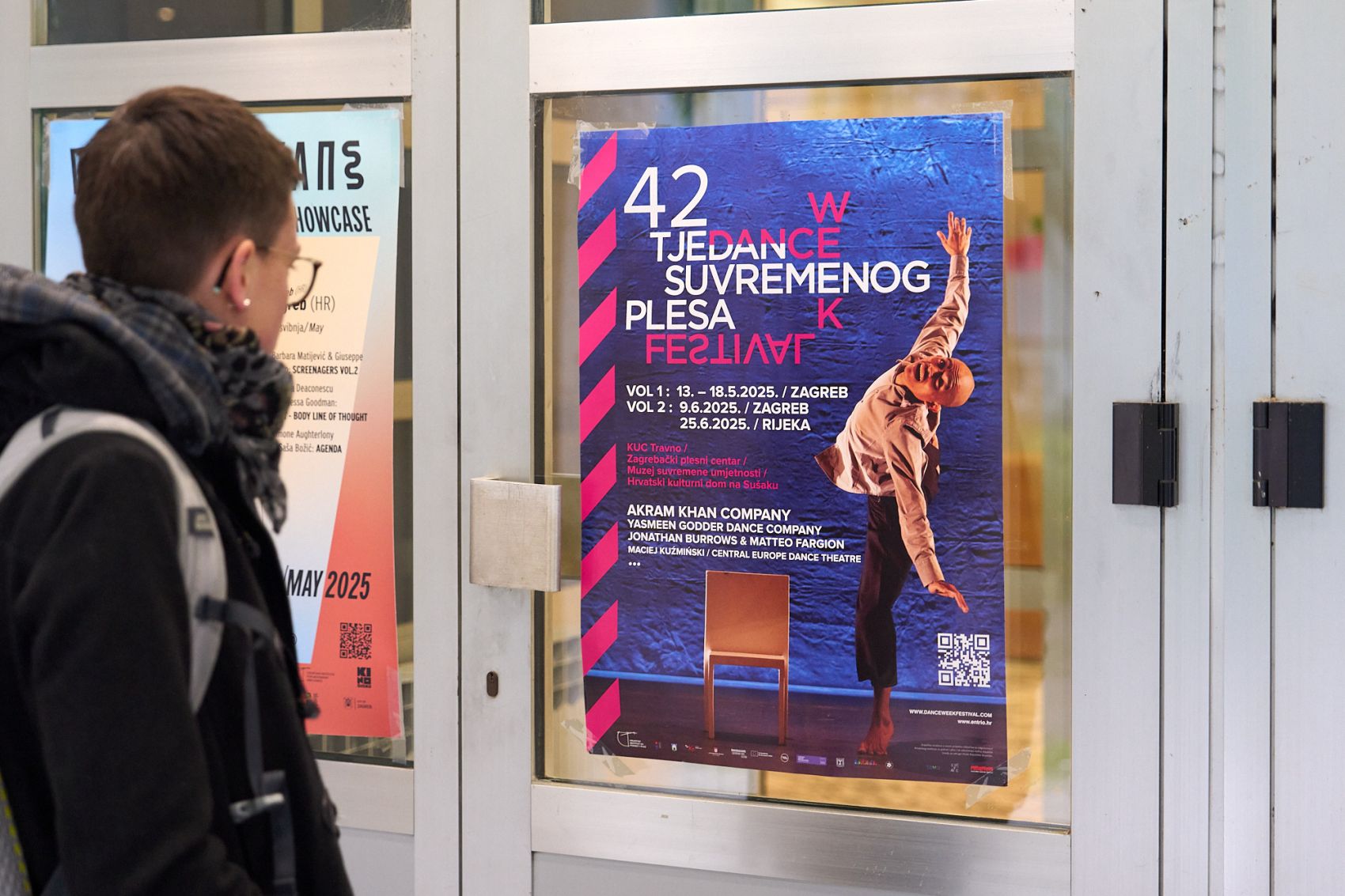 Zagreb Dance Week Festival, Croatia – 15 May 2025. Photo by Sindri Uču
Performances unfolded across two contrasting venues. In Novi Zagreb–Istok lies Travno, one of Croatia’s most densely populated districts, dominated by the country’s largest apartment building, Mamutica. Beside it sits the Travno Cultural Center. Founded in 1972 and modernised in 2007, its 276-seat auditorium feels like an unexpected art oasis among residential blocks.
The other venue, Zagreb Dance Center, opened in 2009 in Gornji Grad–Medveščak (Upper Town). As the first city-owned building in Croatia designed specifically for dance, it nestles in a backyard off Ilica Street, surrounded by shops and restaurants. Watching people flock to both spaces left a strong impression: Zagreb clearly holds space – and appetite – for art and culture. Perhaps it’s a sign there’s room for even more consistent year-round programming to balance the city’s commercial focus.
“Screenagers vol. 2” – Giuseppe Chico & Barbara Matijević
A surprisingly charming one-woman show in which the creator-performer builds her own “bubble”: a local internet to which the audience connects with their phones. The writing is sharp, Matijević genuinely funny, and the piece never feels forced.
One highlight is the audience’s attempt to collectively play Super Mario. The chaotic button-mashing exposes the difficulty of cooperation, as Mario – despite everyone’s best efforts – keeps falling between two blocks.
As a fellow Xennial (that micro-generation between Gen X and Millennials), I recognise Matjević’ playfulness with the internet: growing up without it, yet adapting to it in formative young-adult years. Singing about our human impulses—our need to search, belong, and capture meaning—she projects familiar images: sunsets, tourists posing with monuments, beach feet, a baby’s tiny hand. Uniqueness collapses into repetition—circles back and a becomes a moving image of human strivings. Here; Brian Eno’s Oblique Strategies comes to mind: Repetition is a form of change.
“BLOT – Body Line of Thought” – Simona Deaconescu & Vanessa Goodman
Tightly composed from numbers, facts, and repetitive movement, BLOT is a hybrid—part academic lecture, part art installation, part humanoid-robotics convention. As quoted from the performance: “The human body is a fiction we perform.” But there are no robots here. Performers Simona Dabija and Maria Luiza Dimulescu command the space. With deadpan expressions and rigorously choreographed gestures, their bodies are entirely exposed save for microphone packs taped to their arms. Salt slowly trickles down from a bag above the stage, creating a pyramid on the floor. One of the performers takes a camera and zooms in on a petri-dish on stage. In these simple images, poetry meets science. What the image actually shows is bacteria from the performers’ bodies. The work never points to female vulnerability; intriguingly, the more they speak of human biology, the more severed from it they appear. The effect is unsettling: naked bodies that begin to read like costumes– skinsuits hovering on the edge of the uncanny valley– even as we know they are as human as anyone in the audience, down to the smallest microbe.
“Agenda” – Aughterlony & S. Božić
Entering Zagreb Dance Center this evening feels like walking into a club: corridors lead the audience directly onto the stage, where the performers are already sweaty, dancing a loop of unison. As we settle, expectation is high—but the unison stretches on excruciatingly. At last the co-dancing breaks open into controlled chaos: each performer pursues their own “trip,” talent, or obsession. One delivers a seamless transition into nudity, shaping a living sculpture reminiscent of Xavier Le Roy’s Self Unfinished (1998). Elsewhere, pornographic undertones creep in: a dominatrix in baby-pink cracks a whip before swinging above the cast. The stage becomes a collage of tasks—eating oranges, building sandcastles, rolling a tire, climbing monkey-like along the edge—while Dido’s Lament is sung by a performer in metallic shorts and a blonde wig. Another roams with a laptop flashing: Ignore these other fuckers. I am all you need. Each action competes for attention like TikToks, except here there is no option to scroll away; everything piles up, layer upon layer. In the end, the piece returns to unison—closing the loop it began with. Whether that circularity reads as irony, inevitability, or resolution is left open.
“Sprezzatura” – Nika Disney (work-in-progress, studio showing)
With no stage lights, costumes, or sets, Nika Disney’s studio showing becomes an intimate, beautiful peek into her universe. Sprezzatura refers to the art of making something difficult look easy—an ideal dancers strive for, and one fulfilled here. Arian Šajina and Ema Bates offer a moving portrait of two people trying to connect. The programme imagines a future generation unaccustomed to direct contact. Perhaps that tension is hard to fully capture in a studio, yet the attempt resonates. The stripped-down setting makes the work’s core visible. One image lingers: the “snail carrying its shell”—a struggle that appears effortless yet remains emotionally exposed.
“What do you see, or Not” – Yellowbiz Arts Collective / Michele Pastorini
The programme promises a piece that questions perception and invites us to reconsider assumptions. The ambition is clear: to bridge stage and everyday life.
On stage, however, the work feels out of place. Performed by skilled ballet dancers, it leans heavily on classical vocabulary with occasional acrobatic feats and exaggerated expressions familiar from large opera houses—an aesthetic uneasy in the intimate Zagreb Dance Center and within the festival’s contemporary frame. Rather than provoking reflection, it raises another question: curation. What is contemporary dance, and where do we draw its borders? Placed among more experimental works, this ballet-rooted piece underscored the festival’s contrasts—though perhaps not as intended.
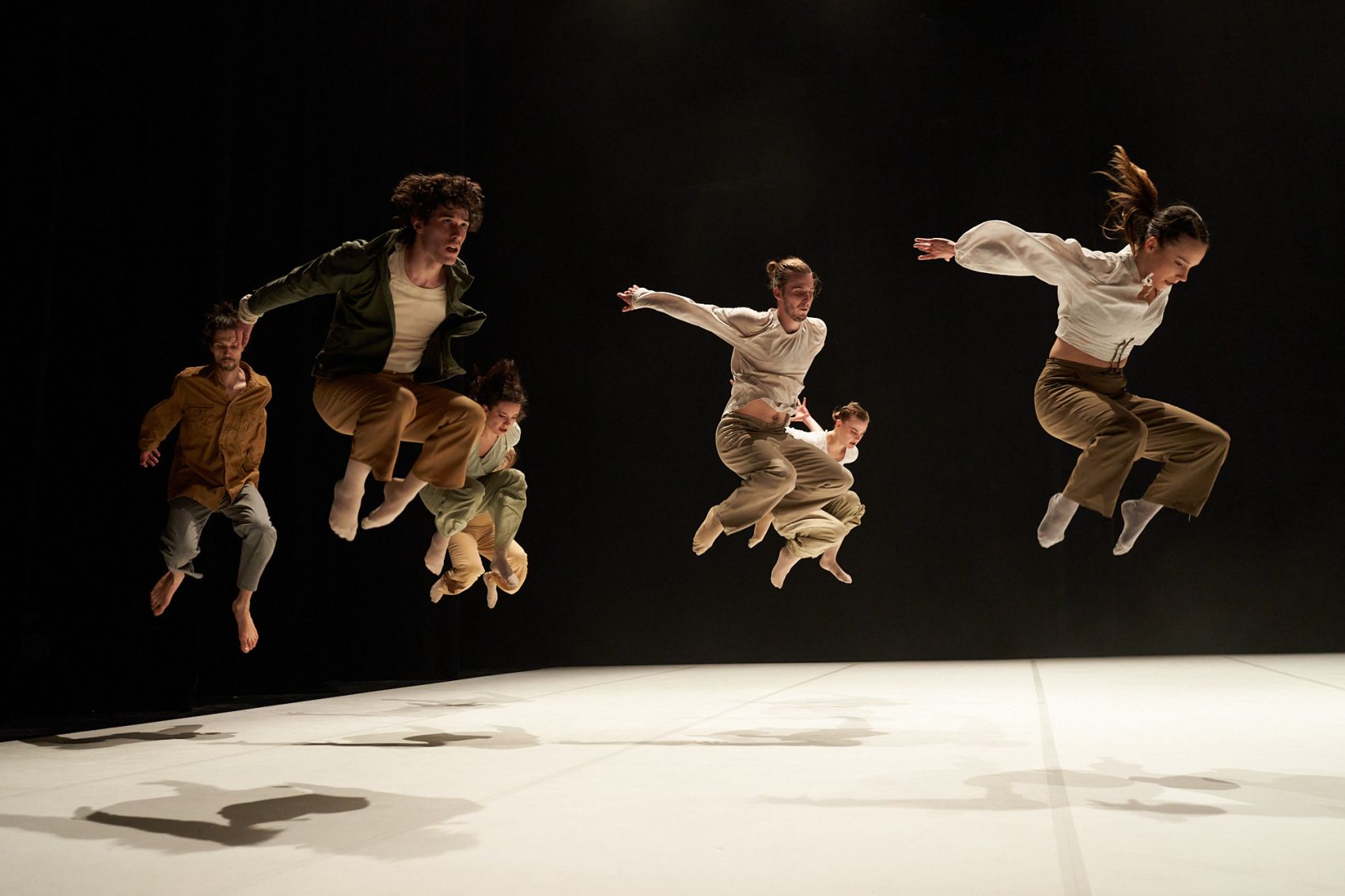 Four Seasons – CEDT (chor. Maciej Kuźmiński) – Zagreb, Croatia – 15 May 2025. Photo by Sindri Uču
“Four Seasons” – Maciej Kuźmiński / Central Europe Dance Theatre
I did not attend the Zagreb performance, but my review of the Krakow premiere is here: https://bridgingperiphery.eu/seasons-blend-together-in-krakow-while-political-landscapes-fade-into-the-background/
“All’Arme” – Ginevra Panzetti & Enrico Ticconi
All’Arme (“to arms!”) evokes defence against imminent danger; Panzetti/Ticconi use that etymology to probe the line between protection and aggression.
The opening feels like the aftermath of a crime: performers enter with flashlights, scanning walls and floor. Gradually the atmosphere shifts to authoritarian order. Extended goose-stepping may border on exaggeration, yet the critique of violence and power is unmistakable. Moments of collapse punctuate the march—individuals fall, vulnerable, only to be lifted by the group. The sound of a football game, of masses of people cheering enhances the eerie feeling of distraction and loss. Are we just marching on the spot as our humanity moves rapidly towards the edge? The lighting intensifies the mood; at one point a looming sunset suggests history forever on the verge of repeating.
“Rewriting” & “The Unison Piece” – Jonathan Burrows & Matteo Fargion
Long-time collaborators (35+ years), Burrows and Fargion start from dance and music yet let simple concepts unfold into complex forms.
“Rewriting” reworks an earlier, unperformed piece. With 108 inscribed cards, Burrows pulls, rearranges, and reiterates prompts while delivering a continuous spoken stream. Fargion, at a Casio keyboard, punctuates with perfectly timed chords and wry gestures. Understated wit and razor-sharp pacing make it both conceptually rich and hilariously light.
“The Unison Piece” explores what it means to do something together. Side by side at tables scattered with objects (guitars, whistle, scores), they play the guitars flat—surfaces to be activated rather than instruments to be held. A looping refrain expands throughout:
– We are doing this. Together in time. We are together with you.
Their organic synchronisation reveals decades of collaboration. Small slips become texture under an unfaltering presence. Funny without forcing it, engaged without pretension—they radiate a rare blend of humour, rigour, and devotion.
“Practicing Empathy #1” – Yasmeen Godder
Godder’s long-term research project (since 2019) Practicing Empathy asks how performance might create spaces of connection. In Zagreb, six dancers screamed, laughed, huddled, and lifted one another in choreographed sequences of support.
Much of the emotional charge, however, felt contrived – seemingly generating emotion as a route to empathy rather than embodying it. Aside from strong moments (notably the genuine and expressive presence of Tamar Kisch) the work risked self-absorption: the “empathy” portrayed seemed to turn inward, rarely extending beyond each individual.
This tension sharpened in context: For audiences who are not familiar with Godder’s work, it’s important to note that in the current context—where empathy for displaced Palestinians in Gaza has been largely absent – presenting an Israeli work titled Practicing Empathy may unintentionally undermine its own message. Art does not exist in a vacuum; while political responsibility may not rest solely with artists, curators cannot ignore the associations that arise. Perhaps such a work, especially now, requires stronger contextual framing. Godder links the project to Israel’s conflicted political climate; and her other, highly socially engaged initiatives such as Moving Communities – which brings Arab and Jewish women together in shared workshops – testifies to genuine efforts at bridging divides. Yet in Zagreb, that intent did not fully translate on stage: instead of opening outward, Practicing Empathy circled inward – what was meant to unite remained contained within the performers’ sphere. A shame, perhaps, since the ambition– and need – for such bridging feels more urgent than ever.
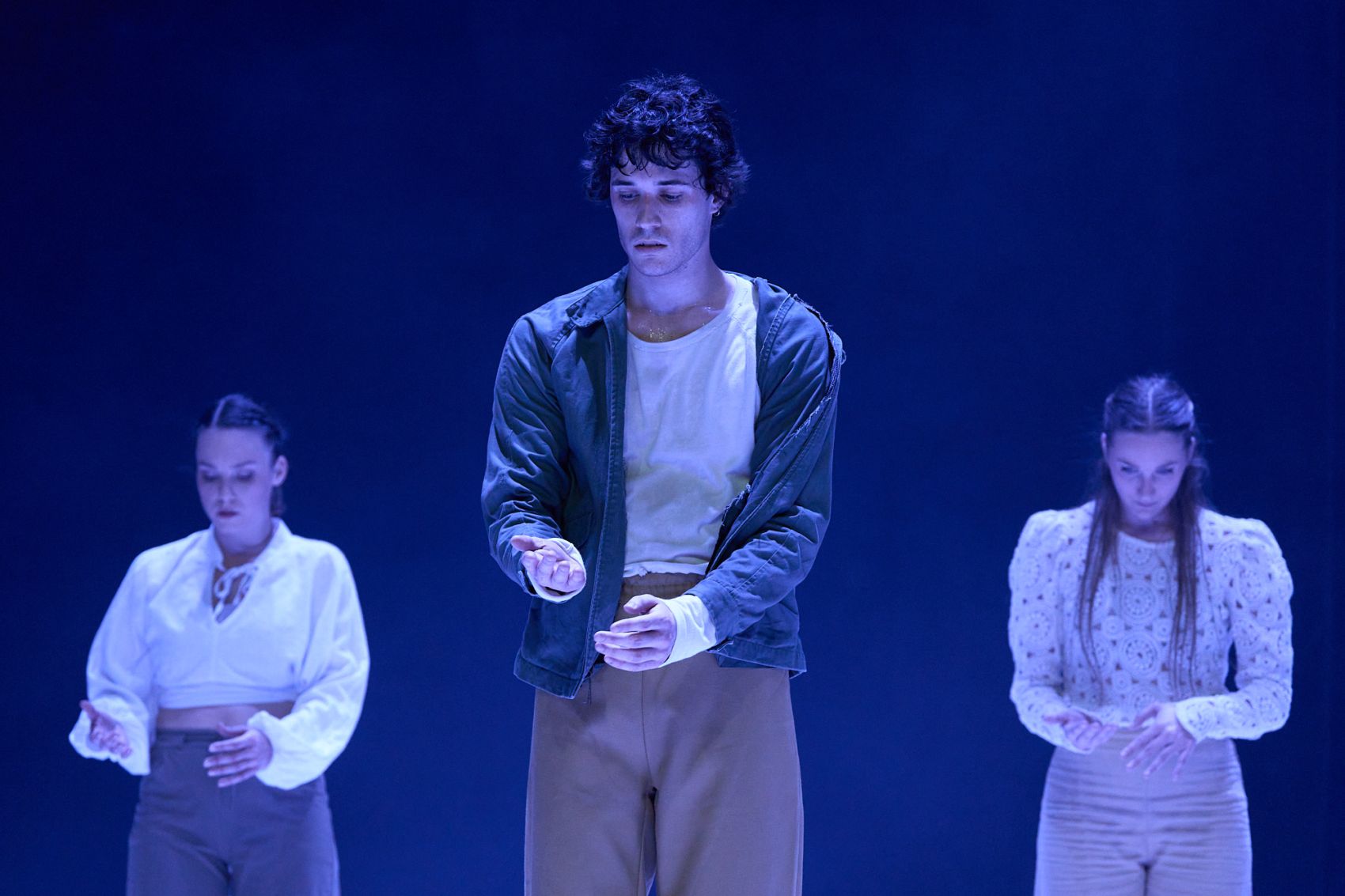 Four Seasons – CEDT (chor. Maciej Kuźmiński) – Zagreb, Croatia – 15 May 2025. Photo by Sindri Uču
Zagreb Dance Week Festival offered a multitude of choreographic approaches. A recurring theme was the striving for human connection in a time of wars, climate crisis, and the onslaught of AI. Ultimately, the more stripped-down works resonated the most – reminders of what still makes us human.
This text was written by Ingeborg Zackariassen within the framework of the Beyond Front@: Bridging Periphery project.

