
Author: Szymon Golec.
it’s hard to start sometimes
for me it’s even harder to end
but we’re nowhere near the end
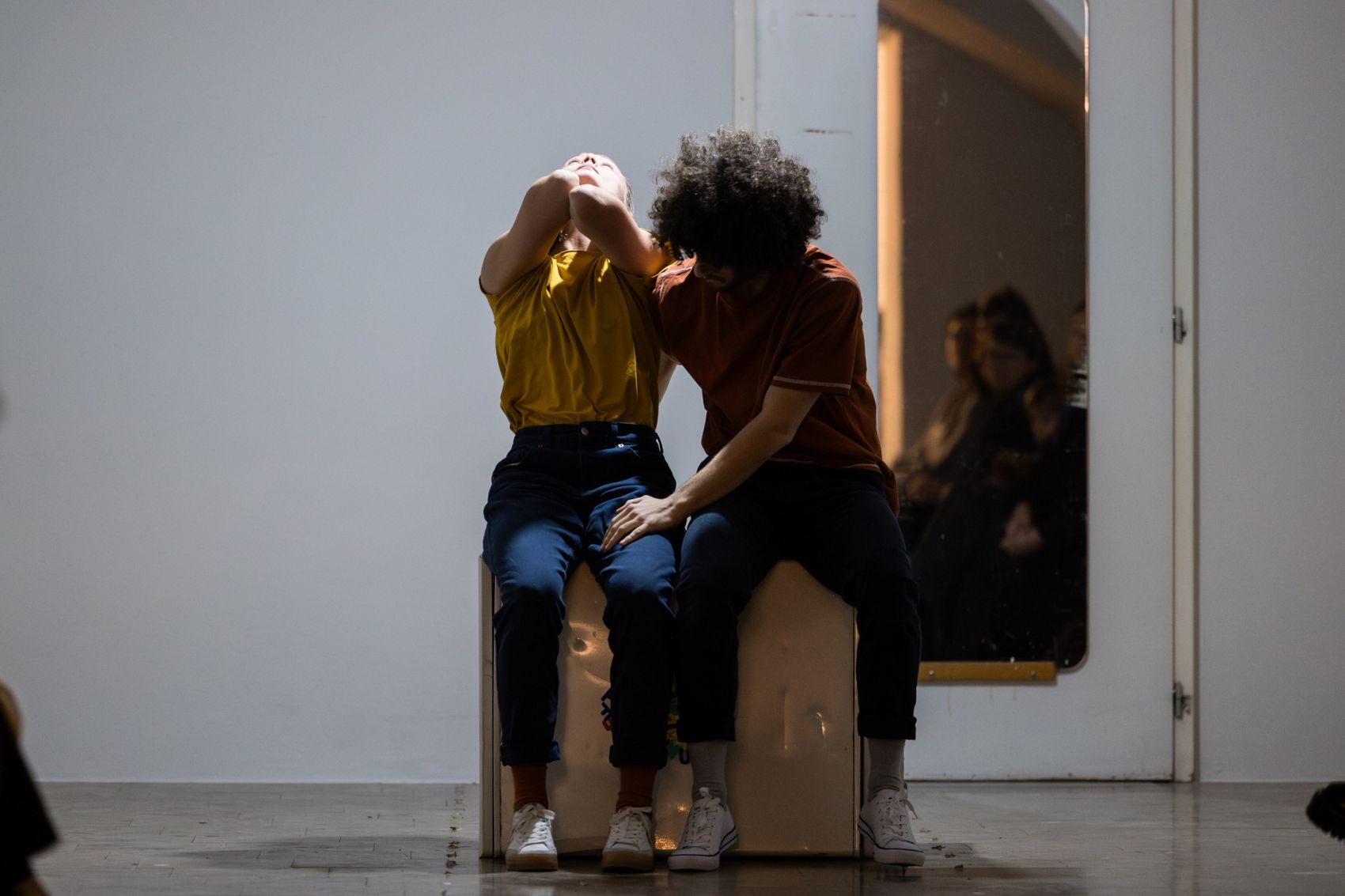
Lia Ujčič and András Engelman: Some Things Touch, at the 23rd Drugajanje Festival in Celje (November 2024). Photo by Lea Remic Valenti.
We must talk about things, mostly movement, but also music, which accompanies movement, and time and space, which are the bearers of those two mentioned things. I really want it to start with a sentence, with which I’ve started to speak at the workshop in Celje. It may be stupid, some will say infantile, but for me it’s joyful, it doesn’t mimic anything, besides what it is:
“The thing I saw was a struggle of two people and a fridge.”
First performance I saw at Druganje festival in Celje during Beyond Front@ project, was Some Things Touch by Lia Ujčič and András Engelmann. When I put it this way, it reminds me of some comedy skits, or even cartoonish, awful ones or, completely opposite, the great ones. Two actors are sitting on the fridge, entangled by one another, by arms, legs, fingers. Their bodies intertwine each other, it looks like a fight for territory, as they want to either merge together or fall. Soon enough one must fall, and he does. Bodies are still relatively close to each other, walking, moving towards us, towards the front of this space. For every progress they make, they also must step back to the fridge, as if it was some kind of sacred space, some start of it all, some safe space even? But this object is also being moved around. It is heavy, and we can feel this weight while watching one of the actors moving it on his back.
Choose your desired interpretation:
a) Freudian
b) Precarity/growing-up/late capitalism
c) New materialism/relationality (D. Haraway)
Sorry for playing with your expectations, I just wanted to have fun, and I have no interest in analyzing this. I feel that over-intellectualizing such fragile and pure things is bad. By “fragile and pure” I mean a play such as this one, that doesn’t impose anything, that it is free of universalities and achieving a particular meaning. Its reading will be different for every person in the audience. It is a play that doesn’t recall any national or religious myths and stories, of which the lack of something greater is its biggest strength. Helmut Kajzar, an author from Poland, wrote a text called Theater of Meta-everyday (PL: Teatr Meta-codzienny), in which he wrote: “Individual worlds are one-use and unique and unsimilar. But how to bring them together in theater? Theater is a place of contact for sovereign individualities. Contact builds on acceptation and similarity of one-time shape, moment and space.” This is what I mean when I say purity.
What remained with me from our workshop was one of questions that Ana – our mentor – asked us during a meeting session: “Describe what review should feel like, use five senses.” This question really stuck with me, and I think a lot about it. Back then I said that it should be meaty, juicy. But what I write is more like some kind of pudding, I feel. Time to change that.
The second thing we saw was a dance performance called Treatise by Milan Tomášik. And for sure it was meaty – mainly because the story and weirdness of inspiration for this play. Treatise is a musical piece composed by Cornelius Cardew. It consists of abstract shapes that are said to be a musical notation, and the only clue from the author is that the piece should be “musical”, and every group that interprets it should come up with their individual semiotic system of interpretation.
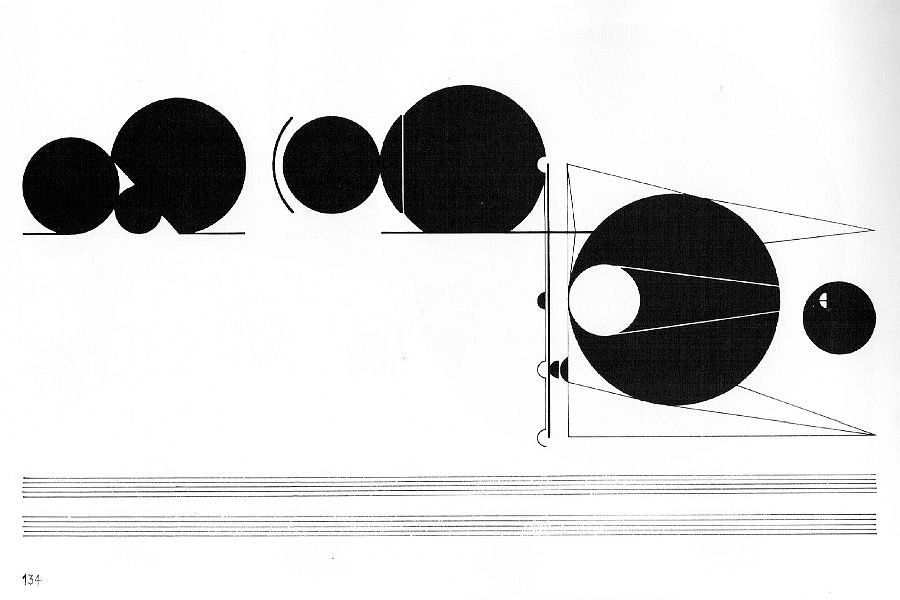
This picture is from one of the pages of the original Cardew’s Treatise. (Szymon Golec)
As for the choreography. I remember that I really felt the concept. It was something about movement of the dancers that reminded me of that original notation. The movement was synchronized between the dancers but a little bit off. They were moving diagonally, but everyone in a different manner, their own pace, adding individual spices. It seemed like some kind of controlled anarchy.
Music also resembled that movement principle. I think it was made with modular synthesizers, which are predictive only to a certain degree, just like a human, and rules of interpretation. They really complemented each other. I felt like it was constructed right before my eyes. It was somewhat hypnotizing, hearing this music, rumbling, trembling, as if a computer was dying in the middle of a rave set, only the remains of this headaching bass was left. Not BOOM BOOM BOOM BOOM, but pr pr pr pr (phonetically: [pr]). The dancers were moving, diagonally, elliptically, in circles, standing in rows, looking at each other. As usual, not all things were great. During the piece there are some moments, when dancers are using black tape to “mark” the space. Near the end, they are making some kind of symbols, resembling language notation, on the left side of the scene. And during the piece they are just sticking the tape in lines. At first, I thought that maybe they are making boundaries on scene, limiting the movement capabilities, because for me it would be a nice touch in the context of referencing to Cornelius Cardew that everyone would be coming up with their own interpretation. Unfortunately, it wasn’t this, and even now I don’t have a clue what it could mean. For sure it was some attempt to make a new language, maybe asking us about the sense of those symbols? Making us reflect on our own language and semiotic systems we live in? It is nice to consider and reflect on it, but in this piece, I think it is just excess. It made things packed to the brim, which made my brain hurt a little bit when it ended. It’s really a pity that some good pieces are victims of this over contextualization and over intellectualization that’s coming from these plays directly. I come across this problem a lot lately, and it really bothers me. Because I think its catching too many birds with one stone, the piece has its limits. We should remember that even if it seems that a play has a dominating interpretation, it will mean something different for every spectator. I know that it’s hard to focus on two or three things (which this text is a great example of, because I’m just drifting away every few sentences), but we really should talk about it and think about it. Because the thing that makes a piece (whether it be a book, painting or play) great isn’t a number of problems it touches. This problem goes far beyond the scene, to the audience and even further, to the whole discussion about modern art and its fake assumption that you have to be familiar with all sorts of theories and discourses (it’s in bold, because this word is really symptomatic to this problem). It makes the whole art scene boil in the same kettle, ensuring that all pieces can be easily read through Foucaultian, Derridaean, or Queer lenses.
It reminded me of another question that Ana asked during some later workshop session: “Should critics know all those theories?”. This question is really tearing me apart, one side of me says YES, WE SHOULD, then the other askes BUT THEY ARE GENERALIZING, PUTTING EVERYTHING IN ONE SACK, NOT LETTING ANYTHING NEW EMERGE.1
We are getting closer to the end. I want to thank you – Dear Reader, I hope it was a pleasant journey, which being part of put a smile on your face. For me ending means overthinking about what I just wrote, so many new thoughts, words, descriptors, all for nothing, because it will be too late, new things always pop up when You can read it, and it’s too late for me to change it. But worry not. We still have the last play to talk about, and I promise that I’ll try my best to be serious.
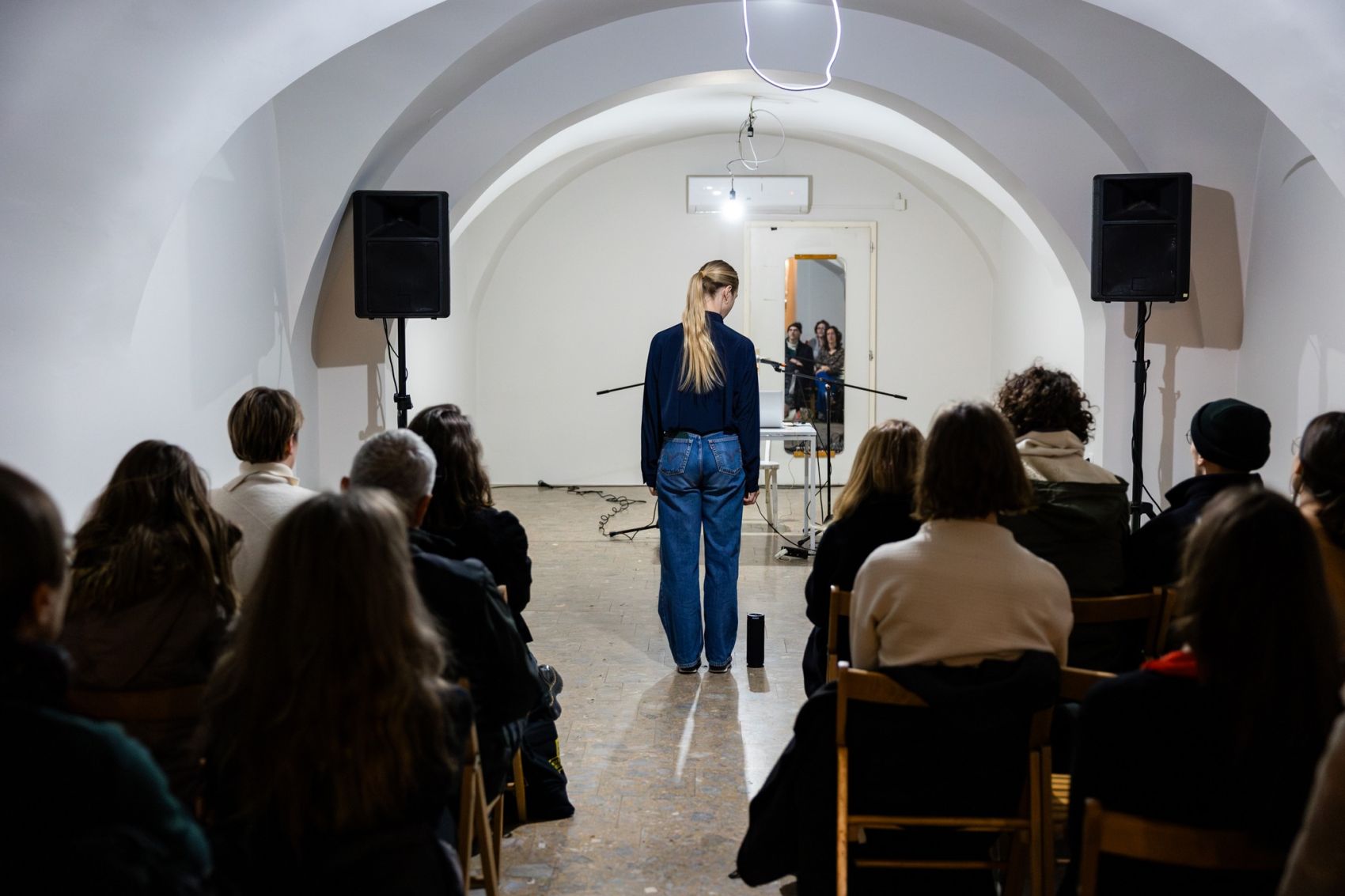
Matea Bilosnić: Kata Strofa, at the 23rd Drugajanje Festival in Celje (November 2024). Photo by Lea Remic Valenti.
The title of the last performance by Matea Bilosnić is called Kata Strofa, and it is funny because it means catastrophe. And there goes my seriousness. Good, I prefer when it is not around. I have this weird assumption that there is always some kind of eroticism in theatre between the gaze of spectators and the bodies of performers, that we are all voyeurs. And this eroticism also plays a role when it comes to our expectations, anticipations and managing our excitement. I will skip the part of describing the play, and will just show you what I have written in my silly little theatre notebook:
[T A S K: put everything that’s below to google translate and click the speaker for sound, click impulsively, rapidly, slowly, intuitively.]
– gaze
– gestures, grasping
– repetition
– steping/over presenting/re
– easy rhymes | Kraftwerk???
– radiohead ok computer
– present communication – crisis of narrative
– how the sound changes when speaker is moved – part of body
– play with expectations
Now, if you stayed obedient to my request, I’m speaking to you through vessel of google voice. This is good, because it resembles the piece I am speaking about. Close your eyes, imagine this soulless voice, modulated, filtrated through a lot of technology, digitalized through and through only to end up analogue for your ear. Imagine playing with this sound, modulating it, distortion, reverb, delay, tremolo, mono/stereo, all sorts of things, this cacophony of waves is puncturing your brain, ricocheting in your skull. Constant: HELLOHELLOHELLOHElLoHIHOWAREYOUHELLOHIHOWAReYOU. HOW TO END, HOW TO START, WHAT TO DO, WHAT TO BE, WHO AM I, WHO IS YOU, HELLO, HI, HOW ARE YOU, FINE, GOOD, HI, GOOD, HELLO, FINE.
Fin.
———————
1 Bold and Italic fonts are representative of this conflict of mine, I really do feel like there is Italic and Bold Times New Roman 12pp in me.
This text was written by Szymon Golec within the framework of the Beyond Front@: Bridging Periphery project.

